
Karteikarten
KS3 Science Biology Revision Cards
Karten in diesem Stapel (28)
- 1How is a leaf adapted to carry out photosynthesis?Thin - short distance for carbon dioxide to move by diffusion into leaf
Contains chlorophyll - absorbs light
Stomata - allows carbon dioxide to move by diffusion into leaf
Guard cells - open & close stomata depending on conditions
Network of tubes - transport water (xylem) & food (phloem) - 2What is the equation for respiration and photosynthesis?Respiration:
glucose + oxygen → carbon dioxide + water
Photosynthesis:
carbon dioxide + water → glucose + oxygen - 3What do animal cells and plant cells both contain and what do they do?Cell membrane - controls movement of substances into & out of cell
Cytoplasm - jelly-like substance, where chemical reactions happen
Nucleus - carries genetic information & controls what happens inside cell
Mitochondria - where most respiration reactions happen - 4Give 5 examples of organ systems.Circulatory system
Respiratory system
Digestive system
Nervous system
Reproductive system
(for example) - 5What does MRS GREN stand for and what does it help remember?Movement, Respiration, Sensitivity, Growth, Reproduction, Excretion and Nutrition.
It helps to remember the 7 life processes. - 6When we swallow, what organs does our food pass through?Oesophagus, stomach, small intestine and large intestine
- 7What happens at each stage of digestion?Food is digested in mouth, stomach & small intestine.
Digested food is absorbed into bloodstream in small intestine.
Excess water is absorbed back into body in large intestine.
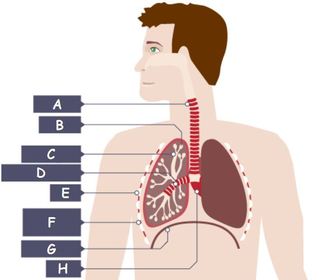
Any undigested food passes out of the anus as faeces when we go to toilet. - 8What does each letter stand for?A - Trachea
B - Alveoli
C - Bronchiole
D - Right Bronchus
E - Ribs
F - Intercostal Muscles
G - Diaphragm
H - Heart - 9What can individuals of the same species do that individuals of different species usually can't?Individuals of the same species can reproduce to make more individuals of the same species. Two individuals belonging to different species cannot normally reproduce together. If they do, their offspring is usually infertile and unable to reproduce.
- 10What is variation?The presence of differences between living things of the same species is called variation. Variation between different species is always greater than the variation within a species.
- 11What is continuous variation? (hint below)Continuous variation is a characteristic that changes gradually over a range of values.
Examples of such characteristics are:
height
weight
foot length
If you put the data into graph form, you normally get a bell shape (as shown on the other side).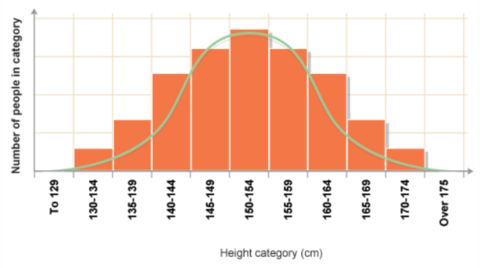
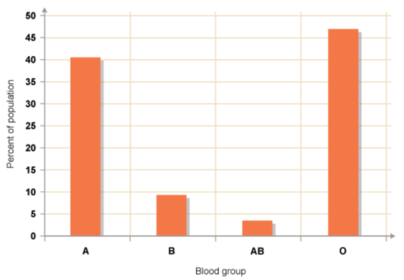
- 12What is discontinuous variation? (hint below)Discontinuous variation is when there are only a few different possibilities that a characteristic could be (categories), where there are no other possibilities and there are no values in between. The characteristic can't change (e.g. blood group).
- 13What are the two types of variation?Inherited and environmental
- 14What is inherited variation?Inherited variation is variation in a characteristic that is a result of genetic inheritance from the parents. e.g. eye colour and ear shape.
Each egg cell and each sperm cell contains half of the genetic information needed for an individual. When these join at fertilisation a new cell is formed with all the needed genetic information. - 15What is environmental variation?Environmental variation is the difference in a characteristic due to the surrounding environment. e.g. weight, height, language and religion.
- 16What is natural selection?Within each species, individuals with the variations best suited to the environment will survive better than the others.
More of them will survive to reproduce than the others. When they do, they pass on the genetic information for these variations to their offspring.
Species gradually evolve in this way and this is natural selection. - 17What is artificial selection?Artificial selection is when people use selective breeding to produce new varieties of a species. e.g. a farmer might breed only cows that produce a lot of milk.
- 18What are the five kingdoms?Protoctists, prokaryotes, fungi, plants and animals
- 19What are the 7 food groups and what are they needed for?Carbohydrates - to fuel the body
Proteins - vital for growth and repair
Fats - store of energy used if the body runs out of carbohydrates
Vitamins - keep many vital processes happening
Minerals: iron for blood, calcium for teeth and bones, sodium for nerves and iodine for thyroid in the neck
Fibre - keeps digestive system fit and healthy
Water - all chemical reactions take place in water - 75% of body is water - 20Describe the menstrual cycle.On day 1, bleeding starts. This is due to the lining of the uterus breaking down.
By the end of about day 5, the loss of blood stops. The lining of the uterus begins to re-grow and an egg cell starts to mature in one of the ovaries.
At about day 14, the mature egg cell is released from the ovary. This is called ovulation. The egg cell travels through the oviduct towards the uterus.
On day 29 (day 1 again), the lining of the uterus begins to break down and the cycle repeats. - 21Name 5 specialised cells and state what they are designed for.1. Sperm cell - designed to fertilise eggs
2. Egg cell - designed to be fertilised
3. Palisade cell - designed for photosynthesis
4. Cilia cell - designed to stop lung damage
5. Root hair cell - designed for absorbing - 22How is a polar bear adapted to arctic conditions?1. A round shape to give minimum possible surface area to reduce heat loss from the skin
2. A thick layer of fat for insulation and a food store
3. A thick hairy coat to keep body heat in
4. Greasy fur to shed water after swimming
5. A white coat to blend into the surroundings
6. Big feet to spread the weight on the snow or ice - 23How is camel adapted to desert conditions?1. It can store a lot of water - it can drink up to 20 gallons at once.
2. It loses very little water in wee or sweat
3. It can cope with big changes in temperature and doesn't sweat below 46 degrees celsius
4. Big feet to spread the weight on the soft sand.
5. All fat is stored in the hump, this helps with heat loss
6. Its sandy colour gives good camoflague - 24What do food chains show?Food chains show the feeding relationships between living things.
- 25What is a carnivore?An animal which only eats animals and never plants.
- 26What is an omnivore?An animal which eats both plants and animals.
- 27What is a herbivore?An anima which only eats plants.
- 28What are food webs?Food webs are systems of interlocking and interdependent food chains.
Informationen
- Beschreibung
- Revision cards for science (biology) at KS3 level.
- Erstellt von
- Lilac Potato
- Aufrufe
- 330
- Tags
- Bewertung