
Karteikarten
THEORIES OF CRIME AND DEVIANCE

Karten in diesem Stapel (49)
- 1Crime and Deviance: Definitions and explanations// CrimeAny act which breaks the laws of society, such as murder or rape.
Social control is enforced by agencies such as police and the courts. - 2Crime and Deviance: Definitions and explanations// DevianceBehaviour which moves away from conventional norms and values such as burping and farting in public.
- 3Crime and Deviance: Definitions and explanations// Deviant not criminalBurping, not queuing
- 4Crime and Deviance: Definitions and explanations// Criminal not deviantSpeeding, parking on yellow lines
- 5Crime and Deviance: Definitions and explanations// Deviant and criminalRape, murder, paedophilia
- 6Crime and Deviance: Definitions and explanations// Crime and deviance as relativeCrime and deviance is relative (changing) in relation to time, place and culture. What one society may see as a crime another may not, such as polygamy (many wives). Other examples are homosexuality and suicide.
- 7Crime and Deviance: Definitions and explanations// Crime as socially constructedIf what is consider to be crime and deviance changes it can’t be inherently wrong but must be culturally specific.
This means crime and deviance is socially constructed i.e. created and defined by the people of that society and not universal. - 8Crime and Deviance: Definitions and explanations// Biological explanationsEarly criminologists like Cesare Lombroso sort to find physical criminal characteristics like long arms or sloping foreheads.
Sociologists find such ‘born bad’ determinism dangerous and prefer to normalise crime by reminding us that we all commit crime and there are social factors which influence our behaviour. - 9Crime and Deviance: Functionalism on crime// Durkheim – Key ideas1. Crime is inevitable and necessary to society.
2. Crime has positive functions.
3. The perfect amount of crime will keep society healthy and avoid anomie (Normlessness) - 10Crime and Deviance: Functionalism on crime// Crime and societySociety is only healthy when social order is maintained through the police and courts. We need a small amount of crime to remind us of what we believe in. Only a small minority will be self-interested and commit crime.
- 11Crime and Deviance: Functionalism on crime// Positive functions of crime1. Re-marking social boundaries – affirms social norms and values.
2. Media coverage – as a warning to others.
3. Social bonds – strengthened as we unite in disapproval.
4. Safety Value – a little bit of deviance reduces more serious problems – Prostitution – Kingley Davis.
5. Malfunctioning society – theft, drug use and truancy alert us to other social problems in society - 12Crime and Deviance: Functionalism on crime// Society of saintsImagine there was no crime or deviance, even the most slight slip like coughing without putting your hand over your mouth would become a crime.
- 13Crime and Deviance: Functionalism on crime// CriticismsWhat is the perfect amount of crime?
Explaining the functions of crime doesn’t explain what caused them in the first place.
Murder maybe functional for society but what about the victim? - 14Crime and Deviance: Merton's strain theory// Key Idea
- 15Crime and Deviance: Types of behaviour
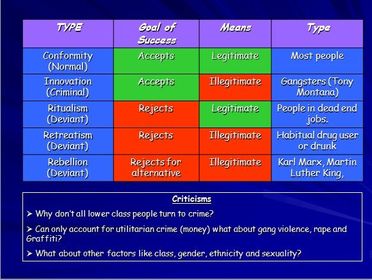
- 16Crime and Deviance: Subcultural strain theories// Subcultural groupA group with its own distinctive norms and values, sometimes although not always deviant.
- 17Crime and Deviance: Subcultural strain theories// Albert Cohen – Status frustrationA Subcultural strain theory which argues lower class people are frustrated because they want to be successful but lack the qualifications and skills to do so. They solve this frustration by rejecting society and creating their own norms and values in a gang. Here they achieve status through non-utilitarian crimes like violence and graffiti.
- 18Crime and Deviance: Subcultural strain theories// Cloward and Ohlin – Opportunity structuresA Subcultural strain theory like Cohen but more concerned about the different types of crimes groups commit.
They conclude where you live dictates the type of criminal activity available to you.
Criminal subcultures are available in areas of criminal hierarchy.
Conflict subcultures arise due to low social cohesion and high population turnover.
Retreatists subcultures are the result of being unsuccessful in society and the other two subcultures. - 19Crime and Deviance: Subcultural strain theories// Walter Miller – Lower class subculturesNot a strain subculture, each social class doesn’t feel any strain but just has different focal concerns which lead to different criminal activity. The lower class experience a lack of excitement at work which leads to the desire to look for excitement in things like joy-riding.
- 20Crime and Deviance: Subcultural strain theories// Contemporary examplesThe Street gangs living in the Favelas of Rio and the gangs of South Africa show that often criminal groups are not rejecting societies norms and values but are in fact conforming to their own.
- 21OVERVIEW
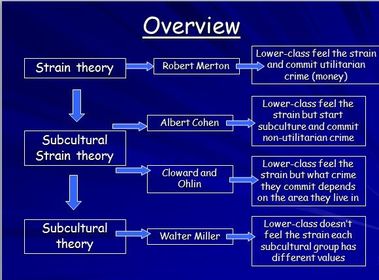
- 22Crime and Deviance: Interactionism – Labelling theory// InteractionismDoesn’t focus on the structures of society but how people and society interact and how this affects criminal behaviour.
- 23Crime and Deviance: Interactionism – Labelling theory// Howard BeckerFocuses on the process of a person and act getting labelled as deviant. He argues that no act is intrinsically deviant but relies on its context to determine its acceptability. Examples: nudity, injecting oneself even murder.
- 24Crime and Deviance: Interactionism – Labelling theory// Labelling processA label is attached by police and courts.
Label becomes a master status –overrides other status as sibling, friend etc.
The labelled person accepts the label – because how we see ourselves relies on how others see us.
Self-fulfilling prophecy – whether the label was true or not we act in accordance with it. This confirms peoples beliefs about the label being true. - 25Crime and Deviance: Interactionism – Labelling theory// Stanley CohenCohen studied how the media has often demonised youth culture. This happened to mods and Rockers in 1964 who were seen as modern day folk devils who threatened social order. His research found that actual acts of deviance were minimal
- 26Crime and Deviance: Interactionism – Labelling theory// Deviancy amplification spiralThis idea says that sensationalist reporting by the newspapers distorts the act of crime or deviance and increases public awareness. Public pressure is put on the police and courts to act. This creates a moral panic where certain acts or groups are seen as a threat to social order.
- 27Crime and Deviance: White collar crime// Blue collar crimeCrimes committed by manual factory workers (working class), these are street crimes like theft which are in public view.
- 28Crime and Deviance: White collar crime// White collar crimeCrimes committed by office workers (middle/upper class) like fraud, these are often hidden from public view.
- 29Crime and Deviance: White collar crime// White collar crimeVery difficult to prosecute due to problems of who is responsible and who is a victim. Much white collar crime is not dealt with criminally but administratively by external agencies like the EPA (Environmental Protection Agency) and the Trading Standards Agency. Only serious cases go to court.
- 30Crime and Deviance: White collar crime// Case study – Guinness affairFalse claims of success led to high share prices and company directors making millions. Gerald Ronson received a one - year sentence in Ford (open prison) and was released on parole after serving about 6 months. He is still a successful businessman and one of Britain's 100 richest people
- 31Crime and Deviance: White collar crime// Case study – EnronFalse accounting and reports of high profit allowed president Kenneth Lay to borrow $74 million from a company before it was made bankrupt. 20,000 creditors were owed an estimated $67 billion, most received less than 20 cents for every dollar they were owed. 19,000 people lost their jobs and savings.
- 32Crime and Deviance: Marxism on crime// Key ideaThe Law and the criminal justice system is another tool used by the ruling class to serve their interests and maintain a position of power.
- 33Crime and Deviance: Marxism on crime// Criminolgenic CapitalismCrime is inevitable in Capitalism. The working class commit utilitarian and non-utilitarian crimes because of poverty, constant advertising, alienation and a lack of control. Even the ruling class feel the pressure to commit crime and get ahead.
- 34Crime and Deviance: Marxism on crime// The state and law makingAll laws serve the ruling class.
Most law is based on protecting private property.
The working class and ethnic minorities are punished harshly while the crimes of the powerful go unnoticed. - 35Crime and Deviance: Marxism on crime// Ideological functions of lawLaws don’t just punish but perform functions to keep capitalism stable. Health and safety laws keep the working class able to work. Seeing crime as a working class problem diverts it away from capitalism. Seeing criminals as disturbed also disguises the true nature of crime.
- 36Crime and Deviance: Marxism on crime// Strengths1. Shows a link between
law and the
interests of the
ruling class.
2. Highlights selective
enforcement. - 37Crime and Deviance: Marxism on crime// Weaknesses1. Very deterministic, not all working class commit crime.
2. Switzerland and Japan are capitalist but have low crime rates.
3. Prosecutions against companies and the ruling class do happen.
4. Left Realists say most working class crime is committed against working class people not the state. - 38Crime and Deviance: Neo-Marxism on crime
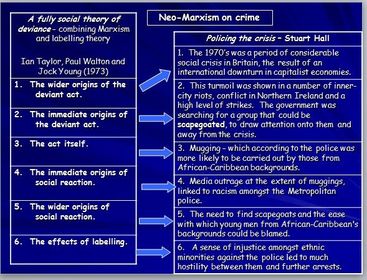
- 39Crime and Deviance: Right Realism// Key ideasThe root cause of crime is biology and poor socialisation as people make a rational choice to commit crime.
The solution is more formal social control such as harsher prison sentences, zero tolerance policies and more CCTV. - 40Crime and Deviance: Right Realism// BiologyWilson and Hernstein suggest some people are innately more strongly predisposed to commit crime than others. Especially those who have personality traits like aggression, risk taking and low impulse control.
- 41Crime and Deviance: Right Realism// Charles Murray (1990)Argues most crime is committed by the underclass (unemployed). A recent upsurge in lone-parent families has led to poor socialisation and encouraged these people to be welfare dependant.
- 42Crime and Deviance: Right Realism// Rational Choice theoryRon Clarke (1980) suggests that people rationalise their choice to commit crime by weighing up the cost vs benefits. If the benefits (money) outweigh the costs (prison) then they will commit crime.
- 43Crime and Deviance: Right Realism// Tackling crimeMake crime less attractive to criminals by (formal control):-
Zero tolerance – harsh sentences ‘broken window’.
Target hardening – make it difficult to access private and public buildings.
More surveillance – CCTV. - 44Crime and Deviance: Right Realism// CriticismsDoesn’t explain white collar crime or domestic violence.
Ignores issues like poverty.
Scapegoats the underclass.
Overstates the role of rationality.
Crime displaced to other areas. - 45Crime and Deviance: Left Realism// Key ideasThe root cause of crime is Relative deprivation, marginalisation and exclusion in modern society.
The solution is more informal social control such as better housing, more job opportunities and more democratic policing. - 46Crime and Deviance: Left Realism// The offendersYoung and Lea argue that most crime is committed by W/C against the W/C.
This is due to discontent caused by relative deprivation (judging your status by that of others) and individualism (being self-interested). - 47Crime and Deviance: Left Realism// MarginalisationMarginalised groups are those who lack clear goals or representation. Young W/C are powerless and unrepresented which leads to violence and rioting.
- 48Crime and Deviance: Left Realism// Modern society and exclusionA lack of jobs for the W/C and being out priced of the property market has left many socially excluded. Jock young says we live in a ‘bulimic society’ where we are exposed to a large variety of consumer products which the W/C cannot purchase.
- 49Crime and Deviance: Left Realism// Tackling crimeMake things better for people by (informal social control):
Giving them housing conditions to be proud of.
Better job opportunities.
A better relationship between police and public, being more democratic will help the flow of information.
Informationen
- Beschreibung
- A Level SOCIOLOGY// CRIME AND DEVIANCE WITH RESEARCH METHODS Karteikarten am THEORIES OF CRIME AND DEVIANCE, erstellt von elliesteel2 am 26/05/2015.
- Erstellt von
- elliesteel2
- Aufrufe
- 151
- Bewertung