
Karteikarten
IB Economics SL Section 1 Microeconomics
Karten in diesem Stapel (94)
- 1DemandThe total amount of goods and services that consumers are willing and able to purchase at a given price in a given time period.
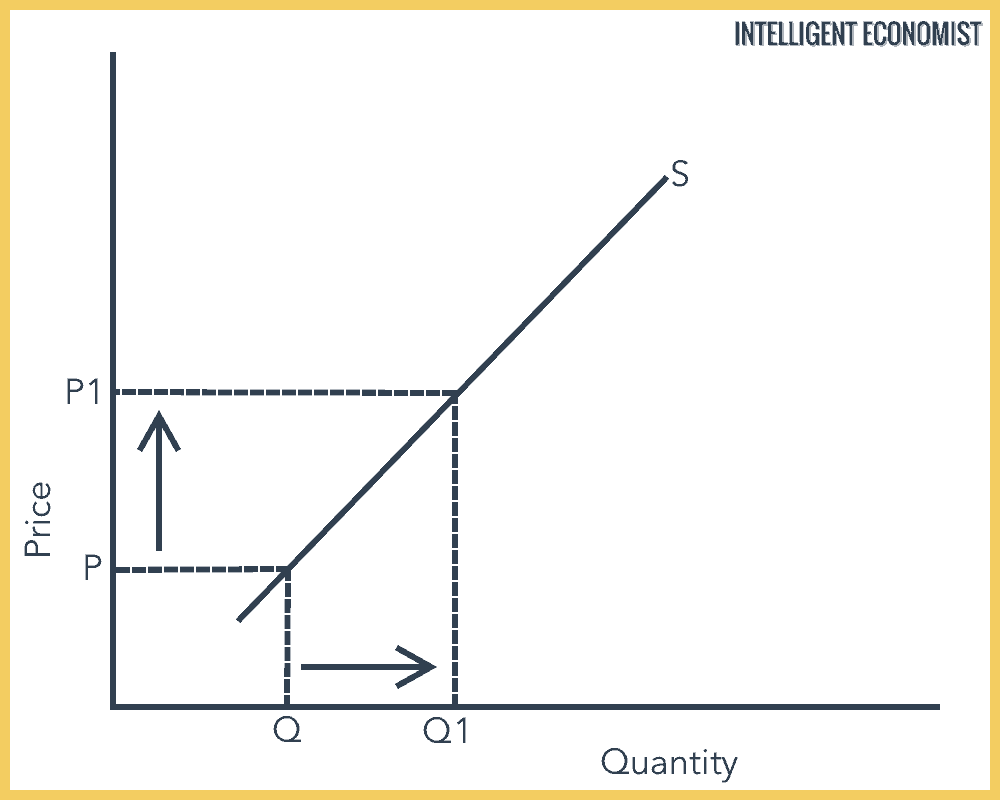
- 2SupplyThe quantity which sellers are willing to sell for a particular good of service at a given price at a given point of time.
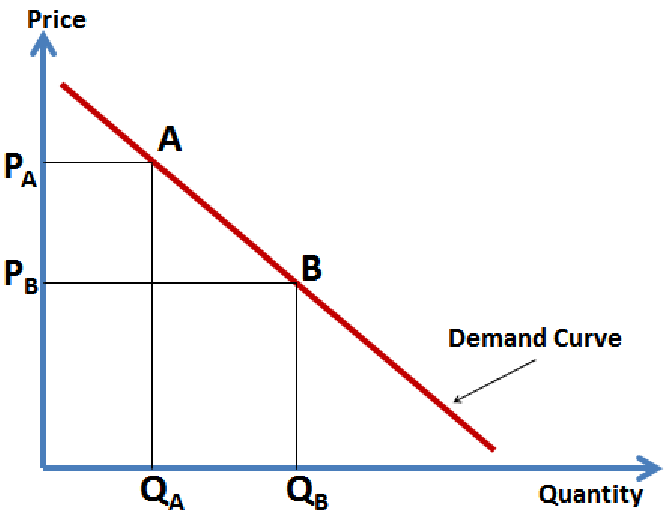
- 3Law of DemandAs price increases demand decreases.
As demand increases price decreases.
Ceteris Paribus - 4Law of SupplyAs price increases supply increases.
As price decreases supply decreases.
Ceteris Paribus - 5Market DemandSum of all individual demands in a market.
- 6Market SupplySum of all individual supplies in a market.
- 7Substitute GoodA substitute for a good/service.
Favoured when the original good's price increases. - 8Factors Affecting DemandPrice.
Advertising.
Price of complements.
Price of substitutes.
Interest rates.
Taxes [Direct]. - 9Demand Curve
- 10Competitive SupplyOccurs if two goods compete for the same resources or factors of production. This means that the firm cannot increase supply of one without reducing supply of the other.
- 11Joint SupplyOccurs if two goods are derived from the same product. In this case, it is impossible to produce more of one good without producing more of the other.
- 12Factors Affecting SupplyPrice.
Price of other products.
Costs of production.
Subsidy.
Tax.
Supply shocks. - 13Supply Curve
- 14Equilibrium PriceThe price at which the quantity demanded is equal to the price.
- 15Price MechanismThe interaction of buyers and sellers in free markets enables goods, services and resources to be allocated prices.
- 16Effects of Scare ResourcesDemand exceeds supply creating a shortage, thus raising the price. The high price attempts to discourage demand and conserve resources. The greater the scarcity the higher the price.
- 17What is an incentive?An incentive is something that motivates a producer or consumer to follow a course of action or to change behavior.
- 18Effects of IncentivesHigher prices provide the producer with an incentive to supply more due to the possibility of higher revenue and greater profits.
- 19Rising PricesRising prices give a signal to consumers to reduce demand or withdraw from the market completely. They give a signal to producers that a shortage exists and tell potential producers to enter the market and existing producers to increase supply.
- 20Falling PricesFalling Prices give a positive message to consumers to enter the market and increase demand. Meanwhile, they tell producers that a surplus has been created and tell them to reduce supply or to leave the market completely.
- 21Price Elasticity of DemandPED is a measure of responsiveness of the quantity demand to the change in price.
- 22Factors Affecting PEDNumber of close substitutes.
Proportion of income.
Necessity.
Habits, fashions, and addictions.
Advertising and brand loyalty.
Costs of switching.
Time period. - 23Elastic Ped and SupplierIf PED is elastic, the producer would aim to decrease price to increase total revenue,
- 24What happens if supply is inelastic (PED)?If supply is inelastic, the firm may not be able to respond to the large increase in demand.
- 25What happens if the price drops below average cost (PED)?If decreasing the price reduces it below the average cost, the firm will incur a loss.
The producer may not be able to reduce price if a minimum price is set by the government. - 26Inelastic PED and SupplierIf PED is inelastic, the producer would aim to increase price to increase total revenue, however:
if a maximum price is set by the government, the producer cannot increase the price. - 27Income Elasticity of Demand (YED)Measure of the responsiveness of quantity demanded to a change in income.
- 28YED < 0If YED < 0, the good is classified as an inferior good, as the quantity demanded decreases as income increases.
- 29YED > 0The good is classified as a normal good, as the quantity demanded increases as income increases.
- 300 < YED < 1The good is a necessity.
- 31YED > 1The good is a luxury good.
- 32What is cross-price elasticity of demand (XED)?A measure of responsiveness of the quantity demanded of one good in the change of price in another good.
- 33XED > 0The good are substitutes of each other.
- 34XED < 0The goods are complements of each other.
- 35XED = 0The goods are non-related.
- 36Price Elasticity of Supply (PES)A measure of responsiveness of the quantity supplied to a change in price.
- 37Factors affecting PESSpare production capacity.
Ability to store and preserve stocks.
Time taken to produce the product.
Ease and cost of factor substitution.
Time period. - 38What is Opportunity Cost?Opportunity cost is the next best alternative given up when making a descision.
- 39What are the three main forms of government intervention?Indirect tax
Subsidy
Price controls:
Maximum price (price ceiling)
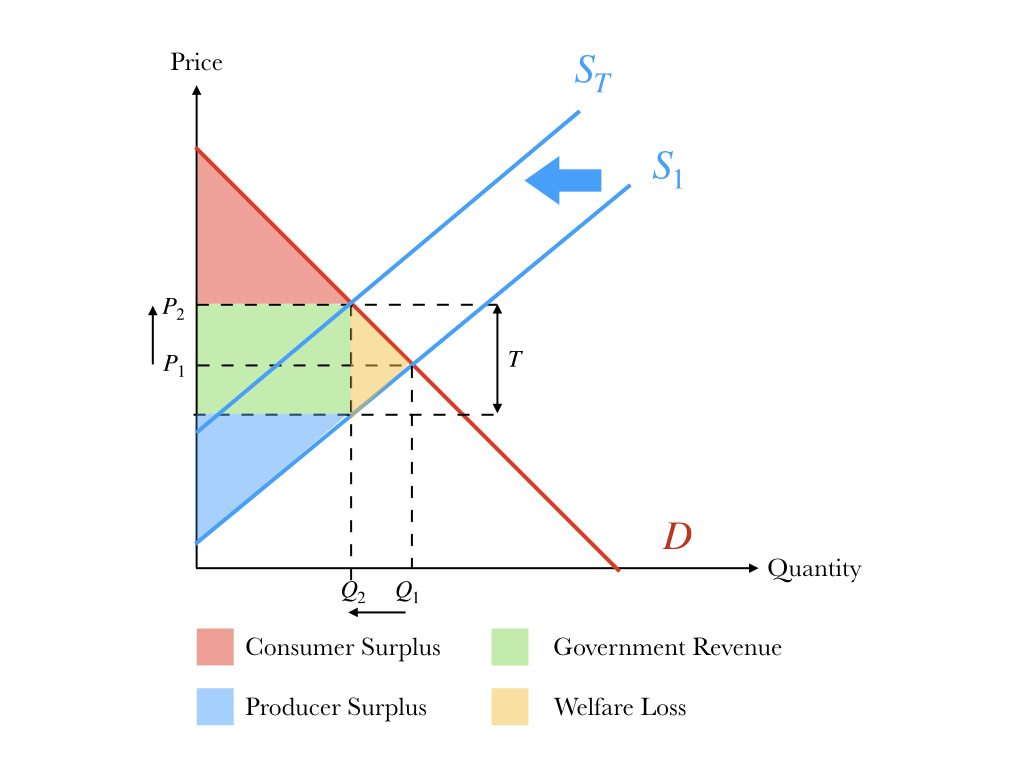
Minimum price (price floor) - 40Indirect TaxAn indirect tax is a tax imposed on the expenditure of goods and services.
- 41Specific TaxTax amount per unit. Does not change with changes in the price of the product.
- 42Ad Valorem/Percentage. TaxTax per unit. Changes with changes in the price of a product.
- 43Why would a government impose an indirect tax?To reduce the consumption of a demerit good.
To earn revenue. - 44What does imposing an indirect tax do?Costs of production increase. Price increases, as supply curve shifts to the left.
- 45What is a subsidy?A subsidy is a form of financial aid/assistance provided by the government to the producer to reduce the costs of production.
- 46Why might a government impose a subsidy?Increase the consumption of a merit good.
Increase the consumption of exports.
Increase the growth of small industries. - 47Effect of the imposition of a subsidyCosts of production decrease.
Supply curve shifts to the right.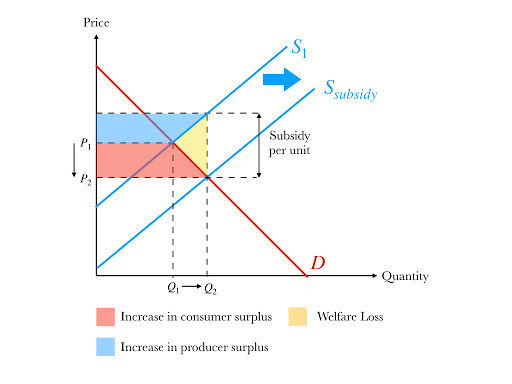
- 48Price CeilingA price ceiling is the maximum price that a good/service can be sold for in the market, determined by the government.
- 49Why a price ceiling?To make goods affordable for everyone. Example Rental housing.
- 50Consequences of Price Ceilings 1Shortage of Supply
Black market created, as there is an excess of demand there exist people who are willing to pay for the good at higher than the price ceiling.
Welfare loss created. - 51Consequences of Price Ceilings 2Governments starts to subsidise the producer.
Government becomes a producer itself.
Leads to non-price rationing - 52Cause of Non-price rationingPrice does not determine who are able to purchase a good/service, as there is a shortage. Therefore not evryone who is willing and able to purchase the good is able to leading to non-price rationting.
- 53Non-price rationing methodsFirst-come-first-served basis: Those who come first will get a chance to purchase the good/service.
Distribution of coupons: Consumers with coupons can purchase a fixed amount of the good in a given time period.
Favouritism: The producer may choose to provide the good to preffered customers. - 54Consequences on Stakeholders Price Ceiling ConsumersPartly gain partly lose
They gain as they are able to purchase the good at a price lower than the equilibrium
They lose as there is a shortage of supply and therefore not everyone who is willing and able to can pruchase the good/service. - 55Consequences on Stakeholders Price Ceiling ProducersLose.
They are forced to sell the good/service at a lower price than the equilibrium and at a lower quantity.
Thus their revenue falls. - 56Consequences on Stakeholders Price Ceiling GovernmentsThe government may start to subsidise and produce this good.
This may lead to an increase in direct taxes, therefore, affecting the standards of living negatively in the long term. - 57Price FloorA price floor is the lowest price that a good can be sold in a market, imposed by the government.
- 58Why a price floor?To increase the revenue of a certain good/service.
- 59Consequences of a Price FloorExcess supply, surplus.
Welfare loss is created because the decrease in consumer surplus is greater than the increase in producer surplus.
May lead to positive advertising of the good/service by the government.
The government can become a buyer to remove the surplus of a good/service. - 60Consequences on Stakeholders Price Floor ConsumersLose.
They have to pay a higher price for the good/service and get to purchase a smaller quantity of it. - 61Consequences on Stakeholders Price Floor ProducersGain.
They get to sell their good/service at a higher equilibrium price and can sell a higher quantity, increasing their revenue. - 62Consequences on Stakeholders Price Floor GovernmentsThe government may begin to purchase the excess supply of the good/service increasing government expenditure.
This may lead to an increase in direct taxes, therefore, affecting the standards of living negatively in the long term. - 63Market FailureWhen the market does not operate at equilibrium. Resources are not allocated efficiently, the market is said to have failed.
- 64Private CostA cost incurred by an individual, government or firm who is producing or consuming a good/service.
- 65External CostThe negative spillover effects/externalities on a third party as a result of an economic transaction.
- 66Social CostThe sum of private and external costs.
- 67Private BenefitThe benefit obtained by the individiual, firm or government as a result of consuming or supplying a good/service.
- 68External BenefitThe positive /spillover effects/externalities on a third party as a result of an economic transaction.
- 69Social BenefitThe sum of private and external benefits.
- 70Demerit GoodA good that has negative externalities of consumption and is over-produced.
- 71Merit GoodA good that has positive externalities of consumption and is under-produced.
- 72Public GoodA good that is non-rivalrous and non-excludable in consumption.
- 73Positive externality of productionThere is underproduction.
A positive externality exists because:
MPC > MSC.
MEC = MSC - MPC
MEC is negative.
So, a positive externality exists.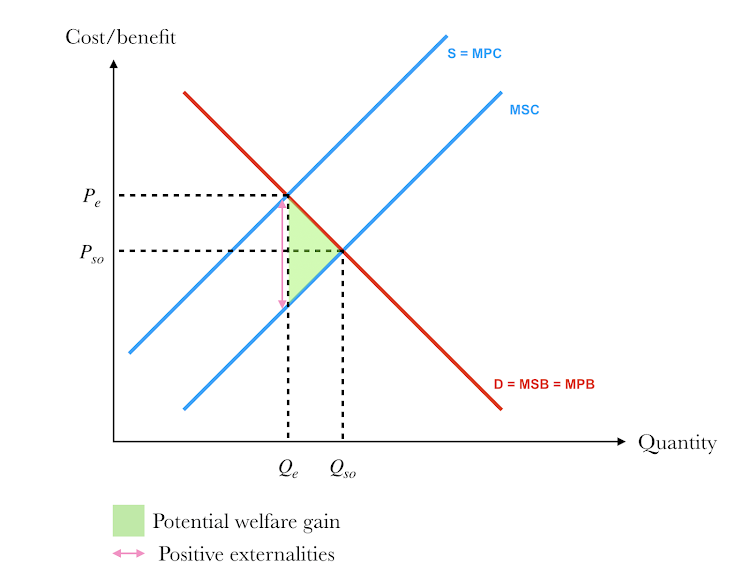
- 74Negative externality of productionThere is overproduction. A negative externality exists because: MSC > MPC.
MEC = MSC - MPC
MEC is positive, meaning an external cost exists.
So, a negative externality exists.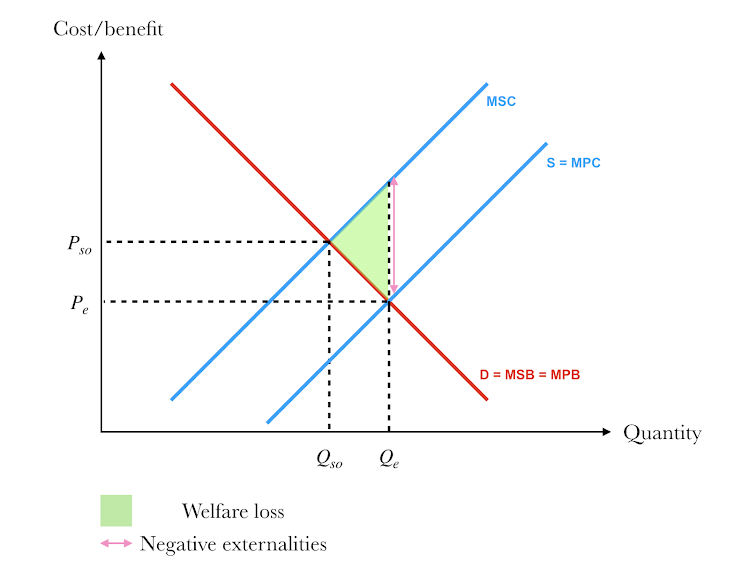
- 75Positive externality of consumptionThere is underconsumption.A positive externality exists MSB > MPB.
MEB = MSB - MPB
MEB is positive, so an external benefit exists.
So, a positive externality exists.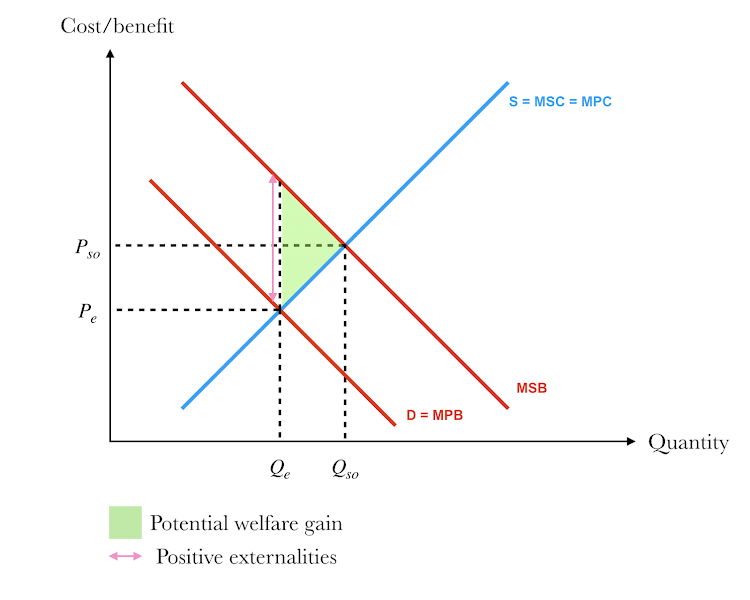
- 76Negative externality of consumptionThere is overconsumption.
A negative externality exists because:
MPB > MSB.
MEB = MSB - MPB
MEB is negative.
So, a negative externality exists.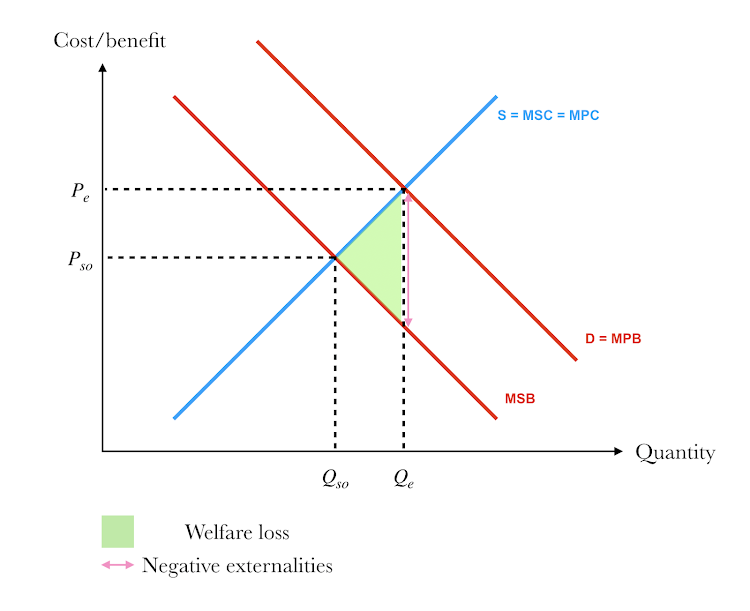
- 77Corrective TaxesAn indirect tax can be imposed on a demerit good. It drives up the price of the good and reduces its consumption.
- 78Advantages of Corrective TaxesCreates a source of revenue for the government.
- 79Disadvantages of Corrective Taxes 1Demand for most demerit goods is inelastic so the percentage decrease in demand is less than that of the percentage increase in price.
Higher costs for the producer.
Unemployment might be created. - 80Disadvantages of Corrective Taxes 2Higher price for the consumer, and since the demand is inelastic, the consumer expenditure on the demerit good increases, and expenditure on other merit goods decreases, which leads to a lower standard of living.
Loss of competitiveness in the global market - 81Tradeable Carbon Permits 1A government or a multi-national body issues or auctions off permits to polluting industries which allows them to emit only a certain amount of carbon. If firms want to pollute beyond a certain amount they will have to buy more permits or reduce emissions.
- 82Tradeable Carbon Permits 2To acquire more permits, they need to buy them from firms in the market (which do not need their permits anymore.)
The supply of permits is fixed. The demand determines the price of pollution. The more firms want to pollute, the more expensive the permits become as they require more. - 83Tradeable Carbon Permits 3There is a strong incentive for firms to reduce their pollution emissions because they can sell the permits they do not need, adding to the firms profit.
- 84Advantages of Permits 1Creates a strong incentive to reduce pollution since permits can be sold off.
Creates a clear price for pollution, changing the external costs into private costs for the firm.
Places a clear limit on the quantity of pollution produced each year. - 85Advantages of Permits 2Price of permits can be increased by reducing supply.
- 86Disadvantages of Permits 1The price of permits is determined by the free market and may be too low to create a strong incentive.
The amount of permits is determined by the free market and may be too high if polluting industries are able to influence the policy. - 87Disadvantages of Permits 2Costly and difficult to monitor industries to make sure everyone who pollutes has permits to do so.
- 88BanA ban can be placed on a certain good/service to reduce the negative externalities.
- 89RegulationsRegulations on factors such as age can be placed to reduce consumption and reduce the negative externalities of the good.
- 90Government responses to negative externalitiesCorrective Taxes
Tradeable Permits
Bans
Regulations - 91Subsidies to fix externalitiesProvided to combat positive externalities.
Since these goods are naturally underproduced, the subsidy helps decrease the costs of production, therefore, increasing supply as producers are willing and able to produce more. - 92Subsidies to fix externalities AdvantagesIt helps to increase the positive externalities caused by the good.
- 93Subsidies to fix externalities Disadvantages 1Difficult to assess the extent of external benefit and external cost due to the provision of the subsidy.
Externalities of consumption are not taken into consideration. - 94Subsidies to fix externalities Disadvantages 2Provision of a subsidy leads to an increase in government expenditure, which leads to an increase in budget deficit. The government may try to increase taxes to deal with the deficit, reducing families disposable income, leading to a reduction of consumption and standards of living and GDP.