
Karteikarten
Medical Physics - Part 3
Karten in diesem Stapel (50)
- 1Examples of Non-ionizing Electromagnetic radiation:Visible Light
Ultraviolet Light (UV)
Infrared radiation (IR)
Micro waves (MW)
Radio Waves - 2Visible Light - Where does the range lie? Wavelength between ? nm and ? nm Photon energies between ? eV and ? eVLies between UV and IR
Wavelength between 380 nm and 760 nm
Photon energies between 3 eV and 6 eV - 3Wave-particle Duality: Electromagnetic radiation exhibits properties of; 1.? 2.? 3.?Electromagnetic radiation exhibits properties of;
1.Waves (geometrical and wave optics)
2.Particles - Photons (Quantum optics)
3.Planck's formula connects particle amd wave properties of light.
"Light has a dual life, as a wave and as a particle" - 4The visible spectrum: Blue light vs Red light ?nm Wavelength? Frequency? Energy?Blue (488nm); Short λ, High f, High En
>Blue 2x energy than red
Red (650nm); Long λ, Low f, Low En
Photon (Particle) as a wave packet of energy - 5Wave optics Standard equationλ = cT = c/v
Wavelength = Speed of light x wave period = Speed of light / Freq of radiation - 6Quantum Optics (Planck's forumla)Energy E of light quanta (photon) is proportional to its frequency v, and inversely proportional to its wavelength λ (Planck's Formula):
E = h v = hc / λ - 7Planck's Constanth = 6.626 x 10(-34) J.s
- 8Dominance of wave or particle properties: Low Energy? High Energy?Low Energy electromagnetic radiation (low f, long λ) exhibits ~wave~ properties: Reflection
Refraction
Diffraction
Interference
Polarization - 9Dominance of wave or particle properties: High Energy?High Energy electromagnetic radiation (High f, short λ) exhibits "particle" properties;
Photoelectric effect
Compton scattering
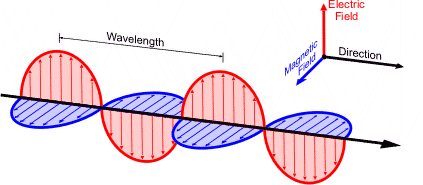
Pair production - 10Nature of light: Light is a transverse electromagnetic wave, consisting of two variable fields: 1.? 2.? 3.?1. Electric Field (With Intensity E>)
2.Magnetic Field (With Intensity H>)
Two Fields propagate simultaneously with the speed of light c (for a particular medium) - 11Electromagnetic Wave; Describe 1.? 2.?Electric and magnetic fields are vectors - i.e. they have both magnitude and direction;
Fields are perpendicular to the direction of propagation - 12Speed of light (c) Determined by? Speed of light in vacuum (c) is?Determined by the electric (electric permittivity) and magnetic (magnetic permeability) properties of the medium;
Speed of light in vacuum (c) is 300,000 km/s - 13Optical density of a medium: Characterized by?Characterized by "absolute" index of refraction (n);
n - a number describes how light, or any other radiation, propagates through optical medium;
n is the ratio of speed of light in vacuum (c) to the speed of light substance (v)
n = c/v
-For vacuum (by definition) n = 1
-For air n ~ 1
- for all other substances n > 1 - 14Definition of reflection; 1.? 2.?Change of direction of light propagation at the interface between two media with different optical density;
Reflected light does not pass into the second medium. - 15Laws of reflection 1st LawIncident ray* and reflected ray, as well as the perpendicular at the point of incidence, lie in the same plane.
- 16Laws of reflection 2nd LawThe angle of the incident ray (α) is equal to the angle of the reflected ray (β)
- 17Definition - Incident RayNarrow beam of light
- 18What does this Illustrate?Law of reflection;
α = β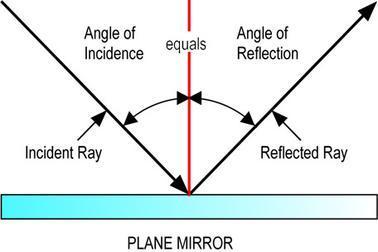
- 19Types of reflection; S?Specular - Reflection from a smooth surface (surface irregularities are smaller than λ)
Law of reflection is valid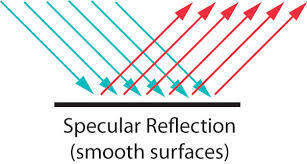
- 20Types of reflection; D?Diffuse - reflection from a rough surface (irregularities are of the order λ or bigger)
Law of reflection NOT valid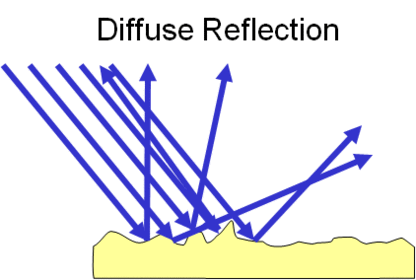
- 21Definition - Refraction of light?The change of direction of propagation of light at the interface between two media with different optical density.
Refracted light passes from first medium to the second. - 22Laws of Refraction 1st Law?Incident ray and refracted ray, as well as the perpendicular at the point of incidence, all lie in the same place.
- 23Laws of Refraction 2nd Law?Ratio of the sines of the angle of incidence (α) and refraction (y) is equivalent to the ratio of light velocities in the two media (Snell's Law)
- 24Sin? SinIllustration of refraction laws
Sin a/Sin y = C1/C2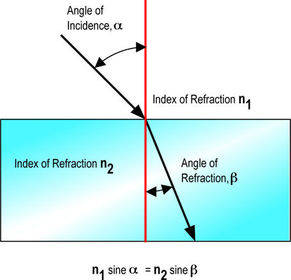
- 25Refraction; Relation between α and yIf the first medium is less optically dense (lower index of refraction) than the second medium, the angle of incidence is larger than the angle of refraction
α > y
If the first medium is optically denser (higher index of refraction) than the second medium, the angle of incidence is smaller than the angle of refraction.
α - 26—Read<<
TIR - The refracted ray is actually reflected because it returns into the first medium - a total internal reflection.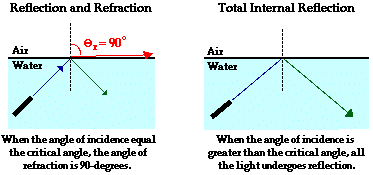
- 27Conditions for Total Internal Reflection; 1st 2nd Result1st - Light must pass from optically higher-density medium to optically lower-density medium.
2nd - Angle of incidence should be larger than the critical angle
Result - Light is reflected back into the incident medium - 28EndoscopeOptical device for examinations of hollow body organs (stomach, bladder, colon, duodenum)
With two optical fiber cables - One for illumination, one for image capture and delivery to monitor. - 29Describe Optical Fiber Cables Built? Optical Density? Light Beams incidence SignalBuilt by great number of glass fibers;
Fiber core is covered by glass layer of lower optical density
For light beams incident to glass fibers at angles larger than the critical angle, a TIR occur
Signal will be trapped inside and transmitted along the length of the fiber.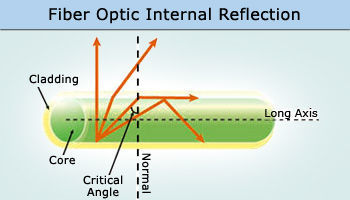
- 30—Medical examination using specular reflection (Forehead reflector)
Light reflects onto the concave surface of the reflector and is focused onto an area of interest.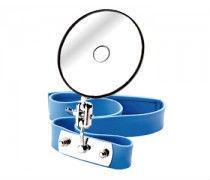
- 31Opthalmoscopy (Funduscopy/Fundoscopy) Describe How is it used? TypesInstrument for examination of eye's fundus (changes in the colour or pigment of the fundus, changes in the retinal blood vessels, abnormalities in the macula lutea)
Light is shone into the patients eyes and the reflection of the retina is observed;
Two major types;
Direct - directly produced image
Indirect - Indirectly producing image - 32Direct Ophthalmoscopy How? Where image forms? Forms? Image? Magnification?Hand-held device
Image forms directly on the retina
Central retina area
Image - Real or virtual
Magnification ~ 15 x - 33Indirect Ophthalmoscopy How? Field of view? Magnification?Image formed by a hand-held condensing lens
Much wider field of view
Less magnification ~ 2x - 5x - 34Diabetic retinal screening Why?Higher risk of micro aneurysms and hemorrhages
- 35Light absorption Describe? (Photons)When light passes through a substance, part of the incident photons loose energy - the light is absorbed.
The photons transfer their energy to the substance, increasing internal energy. - 36Law of light absorptionTransmission of radiant flux Ψ of incident light, decreases by exponential decay law /\
Ψ and Ψ0 - radiant flux (intensity) of the incident and the transmitted light, unit [W/m2]
α - Linear absorption coefficient of the medium, unit [m-1]
d - Thickness of tranversed medium, unit [m]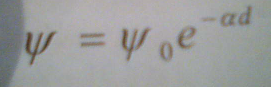
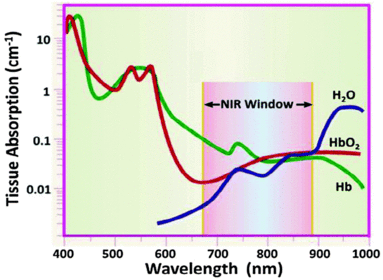
- 37Absorption SpectrumThe dependence of linear absorption coefficient α on light wavelength λ is referred to as absorption spectrum.
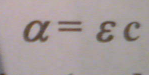
- 38Beer-Lambert-Bouguer LawFor body fluids, the absorption coefficient α is proportional to the molar concentration c of the dissolved substance: /\
ɛ - Molar absorptivity (molar extinction coefficient), depending on λ, unit [m2/mol]
c - Molar concentration, unit [mol/m3]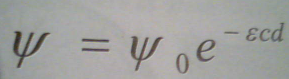
- 39Main absorbing components of tissues? M? H? W?Melanin (Skin, hair, moles) - Absorption in visible and near IR light (400nm - 1000nm)
Hemoglobin (blood) - Absorbs highly in UV & blue and green light of visible spectrum
Water (in tissues) - Transparent to visible light, strong absorption of UV light below 300nm and of IR over 1300nm. - 40Laboratory methods based on light absorption: P? S?Photocolorimetry - analysis of body fluids by attenuation measurement of coloured light.
Spectrophotometry - An improved photocolorimetry method for analysis of body fluids by attenuation measurement of light of precise wavelength. - 41Pulse Oximetry What does it measure? Location? Source? Detects? Calculates?To measure the oxygen level (saturation) in the blood;
Probe (clip-like device), placed on finger or ear lobe.
Source with two different types of light - IR and Red
Detector - for transmitted light through the finger/ear lobe
Microprocessor - Compares and calculates the differences in oxygen-rich (Hbo2) vs. oxygen-poor (Hb) Hemoglobin - 42Pulse Oximetry Operation How they absorb differently? Ratio?Deoxygenated blood (Hb) absorbs light differently than oxygenated blood (HbO2), especially at 660 nm (red) and 920 nm (IR)
Ratio of the difference of absorption at 660 nm vs 920nm is an indication of blood oxygenation. - 43Sebumeter Method for? Procedure? Whats measured? Result Units?Method for direct measurement of skin lipid secretion (sebrum) of face, scalp, hair;
Skin type
Procedure: 0.1 mm transparent tape makes contact with the skin for 30s
The transparency is measured by a light source and results in [ug/cm2] - 44Light Scattering How interacts? Photon Transfer + How is light scattering Determined? General DefinitionLight interacts with systems of much smaller sizes (atoms and molecules);
Photons transfer part of their energy to electrons in a substance, which vibrate and in turn emit new photons (light).
Scattering is determined by particle size and observation.
Light would be scattered, if the propagating medium contains small optical non-homogeneities, i.e particles with optical density different from the bulk medium. - 45Turbidimetry & Nephelometry Used for? Optical Properties?For analysis of dispersed media/colloids (proteins, nucleic acids, viruses, bacteria)
Optical properties of the sample (absorption, transmission, scattering) depend on the size of dispersed particles. - 46Turbidimetry Measures? Using? Concentration? Clinical Applications?Measuring transmitted light and calculating the amount of absorbed light
Using light spectrophotometer
Concentration of particles in suspension dependent on their number and size
Clinical Applications for determining of; total protein in biological fluids (urine, CSF)
Amylase and lipase activity (starch or triglycerides as substrate - 47Nephelometry Measuring? Using? Amount? Clinical Applications?Measuring scattered light
Using light spectrophotometer with forward scattered detection or at angle (90, 70 or 37 degree) of maximal scattered light
Amount of scattered light depends on the size and number of particles.
Clinical Applications - For determination of:
Immunoglobulins (total,IgG,IgE,IgM,IgA)
Individual serum proteins - hemoglobin, albumin. - 48UV Rays: UV Range? UV rays in medicine, range? Wavelength compared to visible light? Photons compared to visible light?UV range: 10nm - 400nm (Visible range:380nm - 760nm)
UV rays in the 200nm - 380nm range are used in medicine
UV rays have shorter Wavelength than visible light
UV photons have higher energy than photons of visible light - 49UV Bands UV A UV B UV CUV A (Aging,Allergy) ~ 315 nm - 380 nm
UV B (Burn) ~ 280 nm - 315 nm
UV C (Bacterial CELL) ~ 200nm - 280nm - 50Effects of UV Rays UVA UVB UVCUVA - Effects of metabolism
UVB - Photochemical effects
UVC - Bactericide effects