
Karteikarten
Bio core questions, 04: Flow of matter in living systems (Gas exchange, circulation and diffusion).

Karten in diesem Stapel (24)
- 1What are the levels of organisation in living organisms, starting from the smallest?organelles, cells, tissues, organs, systems
- 2Why do many multicellular organisms need transport systems?Many cells are to far from the external environment
Diffusion is too slow over large distances (over 1mm is far) - 3Write the equation for the rate of diffusion
- 4What is the concentration gradient?An unequal distribution of molecules, so there is an area of higher concentration, and an area of lower concentration
- 5What is equilibrium?An equal distribution of molecules, so that the flow is equal in all directions
- 6Why does equilibrium cause a problem for cells?To stay living, cells require a constant flow of molecules into, and out of the cell
- 7Name 4 specialised surfaces for exchange in humansLungs, small intestine, placenta, kidneys
- 8What 3 features do all humans specialised surfaces for exchange have to increase the rate of diffusion?Large surface area, short exchange distance, maintain concentration gradient
- 9Explain the meaning of surface area: volumeIt is a comparison between the amount of surface that can exchange with the environment, and the total living volume of the organism
- 10Explain why SA:V is an important restrictor on the shape of organismsThere needs to be enough exchanging surface are to meet the demands for the flow of energy and matter of all cells of the organism
- 11What is the equation for calculating the surface area of a cube?6 x (side length) ²
- 12What is the equation for calculating the volume of a cube?(Side length) ³
- 13What is the equation for calculating surface area to volume ratio?Surface area / volume
- 14Draw a diagram of the human gas exchange system
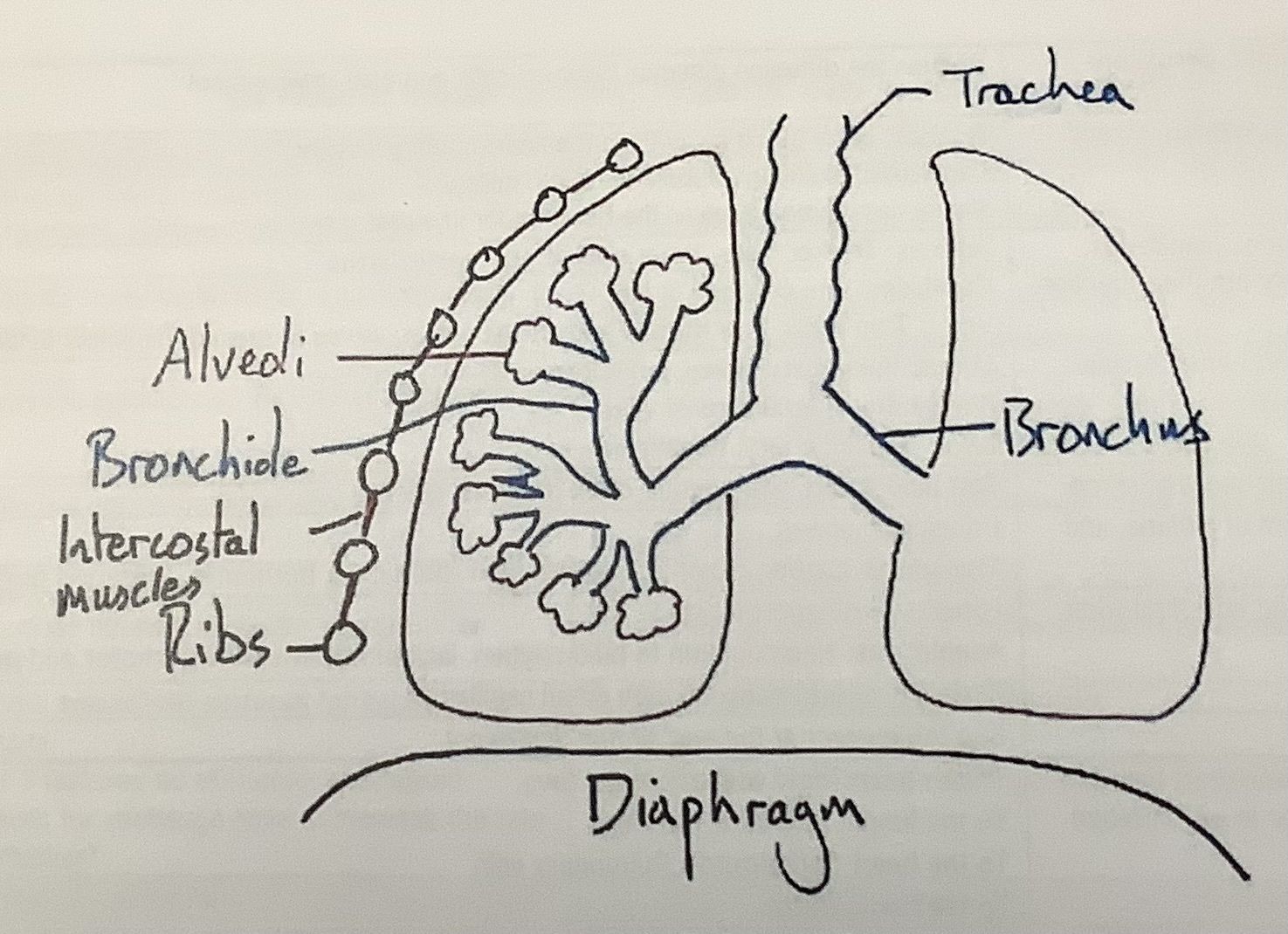
- 15What organs does air pass through (in order) when breathing in?Trachea, bronchi, bronchiole, alveoli
- 16Name two organs found in the thorax cavityLungs, heart
- 17What is the mechanism for breathing in?- The diaphragm & external intercostal muscles contract
- Volume of thorax & lungs increases
- The air pressure decreases in the lungs (lower than atmosphere)
- Air moves into the lungs - 18What is the mechanism for breathing out?- Internal intercostal muscles contract (pulling ribs inwards)
- The lungs decrease in volume
- The air pressure increases in the lungs (higher than the atmosphere)
- Air moves out of the lungs - 19What is the function of the rings of cartilage found in the trachea and bronchi?Prevent them from collapsing when breathing in (due to decrease in pressure)
- 20What is the function of breathing?Renew the alveoli air
- maintain the concentration gradient between the alveoli air and the blood
- maintain the flow of exchange between the organism and the air - 21Name four adaptation of the alveolus (and it’s capillaries) that allow quick gas exchangeShort diffusion distance: Alveolus and capillaries are one cell thick
large surface area: Alveolus has many folds
Allows gases to dissolve: Alveolus is moist (has a water layer)
Maintenance of a concentration gradient: flowing blood in capillaries - 22Name the gases that are exchanged in the alveolus and in what direction they diffuseOxygen: air in the alveolus to blood
Carbon dioxide: from blood into the air in the alveolus - 23What is the function of increasing the breathing rate during exercise?Increase the flow of oxygen to muscle tissue
Increase the excretion of carbon dioxide - 24Why does a faster breathing rate increase the rate of exchange in the alveoli?Maintenance of a larger concentration gradient of gases
- rate of diffusion (in the alveoli) increases
Informationen
- Beschreibung
- Karteikarten am Bio core questions, 04: Flow of matter in living systems (Gas exchange, circulation and diffusion)., erstellt von Laura García Penabad am 18/01/2022.
- Erstellt von
- Laura García Penabad · Jan 2022
- Aktualisiert
- 19 Jan 2022
- Aufrufe
- 116
- Bewertung