
Karteikarten
Complement
Karten in diesem Stapel (43)
- 1What is the complement cascade?- A part of the immune system (innate branch that enhances (complements) the ability of antibodies and phagocytic cells to clear microbes and damaged cells from an organism, promote inflammation, and attack the pathogen's cell membrane
- Can also be recruited and brought into action by antibodies generated by the adaptive immune system though
- Functional link btwn innate and adaptive!
- Consists of a number of small proteins and protein fragments (roughly 50) that are synthesized by the liver, and circulate in the blood as inactive precursors
- When stimulated by one of several triggers, proteases in the system cleave specific proteins to release cytokines and initiate an amplifying cascade of further cleavages
- End result of this is stimulation of phagocytes to clear foreign and damaged material, inflammation to attract additional phagocytes, and activation of the cell-killing membrane attack complex
- Can be activated by three diff pathways - 2What are the 3 diff pathways that can activate the complement cascade?- Mannose-binding lectin pathway (MBL pathway)
- Classical pathway
- Alternative pathway - 3What responses does the complement cascade trigger?- Membrane attack – by rupturing the cell wall of bacteria. (primarily Classical Complement Pathway)
- Phagocytosis – by opsonizing antigens -> C3b has most important opsonizing activity (primarily Alternative Complement Pathway)
- Inflammation – by attracting macrophages and neutrophils. (primarily MBL pathway) - 4Where are the 50 or so proteins involved in the cascade synthesized?- Primarily synthesized by hepatocytes
- Significant amounts are also produced by: . Tissue macrophages
. Blood monocytes
. Epithelial cells of the genitourinary system and gastrointestinal tract - 5All three complement activation pathways have essentially the same end result - what is it?- Formation of a serine protease molecule -> C3 convertase
- Two different homologues prod. dep. on pathway:
. Classical and MBL pathways prod. C3 convertase (C4bC2a)
. Alternative pathway prod. C3 convertase (C3bBb) - 6What is properdin?- A positive regulatory plasma glycoprotein released by activated neutrophils (stored in secondary granules)
- Alternative pathway C3 convertases C3bBb and C3(H2O)Bb are very short-lived -> they are stabilized by binding the plasma protein properdin (factor P)
- Also acts to stabilize C5 convertase so that the membrane attack complex (MAC) can be formed - 7What is the membrane attack complex (MAC) ?- A complex of proteins (C5b, C6, C7, C8, and 10-16 C9) typically formed on the surface of pathogen cell membranes (part of complement resp)
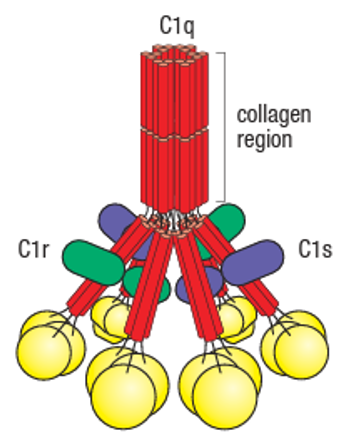
- Assembly of the MAC leads to pores that disrupt the cell membrane of target cells, leading to cell lysis and death - 8What is a C1 complex & what does it look like?- The first component of the classical pathway
- Binds to antibody-antigen complexes mainly
- Composed of the subcomponents C1q, C1r (x2) and C1s (x2) - 9What is mannose binding lectin (MBL) and what does it look like?- (One of) the first component of the mannose-binding lectin pathway
- Binds to mannose, fucose, glucose etc (carbohydrates) residues via it's lectin domain
- Composed of subcomponents incl 2-6 MBL monomers, and MASP-1, MASP-2 and sometimes MASP-3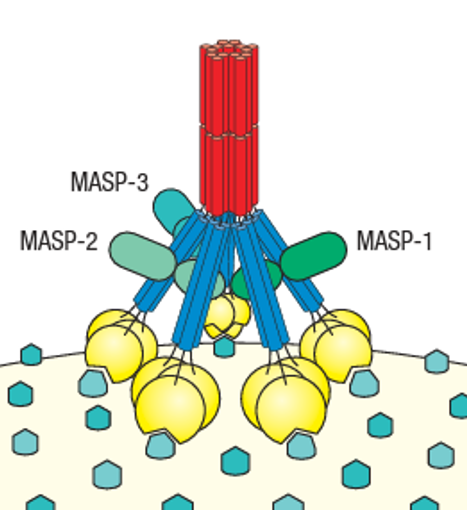
- 10What are ficolins and what do they look like?- Any of three diff types of ficolin can be the first component of the mannose-binding lectin pathway
- Binds to carbohydrates ( specifically oligosaccharides cont. acetylated sugars) but using a fibrinogen-like domain
- Comprised of subcomponents incl. ficolin monomers (2-6?) and MASP-1 and MASP-2 (x2)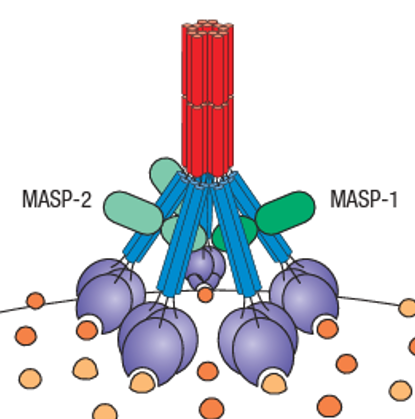
- 11What are MBL-associated serine proteases (MASPs) ?- A type of serine protease which cleaves products in the complement cascade
- Acts as a pattern recognition molecule
- Three relevant types: MASP-1, MASP-2, MASP-3
- Form complexes w/MBL, ficolins - 12What A. activates, B. acts as C3 convertase, C. acts as C5 convertase, and D. forms the MAC in each of the 3 complement pathways?
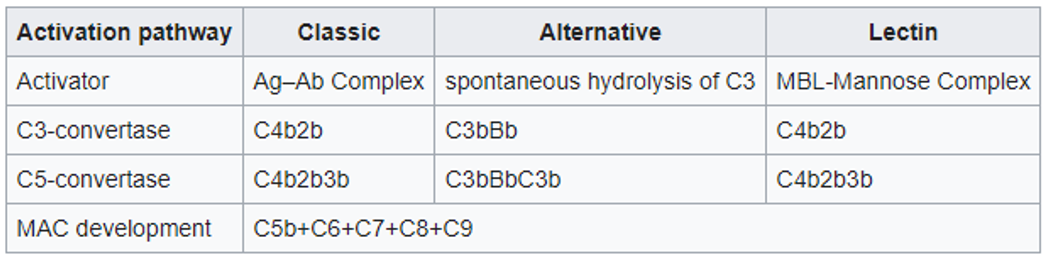
- 13The alternative pathway doesn't act only as an activation pathway but as... ?- An amplification loop for C3b formation that is accelerated by properdin in the presence of pathogens:
- Once C3b has been prod. it can generate more of itself
- This means that once some C3b has been formed, by whichever pathway, the alternative pathway can act as an amplification loop to increase C3b production rapidly - 14Some cells have receptors for C3a, C5a - which cells and what influence can these molecules have by binding to them?
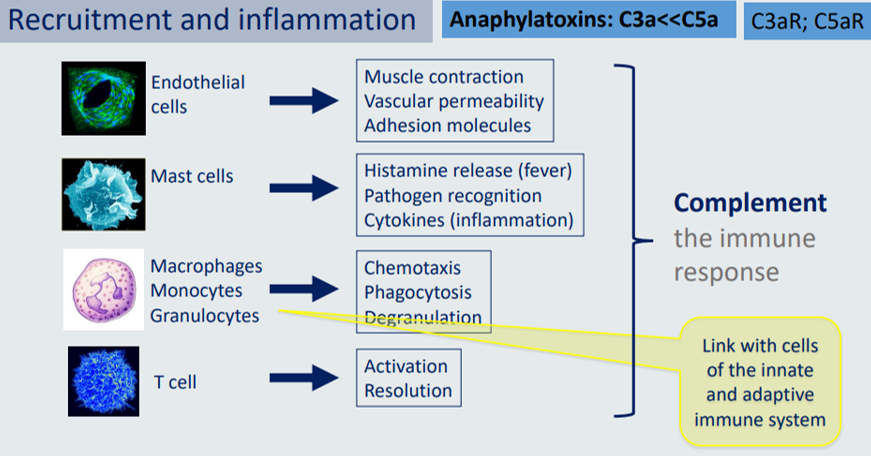
- 15What is opsonisation?- The process of recognizing and targeting invading particles for phagocytosis using opsonins
- 16What are opsonins?- Extracellular proteins that, when bound to substances or cells, induce phagocytes to phagocytose the substances or cells with the opsonins bound -> thus, opsonins act as tags to label things in the body that should be phagocytosed by phagocytes
- Complement opsonins incl. C3b, C4b, C1q - 17What is the only activating protease of the complement system to circulate as an active enzyme rather than a zymogen?- Factor D (fD)
- Safe for the host, because factor D has no other substrate than factor B bound to C3b - 18What is a zymogen?- Alternatively called a proenzyme
- An inactive precursor of an enzyme
- Requires a biochemical change (such as a hydrolysis reaction revealing the active site, or changing the configuration to reveal the active site) for it to become an active enzyme
- This biochemical change is carried out by another enzyme - 19What are complement regulatory proteins?- Negative regulatory proteins, present in plasma and in host-cell membranes, which protect healthy host cells from the injurious effects of inappropriate complement activation on their surfaces
- These complement-regulatory proteins interact with C3b and either prevent the convertase from forming or promote its rapid dissociation - 20What are complement receptors?- Membrane-bound receptors belonging to the complement system
- Complement receptors bind effector protein fragments that are produced in response to antigen-antibody complexes or damage-associated molecules (Also known as DAMPs) - 21—
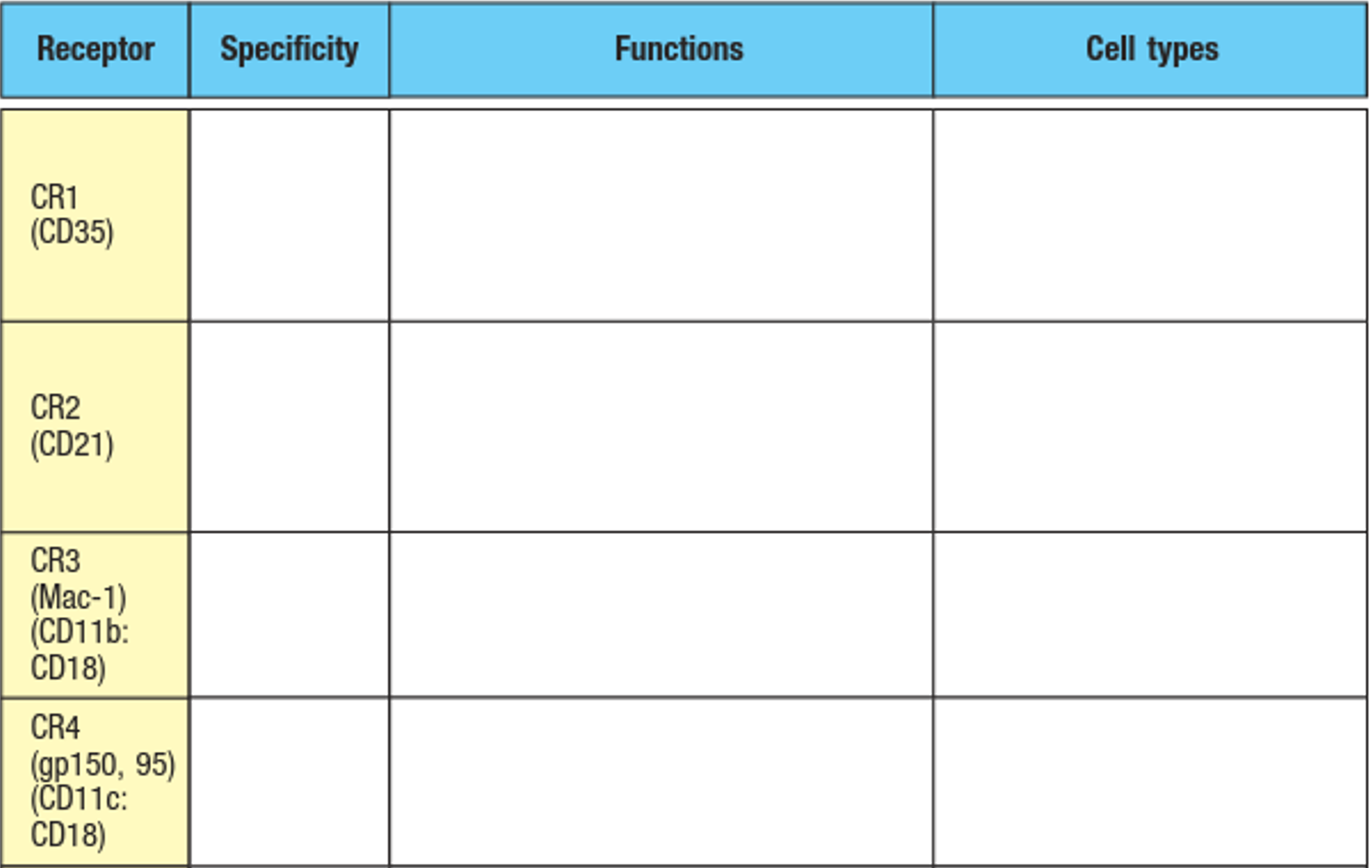
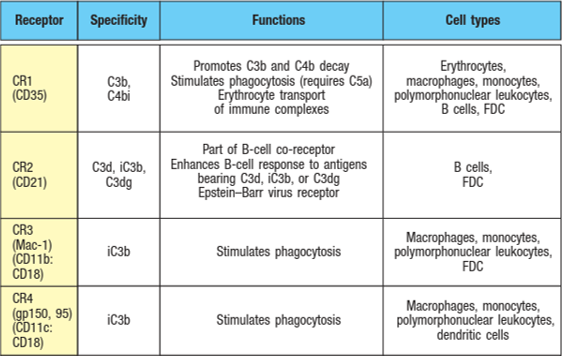
- 22C3b can be broken down further into other products - what are they and what helps break them down?- C3b -> iC3b (+C3f)
- iC3b -> (C3c +) C3dg
- C3dg -> C3d
- Factor I is the protease cleaves C3b but requires a cofactor (e.g Factor H, CR1, MCP or C4BP) for activity - 23What is the function of iC3b?- Retains the capacity of C3b to engage complement receptors as an opsonin, but no longer participates in the production of additional complement
- 24What is the function of C3d?- No longer fixes complement or serves as an opsonin
- May engage B cells and facilitate antibody formation - 25What are DAMPS?- Damage-associated molecular patterns
- Molecules w/in cells that are a component of the innate immune response released from damaged or dying cells due to trauma or an infection by a pathogen - 26Once C3b has opsonised a pathogen and phagocytes have been attracted and bound to it via their CR1 receptor, does phagocytosis proceed?- No - need an immune mediator to activate the macrophage and stimulate uptake
- C5a can act as this immune mediator and bind to a C5a receptor (a G-protein-coupled receptor), activating macrophages to ingest bacteria bound to their CR1 receptors - 27Why is complement regulation necessary?- C3b and C5b are highly reactive and non-specific - they bind host tissue!
- 28What is DAF and what does it do?- Decay-accelerating factor
- Regulates complement on the cell-surface - specifically formation of the MAC
- It recognizes C4b and C3b fragments that are created during activation of C4 (classical or lectin pathway) or C3 (alternative pathway)
- Interaction of DAF with cell-associated C4b of the classical and lectin pathways interferes with the conversion of C2 to C2b, thereby preventing formation of the C4b2a C3-convertase, and interaction of DAF with C3b of the alternative pathway interferes with the conversion of factor B to Bb by factor D, thereby preventing formation of the C3bBb C3 convertase of the alternative pathway -> This limits the amplification convertases
- Acts on self-cells/self-surfaces - not on pathogens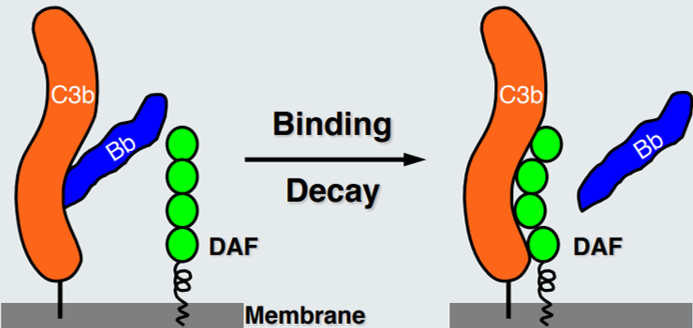
- 29What is MCP (CD46) and what does it do?- Membrane cofactor protein that acts as an inhibitory complement receptor (a compliment control protein)
- Cofactor activity for inactivation (through cleavage) of complement components C3b and C4b by serum factor I
- Acts on self-cells/self-surfaces - not on pathogens
- This process protects the host cell from damage by complement!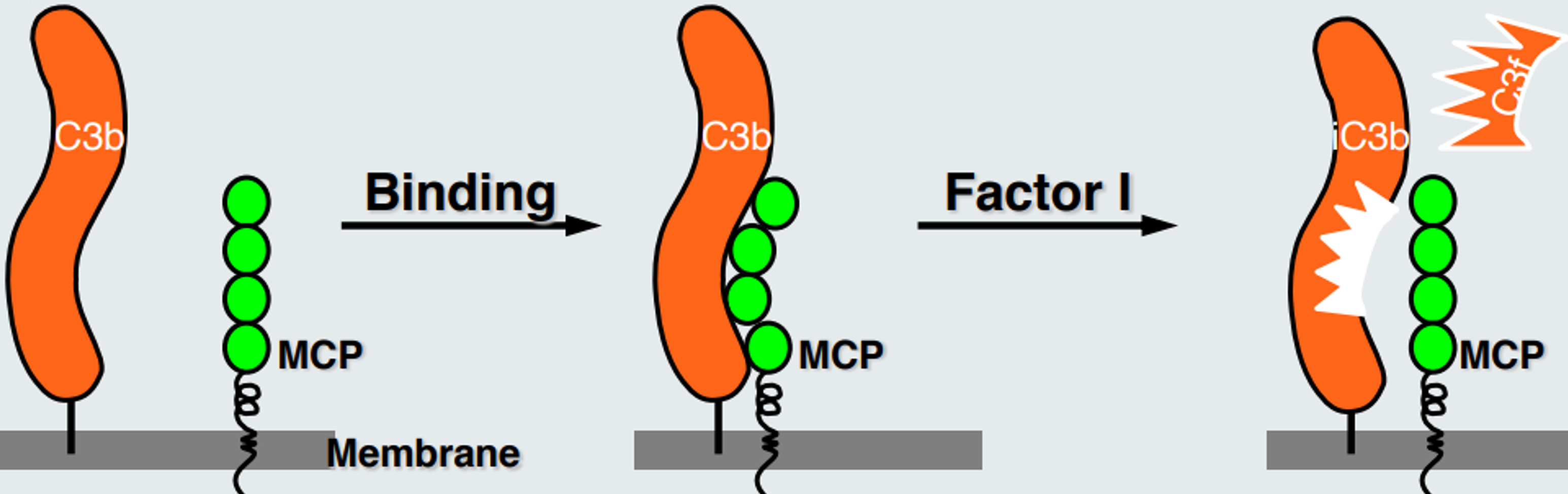
- 30What is Factor H (fH) and what does it do?- A large soluble glycoprotein that acts as a complement control protein
- Regulates the alternative complement pathway
- Has cofactor activity for the Factor I mediated C3b cleavage
- Has decay accelerating activity against the alternative pathway C3-convertase
- Acts on self-cells/self-surfaces - not on pathogens - 31What is vitronectin and what does it do?- A glycoprotein of the hemopexin family that acts as a complement control protein
- Some newly formed membrane-attack complexes may diffuse from the site of complement activation and insert into adjacent host cell membranes
- To prevent host lysis, several plasma proteins, including, notably, vitronectin (also known as S-protein), bind to the C5b67, C5b678, and C5b6789 complexes and thereby inhibit their random insertion into cell membranes - 32What is Factor I (fI) and what does it do?- It is a soluble glycoprotein that circulates in human blood
- Regulates complement activation by cleaving cell-bound or fluid phase C3b and C4b
- Often requires co-factors to work! - 33What is protectin (CD59) and what does it do?- Acts as a complement control protein
- Attaches to host cells via a glycophosphatidylinositol (GPI) anchor
- When complement activation leads to deposition of C5b678 on host cells, CD59 can prevent C9 from polymerizing and forming the complement membrane attack complex - 34What is complement deficiency?- An immunodeficiency of absent or suboptimal functioning of one or more of the complement system proteins
- Caused by genetics - inherited mainly but sometimes acquired (usually after infection)
- Majority inherited as autosomal recessive conditions
- Outliers: properdin deficiency occurs through X-linked inheritance, MBL deficiency can be inherited by either manner - 35What is C1-INH?- A soluble protease inhibitor belonging to the serpin superfamily
- C1-inhibitor irreversibly binds to and inactivates C1r and C1s proteases in the C1 complex of classical pathway of complement
- MASP-1 and MASP-2 proteases in MBL complexes of the lectin pathway are also inactivated
- Via these two activities, C1-inhibitor prevents the proteolytic cleavage of later complement components C4 and C2 by C1 and MBL - 36What does a malfunction or deficiency in C9 cause?- The person would be pretty much normal
- May have slight incr in susceptibility to Neisseria gonorrhoeae or Neisseria menigitidis - 37What is an immune complex?- Antigen-antibody complex
- 38What can malfunctions/deficiencies in C1, C2, C3, and C4 complement proteins cause?- Lupus-like illness (C1 (C1q), C2, C4)
- Chronic renal disease (C3 glomerulopathy)
- Repeated infections - 39What can malfunctions/deficiencies in C5, C6, C7, and C8 complement proteins cause?- Repeated Neisseria infection (gonorrhoea, meningitis)
- - 40How do you diagnose complement malfunction?1. Test overall complement activity: Ch50 or Ch100 test
2. Quantification of specific complement protein levels - 41How do you treat complement malfunctions?1. Overreactive: immunosuppressants
2. Deficiency: supplementation, antibiotics (prophylactic) - 42Complement malfunction can also lead to.... ?- Autoimmune disease (adaptive immunity)
- Such as:
. Systemic Lupus Erythematosus (SLE): C1, C4, C2
. Rheumatoid Arthritis: C1q, C2
. Systemic Sclerosis: C3
. Inflammatory bowel disease: CD55/DAF - 43What is the complosome?- An intracellularly active (autocrine) complement system
- Has emerged as a central regulator of the core metabolic pathways fuelling human immune cell activity -> is required to induce metabolic reprogramming of immune cells -> specifically req. for prod. of pro-inflammatory cytokine IFN-γ
- Reduced complosome activity translates into defects in normal monocyte activation, faulty Th1 and cytotoxic T lymphocyte responses and loss of protective tissue immunity
Informationen
- Beschreibung
- Undergrad The Immune System in Health and Disease Karteikarten am Complement, erstellt von Liberty Grisman-Hughes am 06/04/2022.
- Erstellt von
- Liberty Grisman-Hughes
- Aufrufe
- 1
- Bewertung