
Karteikarten
Penson
Karten in diesem Stapel (36)
- 1WeightIs the force due to a gravitational field acting on the object. Weight is a vector quantity measured in Newtons using W=mg when at the Earth’s surface.
- 2MassIs a measure of the quantity of matter contained in the object. Mass is a scalar quantity measured in kilograms.
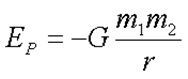
- 3Gravitational potential energyThe amount of energy stored in an object due to its position in a gravitational field. Since the field is non uniform, GPE is given by:
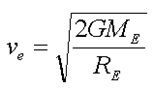
- 4Escape Velocitythe initial velocity required by a projectile to escape the gravitational field of a planet without further propulsion. Given by:
- 5G-ForceAre the inertial forces acting on pilots and astronauts when they are in an accelerating frame of reference. The magnitude of the G Force is expressed as a ratio of their ‘normal’ weight on the Earth’s surface.
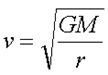
- 6Orbital velocityThe velocity required by a satellite to enter and maintain a stable circular orbit around a celestial object. Given by:
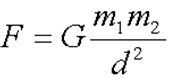
- 7Newton’s Law of Universal GravitationThe force of attraction between any two bodies in the universe is proportional to the product of their masses and inversely proportional to the square of their distance apart. Given by:
- 8An ‘inertial’ frame of referenceA frame of reference in which Newton’s First Law (his law of inertia) is valid. In other words, an inertial reference frame is one that is not accelerating.
- 9A ’non-inertial’ frame of reference.A frame of reference that is accelerating. Newtons Laws ‘appear’ not to be true.
- 10Kepler’s 3rd Law
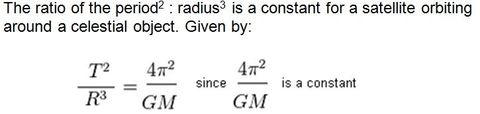
- 11TorqueA rotational force being the product of the tangential force and the perpendicular distance from the fulcrum of turning point. Given by:
T = F d or T = n B I A cos - 12The ‘motor effect’ in relation to electrical currents.The resultant force experienced by a current-carrying conductor due to the interaction of the magnetic field around the conductor with the external magnetic field in which it is placed.
- 13Lenz’s LawAn induced emf in a conductor produces a current that creates a magnetic field that opposes the original change in flux is experienced by the circuit.
- 14Faradays Law of Electromagnetic InductionThe induced emf in a circuit is equal in magnitude to the rate at which the magnetic flux through the circuit is changing with time.

- 15Magnetic flux densityMagnetic flux density is a measure of the number of magnetic flux lines passing through a unit area (one metre squared) hence Wb m-2.
- 16Magnetic field strengthMagnetic field strength B at a point is defined to be the same as magnetic flux density. Measured in Tesla (T) or (Wbm-2)
- 17Magnetic flux

- 18Photoelectric effect.The photoelectric effect is the emission of electrons from the surface of a material when the material is illuminated by EM waves with a frequencygreater than the materials threshold frequency according to the equation E=hf
- 19‘Work Function’ as related to the Photoelectric Effect.The work function is the minimum energy (usually measured in electron volts - eV) needed to remove an electron from the surface of a material.
- 20DiffractionWhen a wave spreads out as it passes through a small aperture or around the edge of an obstacle.
- 21SuperconductorA substance in which the electrical resistance drops to zero when it is below its critical temperature (Tc).
- 22Critical TemperatureThe temperature below which the material loses all electrical resistance i.e. becomes superconductive.
- 23Meisner EffectThe expulsion of applied magnetic fields from inside a superconductor when it is below its critical temperature.
- 24TransmutationThe process of producing a new daughter element either naturally by radioactive decay OR artificially by the bombardment of the parent element.
- 25Conservation of MomentumFor an interaction occurring between objects in an isolated system, the total momentum of the objects before the interaction is equal to the total momentum of the objects after the interaction.
- 26IsotopeAtoms/nuclei with the same atomic number but different atomic mass due to differences in the number of neutrons
- 27½ LifeIs the average time for half the radioactive nuclei in any sample to undergo radioactive decay.
- 28A Scientific ModelA mathematical, conceptual or physical representation that describes, simplifies, clarifies or provides an explanation of the structure, workings or relationships within an object, system or idea. Models can provide a means of testing and predicting behaviour within limited conditions.
- 29Validity (of first-hand data)The extent to which the processes and resultant data measure what was intended. To ensure a valid experiment it must be a fair test i.e. an investigation where one variable is changed and all other conditions (controlled variables) are kept the same and the dependent variable is measured or observed.
- 30Reliability (of first -hand data)The degree to which repeated observation and/or measurements taken under identical circumstances will yield the same results.
- 31Dependent variableThe factor in an experiment that changes as a result of changes to the independent variable. Conventionally plotted on the vertical axis of a graph.
- 32Independent variableThe variable that is deliberately changed, often through a series of preset values. Conventionally plotted on the horizontal axis of a graph.
- 33Scientific TheoryAn explanation of a body of experimental evidence that has been accepted through the processes of review by the scientific community. A theory provides predictions that can be tested against observations and can be supported or refuted.
- 34LawA simple and precise statement that has been shown, based on available evidence, to be universally reliable. It describes phenomena that occur with unvarying regularity under the same conditions. No scientific law is ever conclusively verified
- 35AccuracyThe accuracy of an experiment is the closeness of the result of the experiment to the true value of the quantity being measured
- 36PrecisionThe precision of a value describes the number of digits that are used to express that value. In a scientific setting this would be the total number of digits (sometimes called the significant figures) or the number of decimal places in the measurement