
Karteikarten
Card set 1_(NIMC Guidelines)

Karten in diesem Stapel (36)
- 1What are the essential prescription requirements to make a drug order valid? (ROUTINE order)1. Date
2. Route
3. Dose
4. Frequency
5. Drug (generic)
6. Administration times
7. Prescriber signature
8. Prescriber name
9. Indication - 2What are the essential prescription requirements to make a drug order valid? (PRN order)1.Date
2. Drug
3. Dose
4. Hourly frequency
5. Route
6. Maximum daily dose (e.g. mg/24hrs)
7. Indication
8. Prescriber signature
9. Prescriber printed name - 3How many patient identifiers are required to be checked before administration of medications?Two + Three
-Two identifiers verbally (Name & DOB)
-Three identifiers on the name band (Name, DOB, UR number) - 4Affix patient identification 1. Identify the use 2. Identify the risk addressed1. First prescriber checks pt ID and adhere stickers front and back
**Nurses to not stick labels on chart
**Do not administer if ID sticker is missing
2. Risk: Administration to the incorrect patient - 5Weight and height 1. Identify the use 2. Identify the risk addressed1. Vital clinical information when prescribing doses of medications
Nurses can fill in
2. Administration of correct dose for body weight.
- 6Write the patient's current location 1. Identify the use 2. Identify the risk addressed1. Write the current location
e.g. Ward 3C
2. Location reduces risk of the wrong NIMC being used
Nurses can fill in
- 7Chart numbering 1. Identify the use 2. Identify the risk addressed1. Write the number e.g. 1 of 2, 2 of 2
Update information if additional active NIMCs are created
2. Missed doses or duplicate prescriptions
Nurses can fill in
- 8Specialised charts section 1. Identify the use 2. Identify the risk addressed1. Tick or cross to indicate additional specialist charts in use
2. Missed doses
Nurses can fill in
- 9ADR sticker 1. Identify the use 2. Identify the risk addressed1. Clearly communicate previous allergies & adverse drug events
2. Prescription and administration of harmful medicines
- 10ADR alert sticker 1. Identify the use 2. Identify the risk addressed1. Affix sticker to the FRONT and BACK page of NIMC to alert prescriber
2. Prescription and administration of harmful medicines
- 11Recording medication history 1. Identify the use 2. Identify the risk addressed1. Identify a current and complete list of prescription and non-prescription medicines
2. Reduces risk of prescription errors and omissions
- 12Telephone orders (When must the Dr confirm (sign) the order?All telephone orders MUST be confirmed in writing by a prescriber within 24 hours
- 13Limited duration medicines: What they should look like 'For three days post op' Method 1Boxing clarifies when the dose is required. Do not give where boxes have an 'X'

- 14Limited duration medicines: What they should look like 'For three days post op' Method 2Boxing clarifies when the dose is required. Do not give where boxes have a straight line through them.

- 15Limited duration medicines: What they should look like 'Once a week'Boxing clarifies when the dose is required. Do not give when box is crossed out.

- 16Limited duration medicines: What they should look like 'Once a day on Tues + Fri'Boxing clarifies when the dose is required. Do not give when box is crossed out.

- 17Limited duration medicines: What they should look like 'Once only on a set date'Boxing clarifies when the dose is required. Do not give when box is crossed out.

- 18Ceased medicines: What the order should look likeLine through prescription
Double line through signing area
'Ceased' written
Date ceased & signature
- 19Slow release medicationsThis box must be
ticked to indicate a sustained, modified or controlled release form of an oral drug
- 20How to document PRN orders
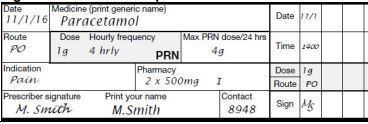
- 21How to document PRN orders Multiple routes

- 22Use of sedation score in Max PRN dose/24hrs sectionDo not give UNLESS sedation score is less than 2
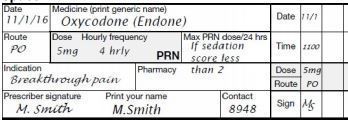
- 23Additional safety features: Paediatric NIMCCalculation based on mg/kg/dose
All calculations are double-checked and counter signed
- 24Reason for not administering: What does this code mean?Self Administered
Prescriber must be aware, and consent to patient self administering in writing (or as per facility policy) - check with RN.
- 25Reason for not administering: What does this code mean?Absent

- 26Reason for not administering: What does this code mean?Fasting

- 27Reason for not administering: What does this code mean?Refused – notify Dr

- 28Reason for not administering: What does this code mean?Vomiting

- 29Reason for not administering: What does this code mean?On leave

- 30Reason for not administering: What does this code mean?Not available –
obtain supply
or contact Dr
- 31Reason for not administering: What does this code mean?Withheld – enter reason in
clinical record
Notify
- 32Pharmacy code: 'I'Medicines available on imprest
- 33Pharmacy code: 'S'Non-imprest items that will be SUPPLIED AND LABELED FOR INDIVIDUAL USE from the pharmacy
Usually kept locked away by the bed side - 34Pharmacy code: 'Pts own'Medicines brought in by the patient that have been checked by the pharmacist and
confirmed to be acceptable for use during the patient’s admission
Usually kept locked away by the bed side - 35Pharmacy code: 'CD, S8'CD, S8 Schedule 8 medicine (stored in CD cupboard)
- 36Pharmacy code: 'Fridge'A medicine that is stored in the refrigerator
Informationen
- Beschreibung
- Nursing Sam A Karteikarten am Card set 1_(NIMC Guidelines), erstellt von Christine Lee am 03/05/2024.
- Erstellt von
- Christine Lee
- Aufrufe
- 0
- Verlauf
-
- Erstellt von Tafe Teachers SB · 26 Jul 2018
- Kopiert von Sam A · 23 Mai 2020
- Kopiert von Christine Lee · 3 Mai 2024
- Bewertung