
Karteikarten
Physics Exam revision
Karten in diesem Stapel (16)
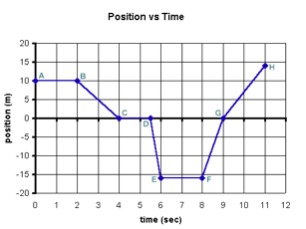
- 1Distance vs time graphs
- 2Velocity Time GraphsA - B) steady acceleration
B - C) same velocity
C - D) acceleration
D - E) same velocity
E - F) steady deceleration
F - G.) constant velocity
G - H.) acceleration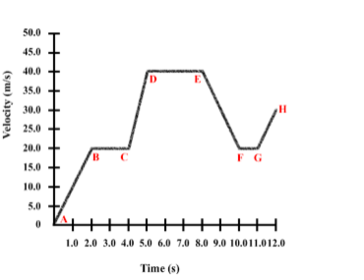
- 3How do you use the formula for velocity to calculate Velocityv= s/t
- 4Rearrange the Velocity formula to calculate either time or distances=v×t
t= s/v - 5Reaction time and braking distanceThe time it takes for the message to travel from eye to your brain and then from your brain to your foot to start to apply the brake is called the reaction time
Braking distance – is the distance a car travels while the brakes are slowing it to a stop
Braking distance depends on factors such as
• The speed
• The efficiency of the brakes
• The force acting on the brakes
• Type of road surface
• Type and condition of the tyres
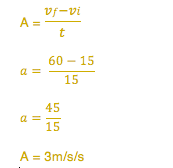
• Mass of car - 6How do you use the acceleration formula to calculate acceleration

- 7A bus accelerates from 15ms-1 East to 60ms-1 East in 15 seconds. What is the acceleration of the bus?
- 8Reading Ticker TimersIf the dots are the same distance apart the speed is constant
If the dots are close together and then growing further apart the speed is acceleration
If the dots are close together and then rapidly growing very far apart that speed is lots of acceleration - 9Interpreting the ticker timer information to make calculations1. Measure the distance with a ruler
2. S=distance = 10.6cm (e.g.)
3. Formula v=s⁄t
E.g.
v=s⁄t = 10.6 / 0.18 = 58.89 cm/s
Time intervals for speed are calculated from dot to dot. How many intervals are there? There are 9 intervals, each interval is 0.02 seconds
t=0.02 × 9
=0.18 s - 10What is the forces equationF=ma
F = Force (measured in Newtons – N + Direction)
M=mass (measured in kilograms - kg)
A= acceleration (measured in ms2+direction of the force) - 11Forces exampleA body of mass 10kg rests on a friction less horizontal surface. A force F acts on the body horizontally to the right the body accelerates at 4 ms-2 to the right
Calculate the force F
M = 10 kg
A= 4 ms-2
F=ma
= 10 x 4
= 40 N
An object of mass 5 kg rests on a flat horizontal surface. A force F acts on the body horizontal surface. A force of 20.0 N is applied. Calculate the acceleration of the object.
M = 5kg
F= 20 N
A=f/m
= 20/5
= 4 ms-2 - 12rearrange the equation to calculate

- 13Newton's 3 laws of motion1. A body at rest tends to stay at rest
2. When an unbalanced force is applied to an object, it will accelerate according to these rules
• a bigger force will cause a larger acceleration
• The same force will cause a smaller mass to accelerate faster
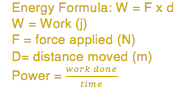
3. For every action there is an equal and opposite reaction for the same length of time - 14formula for energy
- 15Formula for Kinetic energyKinetic energy formula: Ek= ½ mv2
M= mass kg
V = speed (m/s) - 16Kinetic Energy formulaThe ski instructor pulls the sled for 10 seconds with a force of 120 N over a distance of 3 meters
the work the ski instructor has done on the sled
The ski instructor’s power in pulling the sled
w = fxd
= 120 x 3
= 360 J
b. Power = (Work done)/time
= 360/10
= 36 w
Kinetic Energy and Work
Calculate the kinetic energy of a car of mass 1300 kg travelling at
5m/s (18km/h)
6500km/hr
16m/s (58 km/h)
20800 km/hr
Informationen
- Beschreibung
- Year 10 Physics Karteikarten am Physics Exam revision, erstellt von Olivia Gniadek am 22/11/2015.
- Erstellt von
- Olivia Gniadek
- Aufrufe
- 26
- Tags
- Bewertung