Karteikarten
Types of Forces
Karten in diesem Stapel (31)
- 1The Nature of ForceA force gives energy to an object, sometimes causing it to start moving, stop moving, or change direction.
• A force can be a push or pull.
• Newton: the unit used to express force (I pushed
the chair with 50 N of force)
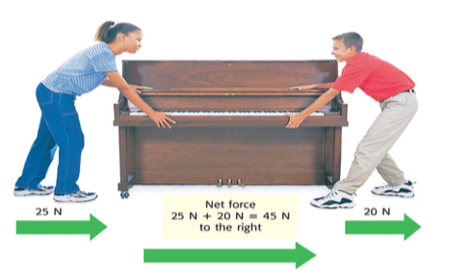
• Net Force: the combination of all forces acting on an object - 2Forces Acting in the Same Direction• When multiple forces act upon an object in the same direction, you ADD the forces to find the net force acting on the object.
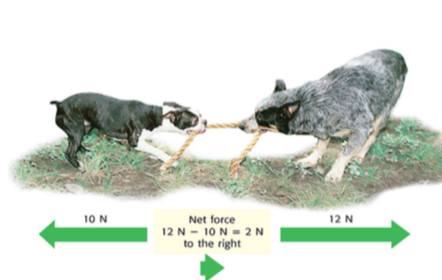
- 3Forces Acting in Opposite Directions• When multiple forces act upon an object in the opposite directions, you SUBTRACT the forces to find the net force acting on the object.
- 4Balanced ForcesBalanced forces cause NO CHANGE in motion
• Forces that are in opposite directions and equal in size are called balanced forces.
• When forces are balanced, there is no change in motion; there would be no overall force (net force) acting on the object. - 5Unbalanced Forces Same DirectionUnbalanced forces cause a CHANGE in motion
Same direction -
When two forces are acting in the same direction, they are added together.
The size of the arrow is relative to the strength of the force.
They each provide an “applied force” in the same direction.
Meanwhile, gravitational force and frictional forces are working against them. - 6Unbalanced Forces-Opposite directions• When two forces act in opposite directions, they combine by subtraction,
• If one force is greater than the other force, the object will move in the direction of the greater force - 7Contact forcesare types of forces in which the two interacting objects are physically contacting each other.
- 8Action-at-a-distance forcesare types of forces in which the two interacting objects are not in physical contact with each other, yet are able to exert a push or pull despite a physical separation.
- 9APPLIED FORCEPUSH OR PULL
- 10 FRICTIONAL FORCEGOES AGAINST THE DIRECTION OF THE MOTION
- 11TENSIONAL FORCEWHEN THINGS ARE PULLING IN OPPOSITE DIRECTION
- 12NORMAL FORCEOPPOSES THE GROUND
- 13AIR RESISTANCE FORCETYPE OF FRICTIONAL FORCE
- 14FrictionThere are 4 types of friction: static, sliding, rolling and fluid.
- 15Friction Pt. 2Friction is a force that acts in a direction opposite to the motion of the moving object causing the moving object to slow down and finally stop.
• Friction arises from the fact that objects and surfaces are not perfectly smooth.
• The amount of friction between two surfaces depends on how hard the surfaces are forced together and on the materials of which the surfaces are made. - 16Sliding FrictionWhen solid objects slide over each other, they produce sliding friction. In order to move the object you must exert a force larger than the force of friction.
• The amount of sliding friction depends on:
• weight of the moving object.
• type of surface that the object is sliding across.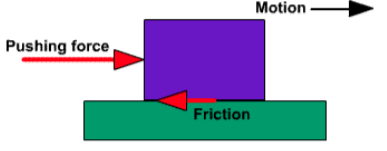
- 17Rolling friction• When an object rolls over a surface rolling friction is produced
• Produced by objects such as wheels and ball bearings
• it tends to be less than that of sliding friction. - 18Fluid Friction• As an object moves through a fluid it produces fluid friction
• All liquids and gases are fluids
• Friction also exists when an object moves across or through a fluid.
• Substance called lubricants (oil, wax, and grease), change sliding friction to fluid friction, thus reducing friction.

fluid friction is less than sliding friction.
Air resistance is an example of fluid friction caused by the particles that make up air. - 19STATIC FRICTION• When a force is applied to an object but does not cause it to move.
• The force of static friction balances the applied force.
• Static friction disappears as soon as an object begins to move - 20 Friction: Is it helpful or harmful?• An example:
• In your car friction can be both helpful and harmful, here is how:
• When you press on the breaks you cause friction between them which HELPS slow down your car
• In this same car there is friction between the moving parts in the engine. This friction causes the parts to wear out over time and therefore they must be replaced.
• Friction between your foot and shoe can make holes in your socks!
• Friction between your shoe and the floor helps you to stand upright. - 21WHY DOES AN APPLE FALL TOWARDS THE GROUND WHEN DROPPED?• Isaac Newton asked this question in 1665.
• The answer to this question gave birth to a law...
THE LAW OF UNIVERSAL GRAVITATION
• All objects in the universe attract each other through gravitational force.
• The size of this force depends on the masses of the objects and the distance between them.
• So...
• Gravitational force increases as mass increases.
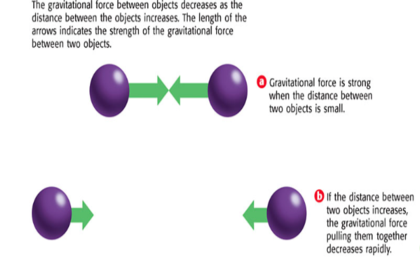
• Gravitational force decreases as distance increases. - 22How Mass Affects Gravitational Force (Photo)
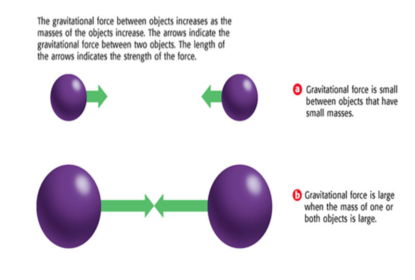
- 23How Distance Affects Gravitational Force (Photo)
- 24GravityOn Earth, all objects experience a "downward" force of gravity.
• The force of gravity on an object is always equal to the weight of the object.
• Gravity is of great importance in the interaction of all objects in the universe;
• it binds us to the Earth,
• holds the Earth and all planets in the solar system, - 25Free Fall (Photo)
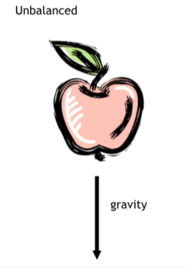
- 26Terminal Velocity (Photo)
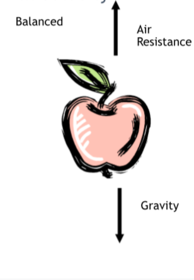
- 27Weight• a measure of the force of gravity on an object
• Metric or SI unit is the Newton (N)
according to the force of gravity pulling on you
•The force of gravity varies according to the distance the object is from the center of the
Earth.
- You weigh less on top of a mountain than you do at sea level.
•Your weight varies - 28GRAVITY IN MOTION• All objects fall to the ground at the same RATE because the acceleration due to gravity is the same for all objects.
• This is because heavier objects experience more gravitational pull but are also harder to accelerate than a lighter object. - 29A FEW MORE THINGS ON ACCELERATION DUE TO GRAVITY• All objects fall to the ground at the same rate; HOWEVER, differences in the size, shape and speed of an object can increase or decrease air resistance.
• As speed increases so does air resistance
• At a certain point the two will equal out and the object will fall at its terminal velocity (a constant rate). - 30Projectile Motion
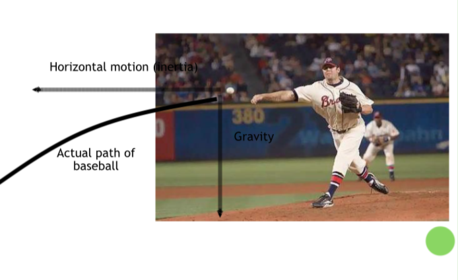
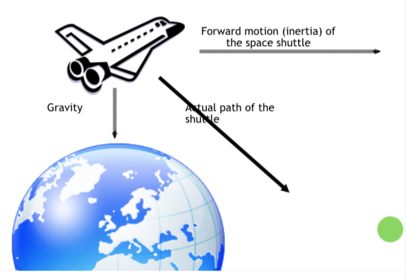
- 31 Orbital Motion