
Karteikarten
First Evaluation Review: MATERIALS APPLICATIONS

Karten in diesem Stapel (59)
- 1Type of ATOMIC BOND present in:Metallic Bond
- 2Covalent BondIt ocurrs when elements share valence electrons between two or more atoms.
Non metal+ Non metal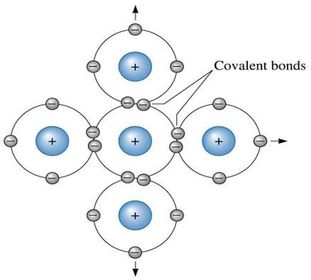
- 3Ionic BondOcurrs when one atom gives its valence electrons to a different atom.
Metal+Non metal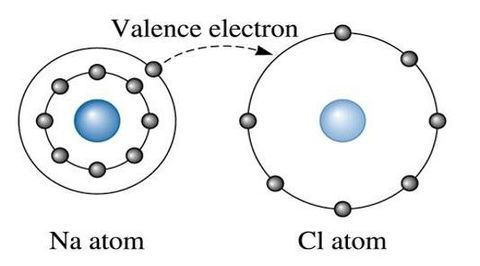
- 4Aluminum, copper, silver, gold are examples of materials with this type CRYSTALLINE STRUCTURE.FCC
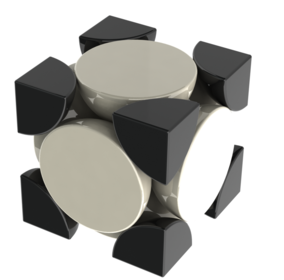
- 5Metals with BCC structureChromium (Cr)
Iron (Fe)
Niobium(Nb)
Potassium (K)
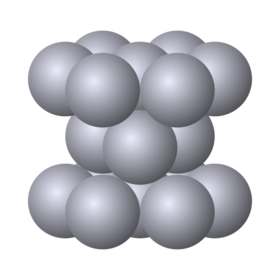
Sodium (Na) - 6Titanium is a metal with this type CRYSTALLINE STRUCTURE.HCP
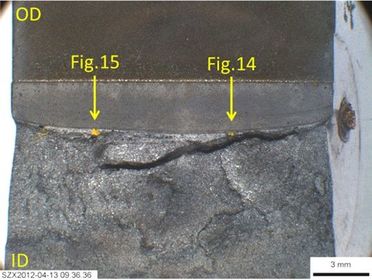
- 7The material fails because of the presence of a flawFracture
- 8FatigueThe material fails due to repetitive stress. Work-cicle related
- 9In this type of failure the material fails because of the temperature and stress.Creep
- 10NucleiFirst solid nanocrystals formed during solidification.
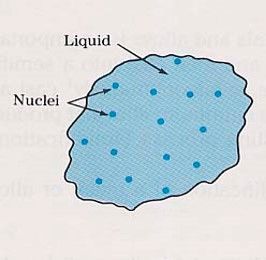
- 11Is a tiny particle of solid that forms from the liquid as atoms cluster together. Is unstable can grow into a stable nucleus or redissolve.Enbryo
- 12The minimum size that must be formed by atoms clustering together in the liquid before the solid particle is stable and begins to grow.Critical radius
- 13UndercoolingThe temperature to which the liquid metal must cool below the equilibrium freezing temperature before nucleation occurs.
- 14To transformate the solid to liquid we need to increase the temperature above its boiling temperature.Superheat
- 15Type of nucleation that occurs in high undercoolingHomogeneous
Nucleation - 16Type of nucleation from a preexisting surfaces, like impurities in the molten metal or in the walls of the mold.Heterogeneous
Nucleation - 17InocutationProcess to intentionally introduce nucleating particles in the liquid
- 18Specific HeatThe heat required to change the temperature of a unit of weight one degree.
- 19Plannar GrowthThe growth of a smooth solid-liquid interface during solidification, when no undercooling of the liquid is present
- 20The treelike structure of the solid that grows when an undercooled liquid solidifiesDentritic Growth
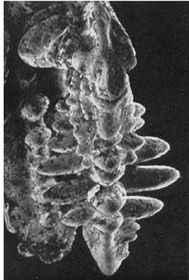
- 21Type of growth mechanism present in not well inoculated liquids.Dentritic Growth
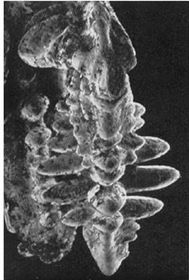
- 22Solidification timeThe rate at which growth of the solid occurs depends on the cooling rate, or the rate of heat extraction.
- 23SDASSecondary dentrite arm spacing
- 24To reduce SDAS:Faster cooling rates
- 25Small SDAS:Increase ductility and tensile strength
- 26Points:A=Pouring temperature
B= Melting/solidification temperature
B-C= Undercooling
C-D= Recalescence
D-E= Thermal arrest
E= solidification complete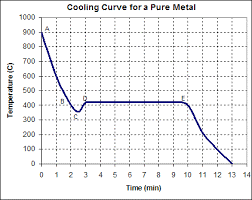
- 27Cooling curve for a well inoculated liquid, or pure metal.NO undercooling
- 28Casting productFinished shape produced by the mold.
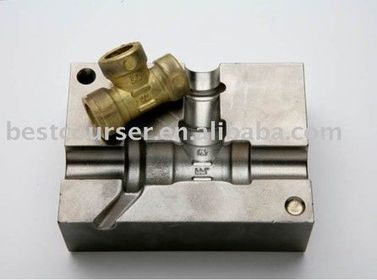
- 29Simple shape produced by a mold, than requires extensive plastic deformation before finished product is created.Ingot
- 30Cast region of randomly oriented grains in the center of a castingEquiaxed zone
- 31During solidification a material contracts, shrinks, as much as:7%
- 32PipeSolidification Defect that occurs when one surface solidifies more slowly than the others, usually is in the surface of the casting.
- 33Extra reservoir of metal, adjacent and conected to the casting to solve solidification defectsRiser
- 34Gas PorosityBubbles of gas trapped within a casting during solidification
- 35Gas produced during aluminum solidificationHydrogen
- 36In this type of welding process the filler metal is brass.Brazing
- 37Solid-Solution StrengtheningStrengthening by the formation of ONE phase
- 38Dispersion StrengtheningStrengthening by the formation of TWO phases
- 39Characteristics of a phase-Same structure or atomic arragement
-Same composition and properties
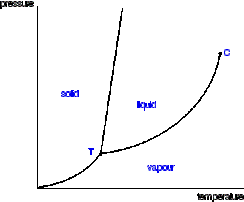
- A definite interface between the phase and any surrounding or adjoining phases. - 40Triple pointA point on the diagram at which the solid, liquid and gaseous phases coexist under equilibrium conditions.
- 411 + C= F + P PartsC= # of components
F= freedom degrees
P= phases present - 42Fredom degrees=2The temperature and composition can change with out changing the phase.
- 43Freedom degrees over a line in any phase diagram1
- 44Part in a phase diagram where the freedom degrees=0Triple point
- 45Unlimited solubilityWhen the amount, of one material that will dissolve in a second material without creating a second phase
- 46When only a maximum amount of a solute material can be dissolved in a solvent material.Limited solubility
- 47Conditions for unlimited solid solubility.Size factor
Crystal structure
Valence
Electronegativity - 48Electrical conductivity and ductility is better in:pure metals
- 49—Unary phase diagram
- 50—Isomorphus phase diagrams
Binary phase diagrams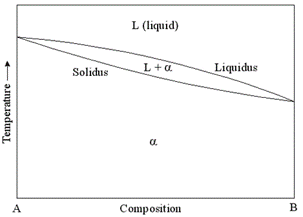
- 51Ternary phase diagramPhase diagram with 3 components (elements or compounds)
- 52Solidus TemperatureThe temperature below which the alloy is 100% solid.
- 53The temperature above which the alloy is 100% liquid.Liquidus Temperature
- 54SegregationThe presence of composition differences in a material, often caused by insufficient time for diffusion during solidification.
- 55Homogenization heat treatmentThe heat treatment used to reduce the microsegregation caused during nonequilibrium solidification
- 56Eutectic reactionSolidification where a liquid freezes to simultaneously form two solid phases.
- 57Eutectoid ReactionOne solid phase reacts to form two different solid phases.
- 58Intermetallic compoundA compound formed of two or more metals that has its own unique composition, crystal structure, and properties.
- 59Peritectic reactionA solid and a liquid combine to produce a second solid on cooling
Informationen
- Beschreibung
- Karteikarten am First Evaluation Review: MATERIALS APPLICATIONS, erstellt von euribelam am 10/02/2016.
- Erstellt von
- euribelam
- Aufrufe
- 59
- Bewertung