
Karteikarten
Thorax & Lungs

Karten in diesem Stapel (69)
- 1What are the bony landmarks of the anterior thorax?- rib cage, sternum, suprasternal notch, clavicle, nipples
- sternal angle (at 2nd intercostal)
- imaginary reference lines - 2What are the bony landmarks of the posterior thorax?- C7
- tip of scapula @ 7th intercostal space
- imaginary reference lines - 3Which ribs are attached to sternum? Which ribs are attached to cartilage of rib above What are the floating ribs?True Ribs = 1-7 attached to sternum
False Ribs = 8-10 attach to cartilage of rib above
Floating ribs = 11 & 12 - 4—1- Clavicle
2- Suprasternal notch
3- Manubrium
4- Sternal angle
5- 2nd intercostal space
6- Xyphoid process
7- Nipple (T4)
8- Costophrenic angle - 5Reference lines of anterior thoraxmid sternal line
mid clavicular line
nipple line (T4) - 6Reference lines of lateral thoraxanterior axillary line
midaxillary line
posterior axillary line - 7Reference lines of posterior thoraxvertebral line
midscapular line - 8—1) anterior axillary line
2) midaxillary line
3) posterior axillary line
- 9—midscapular line
vertebral line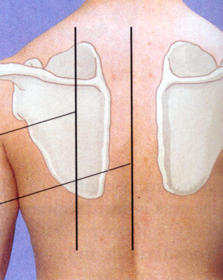
- 10What are the pleurae in the lungs? (serous membranes)Visceral pleura covers the outer surface of each lung
Parietal pleura lines the inner rib cage and thoracic cavity
Pleural space is potential space between visceral and parietal pleurae
- 11Aspects of the Thorax & Lungs Physical Exam- Assess respiratory rate, rhythm, effort and depth of breathing
- Patient position
- Sitting
- Leaning forward
- Supine
- Divide thorax into anterior, lateral, posterior sections for examination - 12Physical Exam: Inspection- Check for Respiratory Difficulty
- Assessment of color
- Observe patient’s posture
- Inspect the nose for nasal flaring
- Inspect the neck for accessory muscle use
- Inspect the ribcage for retractions
- Observe the shape of the chest, A:P diameter
- Anterior & Lateral: 1) Ratio of anterior/posterior to lateral diameter is normally 1:2, 2) Symmetry of respiratory movements
Posterior : 1) Deformity or spinal curvature
2) Symmetry of respiratory movements - 13—1- normal
2- barrel chest (COPD)
3- kyphosis
4) pectus excavatum
5) pectus carinatum
- 14Physical Exam: PalpationAssess for:
- Masses
- Tenderness
- Respiratory Expansion
- Tactile Fremitus - 15Physical Exam: Respiratory Expansion- Indicates equal expansion of lungs during a normal respiratory cycle
- Assesses muscle tone in respiratory muscles
- Assesses compliance of lungs, pleura and chest musculature - 16Tactile Fremitus: What will more solid areas of lung sound like?- More solid areas of lung will transmit more vibrations
- 17What is tactile fremitus? What differences are you looking for?- Palpable vibrations transmitted from the bronchopulmonary tree to the chest wall
- Look for asymmetrical difference in the intensity of the vibratory sensation - 18What does increased fremitus suggest?- Increased fremitus suggests fluid, mass, or pneumonia
- 19What part of hand should you use for tactile fremitus?ball or ulnar aspect of hand
- 20What should you ask pt to say during tactile remits?Ask the patient to say “99” or “1-1-1”
- 21Tactile Fremitus: How many fields should you examine posteriorly and which anteriorly?Examine the Fields:
- Four fields posteriorly
- Three fields anteriorly
- Compare bilaterally - 22What is percussion?Screening the ant/lat/post thorax noting any change in the normal resonant sound
- 23What does percussion help us determine?Helps to determine if structures are air filled, fluid filled, or solid
Compare bilaterally moving side to side - 24Percussion note findings over lung fields: What would resonant sounds indicate?Resonant – healthy lung tissue
- 25Percussion note findings over lung fields: What would flat/dull sounds indicate?Flat/Dull – effusion or consolidation (fluid or solid has replaced air containing lung or occupies pleural space)
- 26Percussion note findings over lung fields: What would hyper resonant lung sounds indicate?Hyperresonant – Emphysema, pneumothorax, asthma
- 27Percussion note findings over lung fields: What would tympanic lung indicate?Tympanic – large pneumothorax
- 28Percussion (Special Test): What does diaphragmatic dullness check for?Diaphragmatic dullness: bilaterally for symmetry
- 29Percussion (Special Test): What does diaphragmatic excursion check for?Diaphragmatic excursion (estimation): noting the distance between the levels of dullness on full expiration and inspiration (normally 5 to 6 cm)
- 30PERCUSSION anterior: (ladder technique)PERCUSSION
posterior:
(ladder technique)

- 31What is the purpose of the ascultation?- Assess air flow thru tracheobronchial tree
- Listening to breathing sounds
- Listening to adventitious (added) sounds - 32What should you then listen to if you hear abnormal breathing sounds?- If you hear abnormal breath sounds, you should then listen to spoken/whispered voice sounds as they are transmitted through the chest wall
- 33What are tracheal breath sounds?Sounds heard directly over trachea & neck
Very loud/high pitched
Expiratory/inspiratory component equal - 34What are bronchial breath sounds?Heard directly over a major bronchus
Loud/high pitched
Short silence between insp & exp with exp lasting longer - 35Where are Bronchovesicular breath sounds best heard?Best heard in 1st and 2nd ICS anteriorly and between scapula posteriorly
Medium pitch
Equal insp/exp - 36Where are vesicular breath sounds best heard?best Heard over lung fields
Soft low pitch
Inspiration last longer than expiration - 37What are types of adventitious sounds?- Rales
- wheezes/rhonchi
- stridor
- pleural friction rub
- mediastinal crunch - 38Adventitious Sounds: What are rales?Intermittent, nonmusical dots in time
Can be fine or coarse, dry or wet
Crackling noises caused by deflated, fluid filled small airways popping open with air
Can be heard with pneumonia, fibrosis, bronchitis - 39Adventitious Sounds: What do wheezes/rhonchi sound like? What do wheezes indicate? What do rhonchi indicate?- Musical continuous sounds
- Wheezes indicate narrowed bronchi (high-pitched)
- Rhonchi indicate secretions (low pitched, snot-like) - 40Adventitious Sounds: What does stridor sound like? What does it indicate?high pitched wheeze during inspiration that is louder at the neck; indicates upper airway obstruction
Note: if you listen to someones trachea it will sound louder than other areas, DANGEROUS! Impending respiratory failure, might be foreign body in trachea - 41Adventitious Sounds: What does Pleural Friction Rub sound like?“floor creaking noise” in one area;
2 pleural surfaces rubbing against each other (rubbing fingers against ear) - 42Adventitious Sounds: What does Mediastinal Crunch (Hamman’s sign) sound like?- precordial crackles caused by air between pleurae
- BAD usually from trauma - 43What are the 3 special tests for auscultation?1- bronchophony
2- egophony
3- whispered pectoriloquy - 44How do you test for Bronchophony? During bronchophony: What does a normal lung sound like? What does a bronchophony sound like?Ask patient to say “99” and listen with stethoscope
Normal: MUFFLED
Bronchophony: LOUD & CLEAR (indicated air-filled lung has become AIRLESS - 45How do you test for egophony? What is indicated if you hear EE instead of AY?Ask patient to say “EE” while listening with stethoscope
If you hear EE instead of AY & quality is nasal, indicates pneumonia or other consolidation - 46How do you test for Whispered Pectoriloquy? What does a normal whisper sound like and what does consolidation sound like?Ask patient to whisper “99” while listening with stethoscope
Normal: Barely audible
Consolidation: LOUD & CLEAR - 47What is respiratory excursion?purcussing diaphragm and estimating distance that diaphragm expands (assymetry)
- 48What is peak flow?- used to access obstruction
- pt. breathes as hard & fast as they can into meter, dial shows if pt has increased respiratory flow (i.e. seen in asthma) and then give them breathing treatment to see if peak flow number improves - 49Chronic Obstructive Pulmonary Disease (COPD)chronic bronchitis & emphysema
- 50What is chronic bronchitis? What is emphysema?Chronic bronchitis – excessive mucus production in bronchi
Emphysema – over distention of alveoli, with alveolar destruction - 51What are the Common Pulmonary Diseases? (4)- COPD
- asthma
- pneumothorax
- pneumonia - 52What are the physical findings during general inspection for COPD?clubbing, cyanosis, accessory muscle use
- 53What are the physical findings during thoracic inspection for COPD?barrel chested habitus, increased AP diameter
- 54What are the physical findings during percussion for COPD?hyperresonant
- 55What are the physical findings during auscultation for COPD? What are the physical findings during adventitious sounds?Auscultation: decreased breath sounds
Adventitious sounds – none; or crackles, wheezes and rhonchi - 56What is asthma?Hyper-reactivity of bronchial tree resulting in inflammation, hypersecretions and bronchoconstriction
No structural or permanent damage - 57Asthma can be asymptomatic with exacerbations or:Mild intermittent
Mild persistent
Moderate persistent
Severe persistent - 58What are some physical findings during an asthma attack? Are there any physical findings during a normal exam?Accessory muscles used to breathe
Resonant percussion note
Wheezes
Decreased peak flow
- not during attack: normal exam - 59What is a pneumothorax?Air leakage into the pleural space cause pressure gradient between space and lung

- 60What is a spontaneous pneumothorax?spontaneous rupture of bleb (bulla)
- 61What is a traumatic pneumothorax?due to penetrating injury to lung from knife, bullet, or rib fragments
- 62What are the physical findings during a pneumothorax?Chest rise is asymmetrical
Hyperresonant percussion note over affected lung
decreased or absent:
Tactile fremitus
Breath sounds (over infected lung) - 63What is Pneumonia?- Inflammation of lung tissue caused by bacterial, viral or mechanical causes
- Alveoli fill with fluid or pus
- pneumonia can be lobar or diffuse - 64What are the physical findings during inspection for pneumonia?- Inspection: normal unless respiratory distress
- 65What are the physical findings during percussion for pneumonia?- Percussion: dull percussion note
- 66What are the physical findings during auscultation for pneumonia?- Auscultation: bronchial breath sounds, inspiratory rales
- 67What are the physical findings during transmitted sounds for pneumonia?Increased Transmitted sounds (bronchony, egophony and whispered pectoriloquy)
Increased tactile fremitus - 68What are these muscles used during?neck accessory muscles used during respiratory difficulty

- 69—
Informationen
- Beschreibung
- Karteikarten am Thorax & Lungs, erstellt von Christina Phan am 15/10/2016.
- Erstellt von
- Christina Phan
- Aufrufe
- 27
- Bewertung