
Karteikarten
1_Vocabulary
Karten in diesem Stapel (23)
- 1Sentence- basic unit of language that we will consider in our study of English grammar
- because it is at this level that grammar primarily operates - 2Words- make up a sentence
- must be in a certain order for understanding to take place
- if not, will sound wrong, & be asked for repetition or clarification - 3Morphemes- elements that make up words
- 'morph': shape, form
- e.g. prefixes, suffixes
- 2 types: free & bound morphemes - 4Prefix- comes at the front of a word
- changes the meanings of words
- e.g. to the opposite (INsincere)
* hence MORPHeme - 5Suffix- comes at the end of a word
- changes the functions of words
- e.g. to the abstract notion (friendSHIP)
* hence MORPHeme - 6Free morphemes- morphemes that can stand freely by themselves as independent words
e.g. tiger, gorgeous, but, in
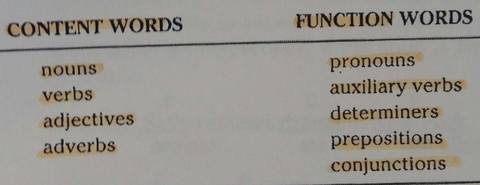
- has 2 groups: lexical morphemes / content words VS grammatical morphemes / function words - 7Content words- a.k.a. lexical morphemes
- allow us to create an image of some kind in our minds
e.g. beautiful, build, fast, thought - 8Function words- a.k.a. grammatical morphemes
- show relationships amongst content words
- by themselves do not have the power to create an image in our minds; dependent on content words to give them a meaning
- e.g. but, in, are, these, she - 9Bound morphemes- elements of words that cannot stand freely & independently
- bound / connected to free morphemes
- have no meaning till attached to free morphemes
- e.g. prefixes & suffixes
- e.g. REstate, quietNESS, pencilS, helpED
- 2 groups: derivational VS inflectional morphemes - 10Derivational morphemes- allow us to make new words in the language
- and / or to change one grammatical category to another
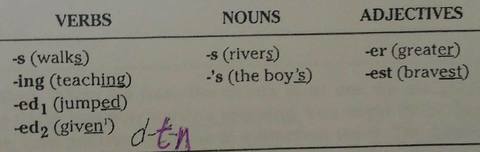
e.g. restate is a new word built from state; quietness (n) is derived from quiet (adj) - 11Inflectional morpheme- show grammatical function of a word
- e.g. how many (pencilS),
time that sth. happens (talkING, helpED),
comparisons to other adj. (smallER)
- always suffixes
- 8 in English - 12Word classes- a.k.a. parts of speech
- 13Nouns- traditional description: a person, place or thing
- easier to identify by bound morphemes, specifically inflectional morphemes
- e.g. -s (singular or plural); -'s (possessive?)
- MOST reliable way to identify: its position in a sentence
(*especially when N has the same form as V)
- e.g. 'PAINT is expensive' VS 'Artists PAINT pictures'
- 2 groups: proper VS common nouns
- 2 other groups: concrete VS abstract nouns
- 2 more groups: count VS noncount nouns - 14Proper nouns- formal names / titles of ppl., countries, days, months, languages, businesses
- in English, almost always begins with a capital letter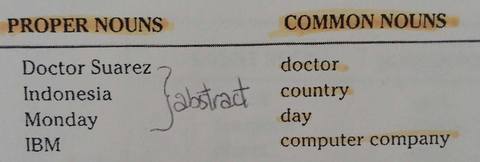
- 15Common nouns- all other nouns that are not proper nouns
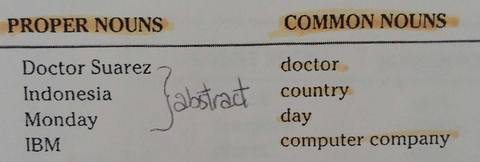
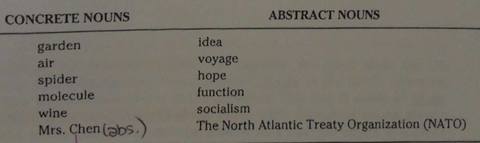
- 16Concrete nouns- describe things we can touch or sense in some way
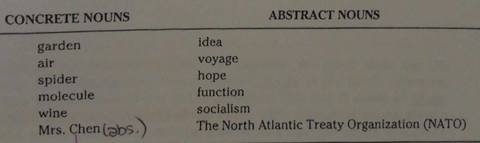
- 17Abstract nouns- have no substance, and can only be imagined or thought about
- 18Count nouns- the forms of a noun that may be counted
- has a plural form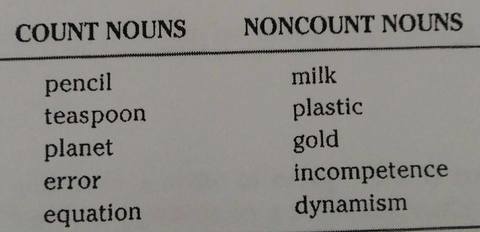
- 19Noncount nouns- forms of a noun that cannot be counted
- only have singular forms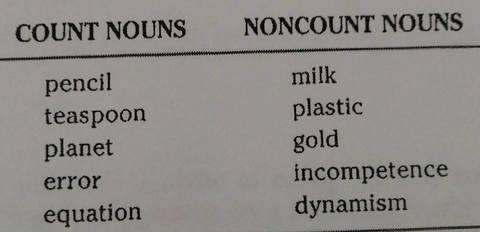
- 20Specific count nouns VS General noncount nouns* most nouns have both count & noncount forms: count n always indicate a more specific form of the noun; whilst noncount nouns a more general form
* sometimes they have completely different meanings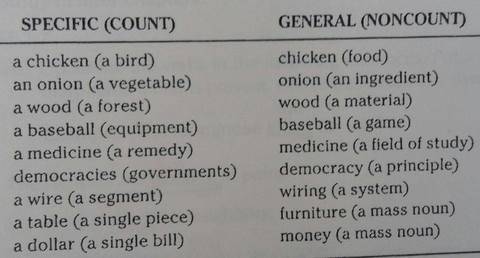
- 21Adjectives- modify the nouns that they occur with (tell the qualities of a noun, e.g. size, shape, condition, age, colour, origin)
- 2 types: attributive VS predicate adjectives
* cannot usu. be identified by their inflectional morphemes (-er & -est are specialised forms that are ONLY applied during comparisons -> so not always present)
* may have derivational morphemes (e.g. -ful, -ive, -ed, -ing, -like, -ly) - 22Attributive adjectives- come directly before the noun
- 23Predicate adjectives- disconnected from the noun they modify, typically coming after a verb like 'be'
- e.g. 'That woman is BEAUTIFUL'
Informationen
- Beschreibung
- TESOL Ed. Karteikarten am 1_Vocabulary, erstellt von Chelsi Kanani Montemayor am 15/01/2017.
- Erstellt von
- Chelsi Kanani Montemayor
- Aufrufe
- 0
- Verlauf
-
- Erstellt von Penelope Stewart · 14 Jan 2017
- Kopiert von Chelsi Kanani Montemayor · 15 Jan 2017
- Bewertung