
Karteikarten
GI pathology
Karten in diesem Stapel (24)
- 1What is gluten intolerace enteropathy?Coeliacs disease
Intolerance to giardin, a prolamin (protein found in gluten). - 2Name two clinical tests that you could do to see if someone has Coeliac's disease, and what you would find if they did1. Blood test (specifically serology): to test for anti-DPG and anti-transglutaminase anibodies
2. Duodenal biopsy: flattened villi, lots of lymphocytes in the tissue, hyperplasia of the crypts of Lieberkuhn
3. GLUTEN CHALLENGE --> the patient will have to be eating gluten for around 6 weeks prior to this test - 3How could someone with coeliac's disease obtain a negative serology result?They may be deficient in IgA --> would need to test for IgG antibodies specific to coeliac diease, e.g. anti-deaminated glianin peptides.
- 4(HARD) In a healthy individual, how is gluten dealt with in the body?Broken down into various proteins through the digestive system, one being gliadin.
This cannot be broken down in the stomach - travels into the duodenum.
Here, it then binds to IgA - this then causes the immune system to destroy it. - 5Describe the pathophysiology behind coeliac diseaseOver-expression of transferrin (receptor) on enterocytes, allowing gliadin to pass into the intestinal walls.
Here, it is then deaminated by tTG into smaller peptides.
Individuals with coeliac - HLA-DQ2/8 (these are found in some healthy individuals too), that cause macrophages to express gliadin fragments on MHC class 2 receptors - CD4+ (T helper) bind to this and release inflammatory cytokines - enterocyte damage. Also cause B cells to release antibodies against the gliadin and associated enzymes. Killer T cells cause direct damage to the enterocyte --> inflammatiion and damage in the gut. - 6List four clinical symptom of coeliac diseaseBloating
Weight loss
Maladsorption associated (e.g. iron deficieny anemia, macrolytic anemia, fatigue, weight loss)
Indigestion
Constipation
Diarrhoea
Nausea
Flatulence (gas) - 7What is the name of the gene that causes macrophages to express gliadin fragments on their MHC2 receptors?HLA-DQ2 or HLA-DQ8
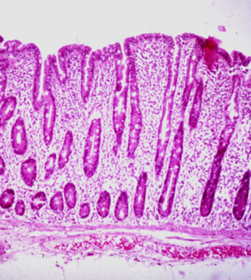
- 8A woman presents with a six month history of diarrhoea and bloating. From this picture, what is the most likely diagnosis, and why?Coeliacs diseaese
Flattened villi, hyperplasia of the crypts, numerous LYMPHOCYTES can be seen (purple dots). - 9A 20 year old girl presents in the clinic with diarrhoea at nightNocturnal diarrhoea should push you towards IBD (rather than IBS)
- 10Name three differences between ulcerative colitis and Chron's1. Ulcerative colitis only affects the large bowel
2. UC is continuos, Chron's is all patchy and discontinuos
3. UC only affects the top layer of the bowel (mucosa), Chron's comes through all the layers of the bowel - 11Name four red flag symptoms of colo-rectal cancer1. Blood in stools
2. Weight loss
3. Altered bowel habits >55 years
4. Abdominal mass
5. Family history of bowel cancer - 12How can you treat IBD?Can't cure IBD, but you can manage the symptoms, improving the QOL for the individual (although flare-ups are still likely to occur with treatment - random).
Some people have a flare up due to certain dietary foods --> avoid these foods and eat a healthy, balanced diet.
Certain medications can improve the symptoms, the first line being anti-inflammatory's (5-ASA's and corticosteroids). Immuno-suppressants may be offered if these do not work, along with biological agents (monoclonal antibodies).
If these drugs do not work, then surgery is an option. - 13Chloe, a 25 year old postgraduate, comes into your clinic complaining of bloating, abdominal pain and diarrhoea. Name three investigations that you could do to determine the cause of her problems.1. Blood test
2. Stool test
3. CT scan - 14A 23 year old male comes into the clinic with a rash across his chest ..... (not finished)Rash = dermetitis epiformis
(coeliac disease) - 15What is Barret's oesophagus?Oesophageal epithelium changes into stomach epithelium
- 16What is the most common cause of Barret's oesophagus?GORD (gastro-oesophageal reflux disease)
- 17What is gluten sensitive enteropathy?Coeliac disease (just another name for it)
- 18Is Helicobacter pylori a gram positive or negative bacterium?Gram negative
- 19What is a volvulus?sdcks;dcks;dkcsdc
- 20What is the most important investigation that you would do if you suspect colorectal (bowel) cancer?COLONSCOPY
(second to this would be the CT scan) - 21Name three reasons why familial colorectal cancer (also known as bowel cancer) screening would be offered to an individual1. 1' relative with/has had colorectal cancer <45 years old
2. 2+ 1' relatives of any age
3. If they have FAP or HNPCC - hereditary conditions that increase the risk of developing colorectal cancer - 22What is the most common type of colorectal cancer?Adenocarcinoma (cancer of the glandular cells)
- 23Give four symptoms of Chron's disease1. Crampy abdominal pain
2. Fatigue
3. Diarrhoea, sometimes fat seen it it (steatorroea, light coloured stools that float)
4. General feeling of being unwell
5. Mouth ulcers - 24In which part of the bowel is cancer most likely to occur?
Informationen
- Beschreibung
- Flashcards about GI conditions (tested on in Phase 2A, Medicine, Sheffield).
- Erstellt von
- Molly Brewster
- Aufrufe
- 57
- Tags
- Bewertung