
Karteikarten
1. General Probability
Karten in diesem Stapel (31)
- 1ElementIs a possible outcome of an experiment
- 2EventIs a collection of one or more outcomes
- 3SetIs a collection of zero or more elements
- 4Sample SpaceIs the collection of all possible outcomes
- 5Empty SpaceIs a set containing zero element
- 6SubsetIFF all elements in set D are also in set E
- 7UnionIs the set of all elements that are contained in at least one of the sets
- 8IntersectionIs the set of elements that are common for each set
- 9DifferenceIs the the set containing all elements that are in set F but not in set G
- 10Mutually ExclusiveIs when two events do not occur at the same time
- 11DisjointSame as mutually exclusive (when two events do not occur at the same time)
- 12ComplementIs the set containing all of the elements in the sample space except the elements that are in T
- 13Pr(anything)Probabilities of anything are only defined between 0 and 1, inclusive
- 14Pr(empty set)Probability of the empty set is always 0
- 15Pr(sample space)Probability of the sample space is always 1
- 16If A1, A2,... are disjoint events then the Pr(Union) isEqual to the sum of the disjoint events
- 17A c B, thenThe Pr(A) =< Pr(B)
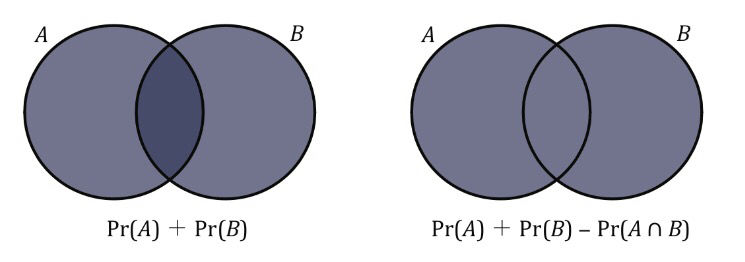
Note: for A to be a subset of B, A has to contain an equal or fewer number of elements than B - 18The Additive Law of ProbabilityPr(A U B) = Pr(A) + Pr(B) - Pr(A & B)
If A and B are mutually exclusive, then Pr(A & B) = 0. Thus, Pr(A U B)= Pr(A) + Pr(B) - 19The union of the disjoint events must equal the sample spacePr(A U A') = Pr(S) = 1
So, the Pr(A') = 1 - Pr(A)
Note: Pr(A') is A complement. - 20The Law of Total ProbabilityConsider n events, A1, A2,..., An which are disjoint. Pr(A1) + Pr(A2) + ... + Pr(An) = 1. Then A1, A2,..., An is a partition of the sample space, S.
Suppose event B exists in S. Then, the Pr(B) = Pr(B & A1) + Pr(B & A2) +...+ Pr(B & An).
Because B overlays the sets in the partition, Pr(B) equals the sum of the probabilities of the intersections of B and A1, A2,..., An.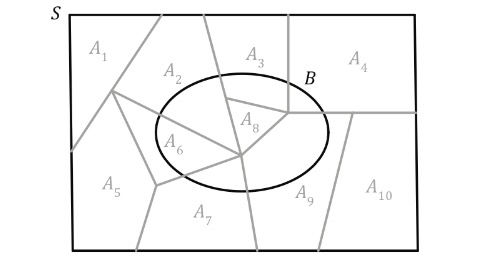
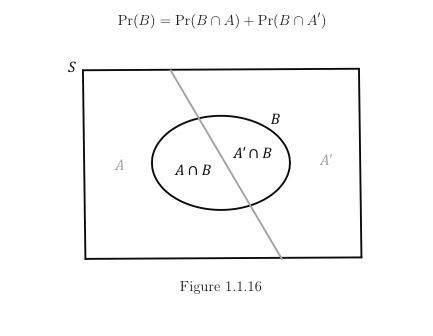
- 21SPECIAL CASE Law of Total ProbabilityWhen S has only two partitions
- 22De Morgan's Laws1. The complement of the union of n events is the intersection of the complements of the events
2. The complement of the intersection of n events is the union of the complements of the events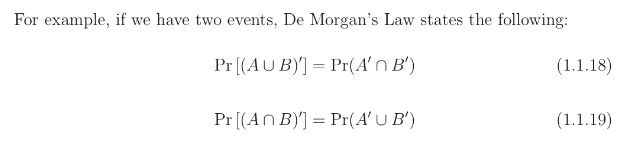
- 23Conditional ProbabilityIs the probability that an event occurs based on a condition, or given that another event has occurred.
Notation: the probability that event A occurs given that event B has occurred is Pr(A|B) - 24Conditional Probability FormulaPr(A & B)/ Pr(A|B) = Pr (B)
for Pr(B) not equal to 0
Similarly, the formula for A' given B is,
Pr(A' & B)/
Pr(A'|B) = Pr(B)
for Pr(B) not equal to 0
From the Law of a Total Probability, Pr(A|B) + Pr(A'|B) = 1 - 25Conditional Probability Independence FormulasPr(A&B) = Pr(A|B) • Pr(B)
Formula conditioned on event A:
Pr(B&A) = Pr(B|A) • Pr(A) - 26The Multiplicative Law of ProbabilitySince Pr(A&B) = Pr(B&A)
Pr(A|B) • Pr(B) = Pr(B|A) • Pr(A) - 27Bayes' TheoremPr(Ai|B) = [Pr(B|Ai) • Pr(Ai)] / [SUM of Pr(B|Ai) • Pr(Ai)]
- 28FactorialNumber of permutations of a set of n instinct elements
Formula: n!
ORDER MATTERS - 29PermutationsNumber of ways to arrange k out of n elements
n! /
Formula: nPk = (n-k)!
ORDER MATTERS - 30CombinationNumber of ways to draw k elements out of n distinct elements
n! /
Formula: nCk = (n-k)!•k!
ORDER DOES NOT MATTER - 31PartitionNumber of ways to divide n distinct elements into r groups
ORDER DOES NOT MATTER (more general than combination)
-------------------------
Number of permutations of n non-distinct elements
ORDER MATTERS (more general than factorial
-------------------------
Formula:
n! /
k1•k2!•...•kr!
Informationen
- Beschreibung
- Actuary (Exam P) Flashcards on General Probability, created by hinal vaghela on 07/09/2017.
- Erstellt von
- hinal vaghela
- Aufrufe
- 24
- Bewertung