
Karteikarten
Fusion-Welding Processes
Karten in diesem Stapel (30)
- 1Why is shielded metal-arc welding a commonly used process?Welding Shielded metal-arc welding (SMAW) is one of the oldest, simplest, and most versatile joining processes
- 2fungsi elektroda pada SMAWsbg filler dan ujung busur listrik
- 3the functions of electrodes1. deliver required power to circuit for welding
2. electrode melts and provide the filler material for welding
3. - 4the functions of electrodes coatingused as a flux and provide shielding gas
- 5the functions of shielding gasused to protect the molten-weld pool and the weld area against oxidation
- 6What properties are useful for a shielding gas?Inert, so the shielding gas will not react with metal
- 7What are the advantages to thermit welding1. No external power source is required (heat of chemical reaction is utilized)
2. Very large heavy section parts may be joined - 8What electron-beam and are the advantages of laserbeam welding compared with arc welding?1. Electron-beam and laser beam are used for very accurate cutting a wide variety of metals and the surface finish is better than that of other arc welding
2. Narrow weld they can lay down.
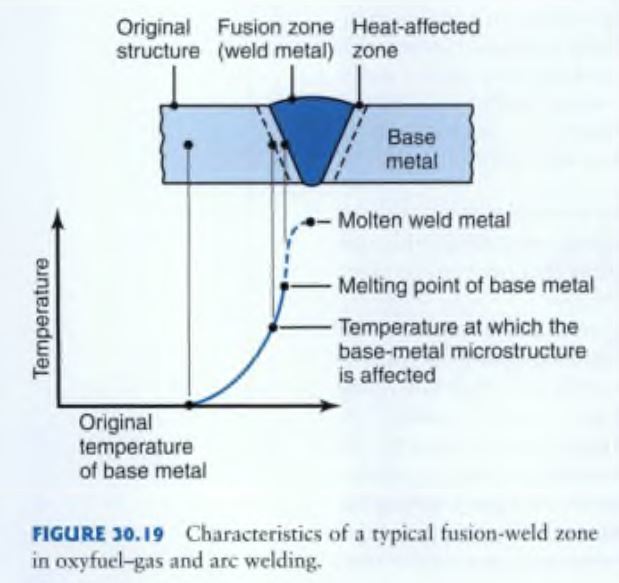
3. Localizing the heat zone minimizes the total heat that gets dissipated. Many failures occur in the HAZ(heat affected zone). By localizing the heat input and weld metal deposited, the HAZ narrow considerably compared to joint width. Making the likelihood of residual stresses and microstucture change less - 9Weld failures always occur in the fusion zone of the weld joint, since this is the part of the joint that has been melted: (a) true, (b) false?(b). Failures also occur in the heat-affected zone because metallurgical damage often
occurs in this region - 10Perbedaan electrogas welding dan electroslag weldingElectroslag : Resistance heating is used for melting the filler metal
Electrogas : Continous arc is used to melt the filler metal and workpiece
Electrogas : The arc and the weld puddle is shielded by a gas such CO2
Electroslag : shielded by slag - 11Metals that are easiest to weld in resistance welding are ones that have low resistivities since low resistivity assists in the flow of electrical current: (a) true, or (b) false?Metals with low resistivities, such as aluminum and copper, are difficult to
weld in RW. Higher resistance is required in the conversion of electrical power to heat energy; hence, metals with high resistivity are generally preferable. - 12The Highest labor skill requiredOxyfuel and shield metal arc
- 13DC currentGMAW and FCAW
- 14The most expensive costElectro beam and Lase beam
- 15The cheapest cost and lowest qualityoxfuel
- 16If the materials to be welded are preheated, is the likelihood for porosity increased or decreasedGenerally porosity will decrease with preheating. Weld pieces will cool slower allowing trapped gases to have time to do stuff.
Cracks and bridging created when the weld is cooled to quickly will be dissipated by preheating the metal.
It is still possible to end up with porosity in the weld if the molten pool is given too much time to cool. - 17What is weld spatter? How can spatter be controlled? Explain.A very common occurrence in gas metal arc welding (GMAW) is the creation of what welders call "spatter," which is essentially droplets of molten material that are generated at or near the welding arc. In SAW, the thick layer of flux prevents spatter
- 18Jelaskan apa itu oxyfuel-gas WeldingOxyfuel-gas welding (OFW) is a general term to describe any welding process that uses a fuel gas combined with oxygen to produce a flame, which is the source of the heat required to melt the metals at the joint
- 193 tipe flamesneutral, oxidizing and carburizing(reducing) flames
- 20Fungsi flux pada Oxyfuel Weldingmemperlambat terjadinya oksidasi serta melarutkan dan menghilangkan oksidasi dengan perisai gas
- 21Fungsi slag pada oxyfuel weldingMerupakan gabungan dari oxides, flux, electrode-coating material. The slag developed protects the molten puddle of
metal against oxidation as it cools. - 22Oxyfuel dapat digunakan pada banyak jenis besi dan non besi (T/F)T
- 23flames yang tidak menyebabkan perubahan kimia pada metalneutral flames
- 24flames yang menyebabkan perubahan kimia pada baja dan besicarburizing flames
- 25flames yang tidak boleh diaplikasikan pada jenis logam yang dapat menyerap karboncarburizing flames
- 26flames yang paling panasoxidizing flames
- 27Jelaskan apa itu oxyfuel weldingthis processutilizes the heat generated by the combustion of acetylene gas (C2H2) in a mixture with oxygen.
- 28jenis jenis flames dipisahkan berdasarkanratio acetlyne dengan oksigen
- 29oxidizing flames cocok dan tidak cocok kepada jenis logamThis flame is harmful, especially
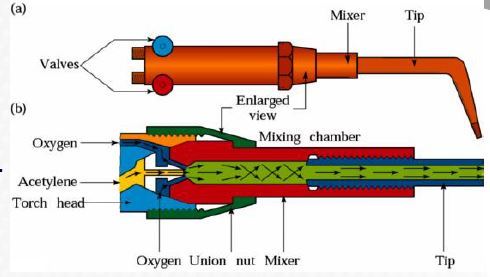
for steels, because it oxidizes the steel. Only in copper and copper-base alloys is an oxidizing flame desirable because a thin protective layer of slag forms over the molten metal. - 30prosedur pada oxyfuel welding serta nama-nama komponennyaPertama kali katup acetylene dibuka; gasdinyalakan dengan korek api atau penyala;kemudian katup oksigen dibuka dan nyala diatur.
Informationen
- Beschreibung
- Flashcards on Fusion-welding Processes, created by Kalolo 34 on 16/08/2017.
- Erstellt von
- Kalolo 34
- Aufrufe
- 245
- Bewertung