
Flussdiagramm
CONCEPTUAL FRAMEWORK
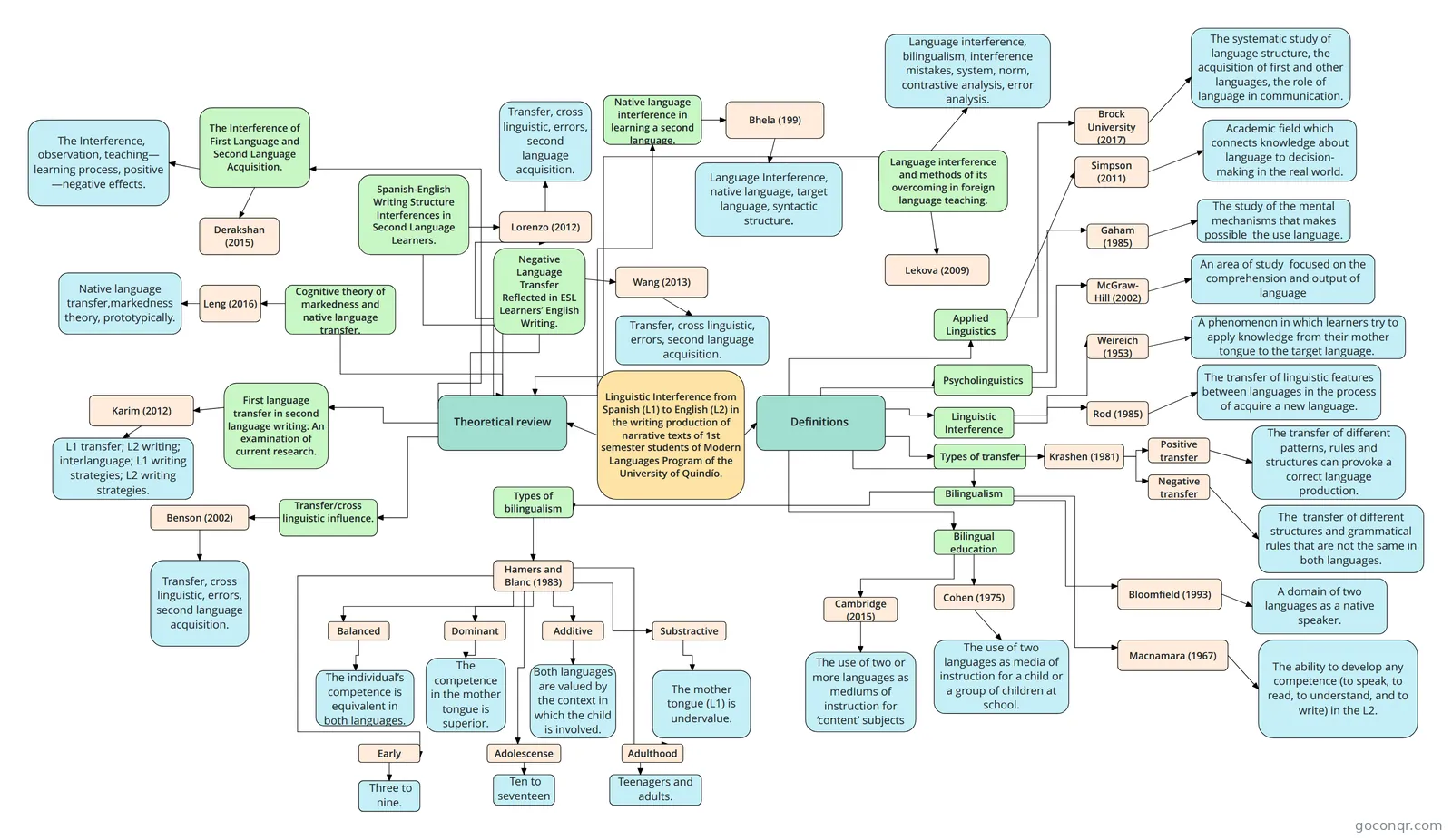
Flowchart: Linguistic interference from Spanish to English
Inhalt des Flussdiagramms
Linguistic Interference from Spanish (L1) to English (L2) in the writing production of narrative texts of 1st semester students of Modern Languages Program of the University of Quindío.
Definitions
Theoretical review
Applied Linguistics
Psycholinguistics
Bilingual education
Bilingualism
Types of transfer
Linguistic Interference
Simpson (2011)
Brock University (2017)
Academic field which connects knowledge about language to decision- making in the real world.
The systematic study of language structure, the acquisition of first and other languages, the role of language in communication.
Gaham (1985)
McGraw-Hill (2002)
The study of the mental mechanisms that makes possible the use language.
An area of study focused on the comprehension and output of language
Weireich (1953)
Rod (1985)
A phenomenon in which learners try to apply knowledge from their mother tongue to the target language.
The transfer of linguistic features between languages in the process of acquire a new language.
Positive transfer
Negative transfer
Krashen (1981)
The transfer of different patterns, rules and structures can provoke a correct language production.
The transfer of different structures and grammatical rules that are not the same in both languages.
Cohen (1975)
The use of two languages as media of instruction for a child or a group of children at school.
Bloomfield (1993)
Macnamara (1967)
A domain of two languages as a native speaker.
The ability to develop any competence (to speak, to read, to understand, and to write) in the L2.
Types of bilingualism
Cambridge (2015)
The use of two or more languages as mediums of instruction for ‘content’ subjects
Hamers and Blanc (1983)
Balanced
Dominant
Adulthood
Early
Adolescense
Substractive
Additive
The individual’s competence is equivalent in both languages.
The competence in the mother tongue is superior.
Both languages are valued by the context in which the child is involved.
The mother tongue (L1) is undervalue.
Three to nine.
Ten to seventeen.
Teenagers and adults.
Cognitive theory of markedness and native language transfer.
Leng (2016)
Native language transfer,markedness theory, prototypically.
First language transfer in second language writing: An examination of current research.
Karim (2012)
L1 transfer; L2 writing; interlanguage; L1 writing strategies; L2 writing strategies.
Transfer/cross linguistic influence.
Benson (2002)
Transfer, cross linguistic, errors, second language acquisition.
Negative Language Transfer Reflected in ESL Learners’ English Writing.
Wang (2013)
Transfer, cross linguistic, errors, second language acquisition.
Spanish-English Writing Structure Interferences in Second Language Learners.
Lorenzo (2012)
Transfer, cross linguistic, errors, second language acquisition.
The Interference of First Language and Second Language Acquisition.
Derakshan (2015)
The Interference, observation, teaching—learning process, positive—negative effects.
Native language interference in learning a second language.
Bhela (199)
Language Interference, native language, target language, syntactic structure.
Language interference and methods of its overcoming in foreign language teaching.
Lekova (2009)
Language interference, bilingualism, interference mistakes, system, norm, contrastive analysis, error analysis.
Informationen
- Beschreibung
- Flussdiagramm am CONCEPTUAL FRAMEWORK, erstellt von Katherine ROMERO BERMUDEZ am 22/02/2018.
- Erstellt von
- Katherine ROMERO BERMUDEZ
- Aufrufe
- 4
- Bewertung