
Flussdiagramm
Innate Immunity
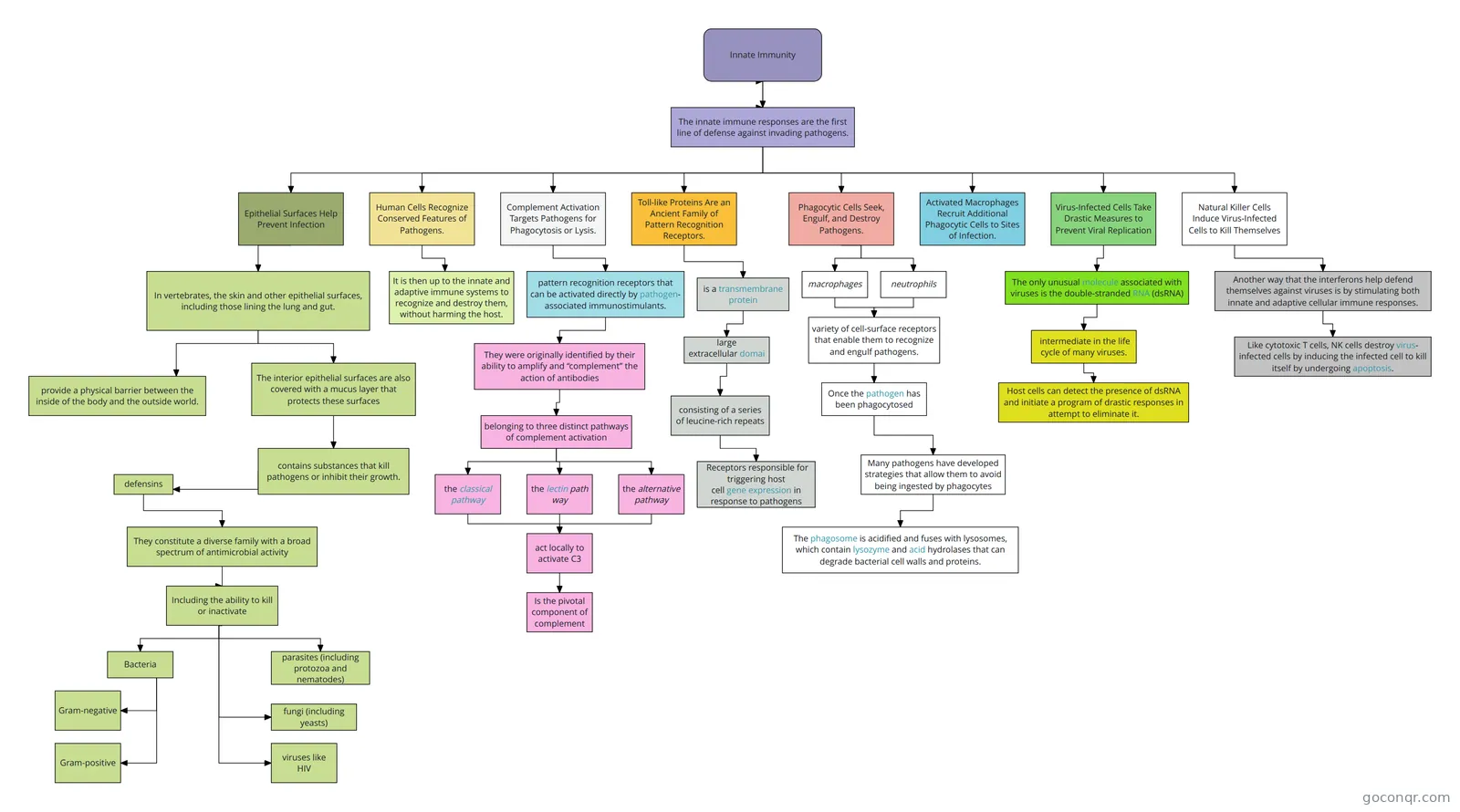
Flowchart: Innate Immunity
Inhalt des Flussdiagramms
Innate Immunity
The innate immune responses are the first line of defense against invading pathogens.
Epithelial Surfaces Help Prevent Infection
Human Cells Recognize Conserved Features of Pathogens.
Complement Activation Targets Pathogens for Phagocytosis or Lysis.
Toll-like Proteins Are an Ancient Family of Pattern Recognition Receptors.
Phagocytic Cells Seek, Engulf, and Destroy Pathogens.
Activated Macrophages Recruit Additional Phagocytic Cells to Sites of Infection.
Virus-Infected Cells Take Drastic Measures to Prevent Viral Replication
Natural Killer Cells Induce Virus-Infected Cells to Kill Themselves
In vertebrates, the skin and other epithelial surfaces, including those lining the lung and gut.
provide a physical barrier between the inside of the body and the outside world.
The interior epithelial surfaces are also covered with a mucus layer that protects these surfaces
contains substances that kill pathogens or inhibit their growth.
defensins
They constitute a diverse family with a broad spectrum of antimicrobial activity
Including the ability to kill or inactivate
Bacteria
Gram-negative
Gram-positive
parasites (including protozoa and nematodes)
fungi (including yeasts)
viruses like HIV
It is then up to the innate and adaptive immune systems to recognize and destroy them, without harming the host.
pattern recognition receptors that can be activated directly by pathogen-associated immunostimulants.
They were originally identified by their ability to amplify and “complement” the action of antibodies
belonging to three distinct pathways of complement activation
the classical pathway
the lectin pathway
the alternative pathway
act locally to activate C3
Is the pivotal component of complement
is a transmembrane protein
large extracellular domain
consisting of a series of leucine-rich repeats
Receptors responsible for triggering host cell gene expression in response to pathogens
macrophages
neutrophils
variety of cell-surface receptors that enable them to recognize and engulf pathogens.
Once the pathogen has been phagocytosed
The phagosome is acidified and fuses with lysosomes, which contain lysozyme and acid hydrolases that can degrade bacterial cell walls and proteins.
Many pathogens have developed strategies that allow them to avoid being ingested by phagocytes
The only unusual molecule associated with viruses is the double-stranded RNA (dsRNA)
intermediate in the life cycle of many viruses.
Host cells can detect the presence of dsRNA and initiate a program of drastic responses in attempt to eliminate it.
Another way that the interferons help defend themselves against viruses is by stimulating both innate and adaptive cellular immune responses.
Like cytotoxic T cells, NK cells destroy virus-infected cells by inducing the infected cell to kill itself by undergoing apoptosis.