
Flussdiagramm
Ohne Titel
Inhalt des Flussdiagramms
ways to create the future
present simple
¿como se usa?
To express habits and routines, general facts, repeated actions or permanent situations, emotions and desires:
I smoke (habit); I work in London (permanence); London is a large city (general fact)
To give instructions or directions:
You walk for two hundred meters, then you turn left.
To talk about scheduled, present or future events:
Your exam starts at 09.00.
To refer to the future, behind some conjunctions: after, when, before, as soon as, until:
He'll give it to you when you come next Saturday.
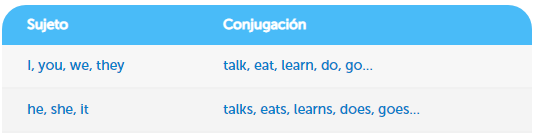
To conjugate the present simple we use the infinitive for the subjects "I", "you", "we" and "they" and for the third persons "he", "she" and "it", we add a "-s" to the end of the verb.
grammar
https://www.curso-ingles.com/practicar/ejercicios/present-simple
- I work as a secretary
- You call her every day
- He finishes his job
examples
present continuous
¿como se usa?
to describe an action that is taking place right now: You are using the Internet. You are studying English grammar.
to describe a trend or action that is currently happening: Are you still working for the same company? More and more people are becoming vegetarian.
to describe a future action or event that is already scheduled: We're going on holiday tomorrow. I'm meeting my boyfriend tonight. Are they visiting you next winter?
to describe a temporary situation or event: He usually plays the drums, but he's playing bass guitar tonight. The weather forecast was good, but it's raining at the moment.
grammar
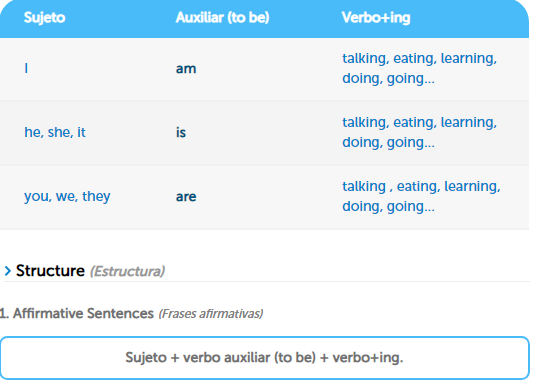
The present continuous of any verb is made up of two parts: the present of the verb to be + the present participle of the main verb.
(The present participle form is: base + ing, for example, speak, play, move, smile)
examples
- The elephant is playing in the water.
- The jaguar is running.
- I am seeing my lawyer next Monday.
will
uses
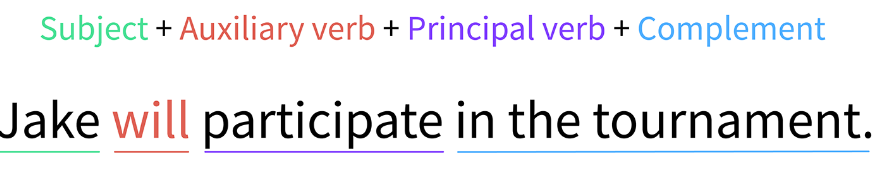
The forms "will" and "going to" are used to express the future. The difference between "going to" and "will" is the sense of planning and probability of an action happening. In general, "going to" is used for concrete plans, when we are sure that something is going to happen.
grammar
It expresses a future situation that has not been planned, a spontaneous decision or an event on which it cannot be decided.
-I will help you with your speech.
- Ok, I will go instead of you.
- Please, will you come with me to the meeting?
examples
going to
uses
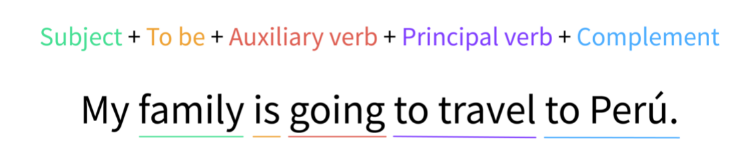
Going to is used to express forceful plans or events for the future.
grammar
It is important to note that in this form of the future tense the verb to be is used in the present form, for example:
examples
- Lucas is going to make another movie.
- Miss Anderson is going to be a juror in the contest.
- It's going to rain.
futuro continuous
uses
Use the future continuous to indicate that a longer action in the future will be interrupted by a shorter action in the future. Remember this can be a real interruption or just an interruption in time.
grammer
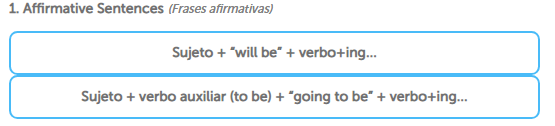
Form: The future continuous in English is formed with the auxiliary will / shall + be + verb in –ing.
examples
- You won't be playing basketball.
- He will not be kissing me "good night".
future perfect simple
uses
We use the future perfect to say 'how long' for an action that starts earlier and continues until another action or time in the future. Usually we need 'to'. We can also use the future perfect continuous here, which is why we often use the future perfect simple with state verbs. If we use 'when', we usually need the present simple.
grammar
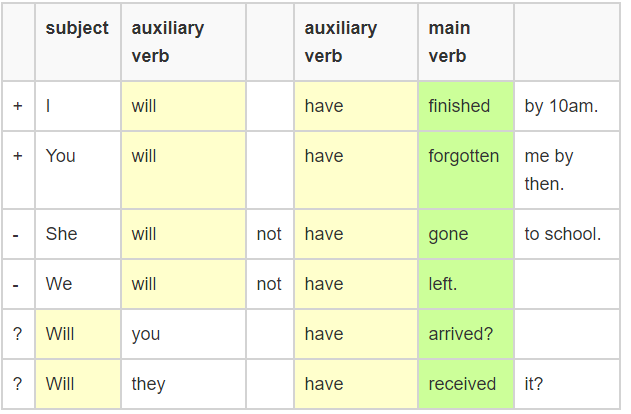
We use will/shall + have + the -ed form of the verb.
We use shall only for future time reference with I and we. Shall is more formal than will.
examples
- I'll have finished by the time you get home.
- He will have decided to leave.
- They'll have studied the lesson by Saturday.
future perfect contonuous
uses
We use the future perfect continuous to show that something will continue up until a particular event or time in the future. "For five minutes," "for two weeks," and "since Friday" are all durations which can be used with the future perfect continuous. Notice that this is related to the present perfect continuous and the past perfect continuous; however, with future perfect continuous, the duration stops at or before a reference point in the future.
grammar
The future perfect continuous is formed by taking the auxiliary will together with the auxiliary have, followed by the past participle of the verb to be and the main verb of the sentence in the –ing form.

examples
-
- I will have been waiting here for three hours by six o'clock.
-
By 2001 I will have been living in London for sixteen years.
Informationen
- Beschreibung
- Flussdiagramm am Ohne Titel, erstellt von Santiago Clavijo am 30/05/2021.
- Erstellt von
- Santiago Clavijo
- Aufrufe
- 0
- Bewertung