
Flussdiagramm
Language teaching approaches
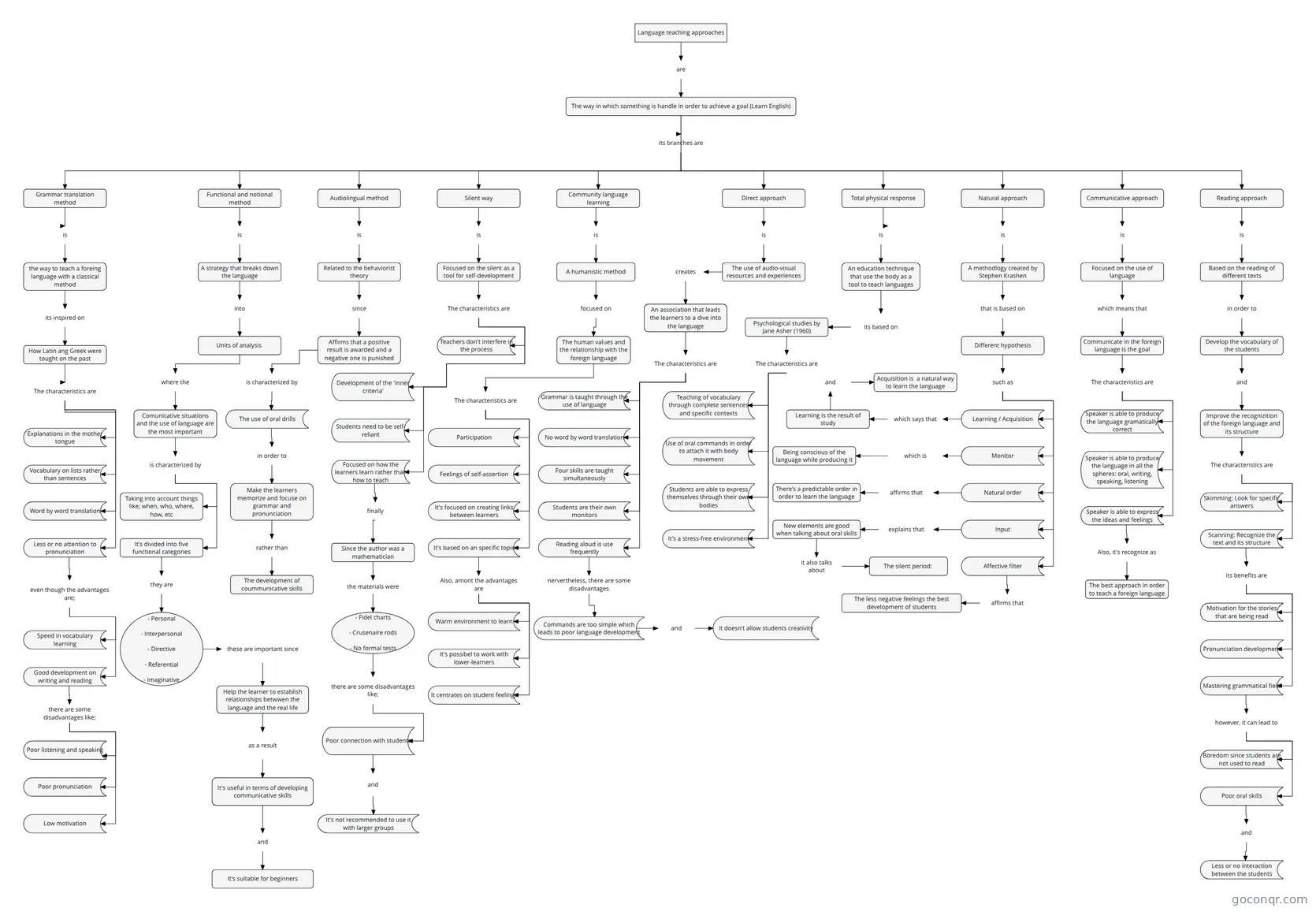
Flowchart: Language teaching approaches
Inhalt des Flussdiagramms
Language teaching approaches
are
The way in which something is handle in order to achieve a goal (Learn English)
its branches are
Grammar translation method
Functional and notional method
Audiolingual method
Silent way
Community language learning
Direct approach
Total physical response
Natural approach
Communicative approach
Reading approach
is
is
is
is
is
is
is
is
is
is
the way to teach a foreing language with a classical method
its inspired on
How Latin ang Greek were tought on the past
The characteristics are
Explanations in the mother tongue
Vocabulary on lists rather than sentences
Word by word translation
Less or no attention to pronunciation
The characteristics are
The characteristics are
The characteristics are
The characteristics are
The characteristics are
The characteristics are
is characterized by
is characterized by
even though the advantages are;
Speed in vocabulary learning
Good development on writing and reading
Poor listening and speaking
there are some disadvantages like;
Poor pronunciation
Low motivation
A strategy that breaks down the language
into
Units of analysis
where the
Comunicative situations and the use of language are the most important
Taking into account things like; when, who, where, how, etc
It's divided into five functional categories
they are
- Personal
- Interpersonal
- Directive
- Referential
- Imaginative
these are important since
Help the learner to establish relationships betwwen the language and the real life
as a result
It's useful in terms of developing communicative skills
and
It's suitable for beginners
Related to the behaviorist theory
Focused on the silent as a tool for self-development
since
Affirms that a positive result is awarded and a negative one is punished
The use of oral drills
in order to
Make the learners memorize and focuse on grammar and pronunciation
rather than
The development of coummunicative skills
Teachers don't interfere in the process
Development of the 'inner criteria'
Students need to be self-reliant
finally
Since the author was a mathematician
the materials were
- Fidel charts
- Crusenaire rods
- No formal tests
Focused on how the learners learn rather than how to teach
A humanistic method
focused on
The human values and the relationship with the foreign language
Participation
Feelings of self-assertion
It's focused on creating links between learners
It's based on an specific topic
Also, amont the advantages are
Warm environment to learn
It's possibel to work with lower-learners
It centrates on student feelings
The use of audio-visual resources and experiences
creates
An association that leads the learners to a dive into the language
Grammar is taught through the use of language
No word by word translation
Four skills are taught simultaneously
Students are their own monitors
Reading aloud is use frequently
An education technique that use the body as a tool to teach languages
its based on
Psychological studies by Jane Asher (1960)
there are some disadvantages like;
Poor connection with students
It's not recommended to use it with larger groups
and
nervertheless, there are some disadvantages
Commands are too simple which leads to poor language development
Teaching of vocabulary through complete sentences and specific contexts
Use of oral commands in order to attach it with body movement
Students are able to express themselves through their own bodies
It's a stress-free environment
and
It doesn't allow students creativity
A methodlogy created by Stephen Krashen
that is based on
Different hypothesis
such as
Learning / Acquisition
Monitor
Natural order
Input
Affective filter
which says that
Learning is the result of study
and
Acquisition is a natural way to learn the language
which is
affirms that
The less negative feelings the best development of students
explains that
New elements are good when talking about oral skills
it also talks about
The silent period:
Being conscious of the language while producing it
affirms that
There's a predictable order in order to learn the language
Focused on the use of language
which means that
Communicate in the foreign language is the goal
Speaker is able to produce the language gramatically correct
Speaker is able to produce the language in all the spheres: oral, writing, speaking, listening
Speaker is able to express the ideas and feelings
Also, it's recognize as
The best approach in order to teach a foreign language
Based on the reading of different texts
in order to
Develop the vocabulary of the students
and
Improve the recognizition of the foreign language and its structure
Skimming: Look for specific answers
Scanning: Recognize the text and its structure
its benefits are
Motivation for the stories that are being read
Pronunciation development
Mastering grammatical field
however, it can lead to
Boredom since students are not used to read
Poor oral skills
Less or no interaction between the students
and
Informationen
- Beschreibung
- Magisterio (Educación) Flussdiagramm am Language teaching approaches, erstellt von Claudia Rodríguez am 22/09/2021.
- Erstellt von
- Claudia Rodríguez
- Aufrufe
- 0
- Bewertung
Mehr zu History and Approaches to Language Teaching