
Flussdiagramm
Topic 11 new
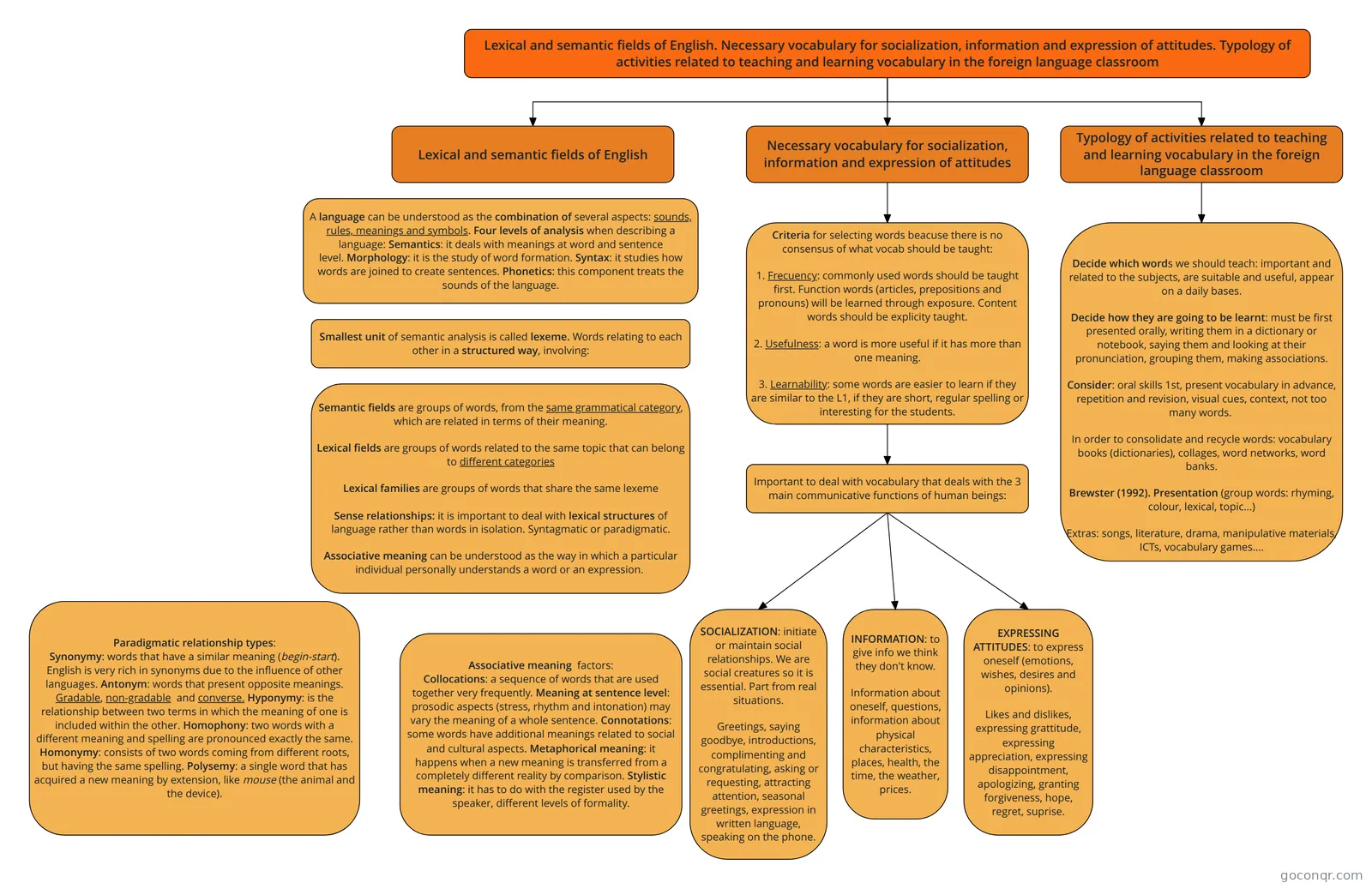
Flowchart: teaching English vocabulary
Inhalt des Flussdiagramms
Lexical and semantic fields of English. Necessary vocabulary for socialization, information and expression of attitudes. Typology of activities related to teaching and learning vocabulary in the foreign language classroom
Lexical and semantic fields of English
Necessary vocabulary for socialization, information and expression of attitudes
Typology of activities related to teaching and learning vocabulary in the foreign language classroom
A language can be understood as the combination of several aspects: sounds, rules, meanings and symbols. Four levels of analysis when describing a language: Semantics: it deals with meanings at word and sentence level. Morphology: it is the study of word formation. Syntax: it studies how words are joined to create sentences. Phonetics: this component treats the sounds of the language.
Criteria for selecting words beacuse there is no consensus of what vocab should be taught:
1. Frecuency: commonly used words should be taught first. Function words (articles, prepositions and pronouns) will be learned through exposure. Content words should be explicity taught.
2. Usefulness: a word is more useful if it has more than one meaning.
3. Learnability: some words are easier to learn if they are similar to the L1, if they are short, regular spelling or interesting for the students.
Decide which words we should teach: important and related to the subjects, are suitable and useful, appear on a daily bases.
Decide how they are going to be learnt: must be first presented orally, writing them in a dictionary or notebook, saying them and looking at their pronunciation, grouping them, making associations.
Consider: oral skills 1st, present vocabulary in advance, repetition and revision, visual cues, context, not too many words.
In order to consolidate and recycle words: vocabulary books (dictionaries), collages, word networks, word banks.
Brewster (1992). Presentation (group words: rhyming, colour, lexical, topic...)
Extras: songs, literature, drama, manipulative materials, ICTs, vocabulary games....
Smallest unit of semantic analysis is called lexeme. Words relating to each other in a structured way, involving:
Semantic fields are groups of words, from the same grammatical category, which are related in terms of their meaning.
Lexical fields are groups of words related to the same topic that can belong to different categories
Lexical families are groups of words that share the same lexeme
Sense relationships: it is important to deal with lexical structures of language rather than words in isolation. Syntagmatic or paradigmatic.
Associative meaning can be understood as the way in which a particular individual personally understands a word or an expression.
Paradigmatic relationship types:
Synonymy: words that have a similar meaning (begin-start). English is very rich in synonyms due to the influence of other languages.
Antonym: words that present opposite meanings. Gradable, non-gradable and converse.
Hyponymy: is the relationship between two terms in which the meaning of one is included within the other.
Homophony: two words with a different meaning and spelling are pronounced exactly the same.
Homonymy: consists of two words coming from different roots, but having the same spelling.
Polysemy: a single word that has acquired a new meaning by extension, like mouse (the animal and the device).
Important to deal with vocabulary that deals with the 3 main communicative functions of human beings:
EXPRESSING ATTITUDES: to express oneself (emotions, wishes, desires and opinions).
Likes and dislikes, expressing grattitude, expressing appreciation, expressing disappointment, apologizing, granting forgiveness, hope, regret, suprise.
INFORMATION: to give info we think they don't know.
Information about oneself, questions, information about physical characteristics, places, health, the time, the weather, prices.
SOCIALIZATION: initiate or maintain social relationships. We are social creatures so it is essential. Part from real situations.
Greetings, saying goodbye, introductions, complimenting and congratulating, asking or requesting, attracting attention, seasonal greetings, expression in written language, speaking on the phone.
Associative meaning factors:
Collocations: a sequence of words that are used together very frequently.
Meaning at sentence level: prosodic aspects (stress, rhythm and intonation) may vary the meaning of a whole sentence.
Connotations: some words have additional meanings related to social and cultural aspects.
Metaphorical meaning: it happens when a new meaning is transferred from a completely different reality by comparison.
Stylistic meaning: it has to do with the register used by the speaker, different levels of formality.
Informationen
- Beschreibung
- Flussdiagramm am Topic 11 new, erstellt von Emma Atkinson am 16/01/2026.
- Erstellt von
- Emma Atkinson
- Aufrufe
- 1
- Verlauf
-
- Erstellt von Emma Atkinson · 5 Nov 2021
- Kopiert von Emma Atkinson · 16 Jan 2026
- Bewertung