
Flussdiagramm
Risk Matrix Approaches in Supply Chain Risk Management
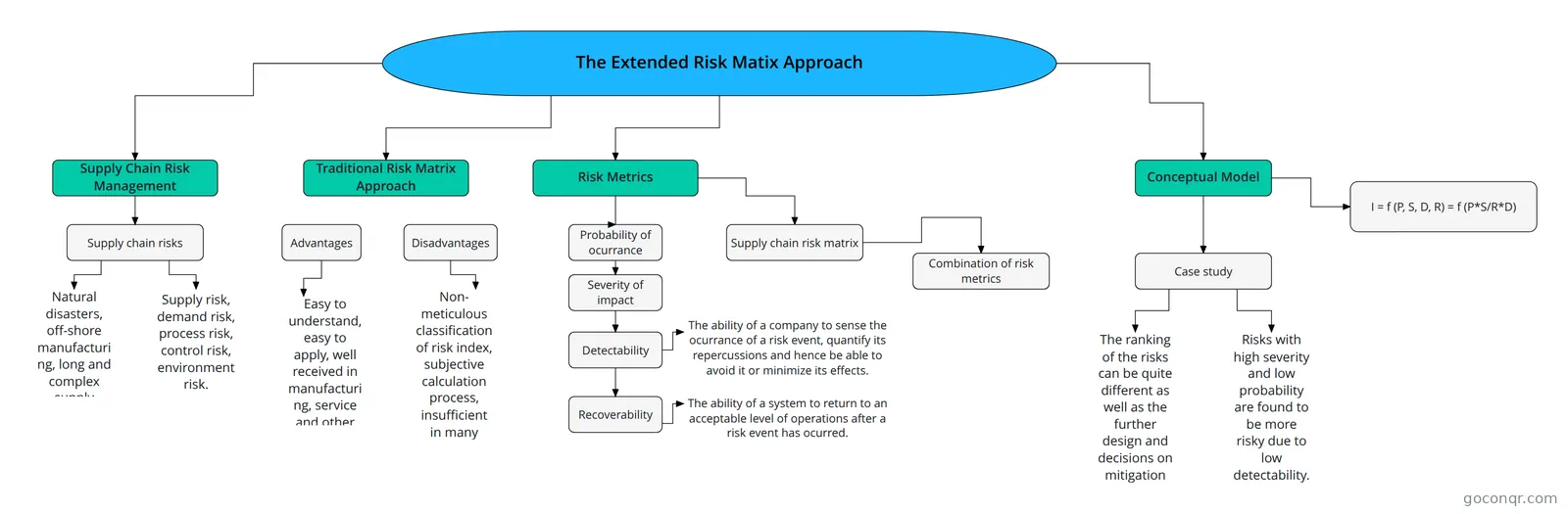
Flowchart: supply chain risk management
Inhalt des Flussdiagramms
The Extended Risk Matix Approach
Supply Chain Risk Management
Natural disasters, off-shore manufacturing, long and complex supply chains, global outsourcing.
Supply risk, demand risk, process risk, control risk, environment risk.
Supply chain risks
Traditional Risk Matrix Approach
Advantages
Disadvantages
Easy to understand, easy to apply, well received in manufacturing, service and other industries, complies with international standards.
Non-meticulous classification of risk index, subjective calculation process, insufficient in many cases, too simple to manage the risk complexities.
Risk Metrics
Probability of ocurrance
Severity of impact
Detectability
The ability of a company to sense the ocurrance of a risk event, quantify its repercussions and hence be able to avoid it or minimize its effects.
Recoverability
The ability of a system to return to an acceptable level of operations after a risk event has ocurred.
Supply chain risk matrix
Combination of risk metrics
Conceptual Model
I = f (P, S, D, R) = f (P*S/R*D)
Case study
The ranking of the risks can be quite different as well as the further design and decisions on mitigation policies and contingency plans.
Risks with high severity and low probability are found to be more risky due to low detectability.
Informationen
- Beschreibung
- Flussdiagramm am Ohne Titel, erstellt von Jaime Cortés am 26/11/2016.
- Erstellt von
- Jaime Cortés
- Aufrufe
- 13
- Bewertung