
Mindmap
Ceramics
Inhalt der Mindmap
Ceramics
What is Ceramics
- A ceramic is an inorganic solid material,where their products (ceramics product) are known to withstand high temperature and resist high pressure and can resist corrosion. Ex: White-wares (pottery,porcelain,.) Refractories (fire bricks,.. ) Glass Ceramic composites
Raw materials
- 1. Clay: Is hydrated aluminum silicate as kaolinite Al2(Si2O5)(OH)4 2. Feldspar: a common mineral in the earth's crust composed of aluminum silicates, there are 3 main types of feldspar 1.Soda Feldspar: Na2O.Al2O3.6SiO2 2. Potash Feldspar :K2O.Al2O3.6SiO2 3. Lime Feldspar (Anorthite):CaO.Al2O3.2SiO23. Sand also called flint , a natural material composed of granular minerals, it composed mainly of silica(in form of quartz SiO2) and calcium carbonate(Aragonite ).
Additives
- Additives are added to ceramics to enhance its characteristic: 1. Fluxing agents : Lower the vitrification (transfer substance to glass), melting or reaction temperature. As: Soda ash (Na2CO3), Soda Nitrate(NaNO3), Apatite,iron oxide,borax,boric acid(H3BO3) 2. Refractory agents: Increase the heat resistance of the product As: Magnesite(MgCO3),lime(CaO) limestone(CaCO3), Dolmite,Alumina(Aluminium oxide)(Al2O3),Aluminium silicates,Zirconia and Titania(Titanium Dioxide)(TiO2)
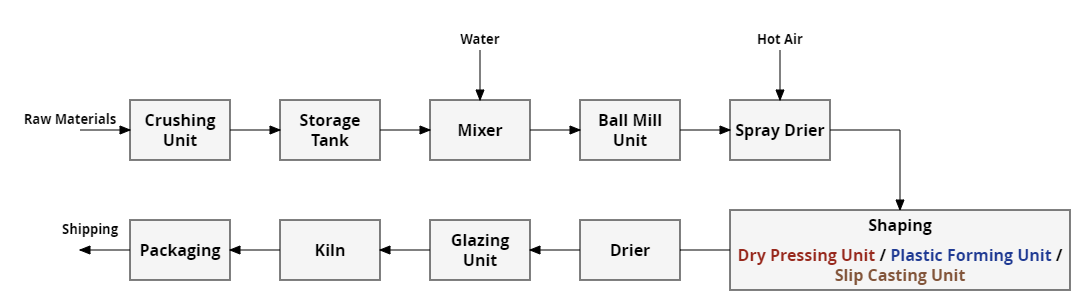
Ceramics Processing
- 1. Crushing: Usually jaw crusher is used to crush the raw material with product of 20 - 50 mm, then crusher rolls or hammer crusher is used for further crushing producing 10 mm product.
- 2. Grinding: It can be accomplished by ball mills,dry or wet grinding is used according to type of product required, example for the refractory industry dry grinding is preferred in tube mills,while in porcelain industry,it is common to mix and grind the crushed raw materials using wet ball mills to produce slurry (water added to the mixer to form plasticity form suitable for shaping).
- 3. Drying: The slurry is then dried with hot air and ready to be shaped.
- 4. Forming Technique: a) Slip casting: the clay/water mixture is slurry b) Plastic Forming: Clay is plastic c) Semi-dry Pressing: the clay is moist but have low plasticity d) Dry Pressing: the clay is basically dry(< %5 water) and no plasticity
- a) Slip casting: the slip (suspension of ceramic powder in water) ( 25-40 % water) is poured into mold cavity, the water is absorbed in plaster mold to form firm layer and then the product is removed from the mold ( used in pottery industry).
- b) Plastic forming: it includes 4 individual methods: 1) Hand molding :manual method use clay with more water to easily shaped. 2) Jiggering: include potter's wheel. 3) Plastic pressing: plastic clay slug is pressed between upper and lower mold contained in metal ring (shape better than jiggering). 4)Extrusion: screw extrusion then molded as in polymer .
- c) Semi-dry pressing:use high pressure to overcome the clay's low plasticity and force it into a die cavity,first deposit moist powder into die cavity,second pressing, third opening the cavity and eject.
- d) Dry pressing: similar to semi-dry pressing except the water content is less than 5 % , used in ceramics plates , the pressure range of hydraulic press = 20 - 30 MPa, the high pressure turns the powder to solid.
- 5. Drying: To remove the water content before firing, as water content increase the shrinkage increase upon drying and volume decreased, so we have to remove water before firing the ceramics.
- 6.Glazing: Application of ceramics surface coating to make the piece more impervious(resist) to water and enhance its appearance, Raw materials of ceramic glazes generally include silica, which will be the main glass former. Various metal oxides, such as sodium, potassium and calcium, act as a flux to lower the melting temperature. Alumina, often derived from clay, stiffens the molten glaze to prevent it from running off the piece. Colorants, such as iron oxide, copper carbonate or cobalt carbonate, and sometimes opacifiers such as tin oxide or zirconium oxide, are used to modify the visual appearance of the fired glaze. the usual processing sequence with glazed ware are:1) Fire the piece once before glazing to harden the body of the piece2) Apply the glaze 3) Fire the piece for a second time to harden the glaze
- 7. Firing: performed in a furnace called kiln, bonds are developed between the ceramics grains and this is accomplished by reducing the porosity, the kiln used is roller hearth kiln which is more efficient and the temperature in kiln is about 1200 C
- 8. Packaging and shipping
Bilder und Dateien der Mindmap
Informationen
- Beschreibung
- Mindmap am Ceramics, erstellt von Abdou Mohamed am 04/09/2017.
- Erstellt von
- Abdou Mohamed
- Aufrufe
- 0
- Verlauf
-
- Erstellt von Abdou Mohamed · 3 Sep 2017
- Kopiert von Abdou Mohamed · 4 Sep 2017
- Bewertung