
Mindmap
Chromatography
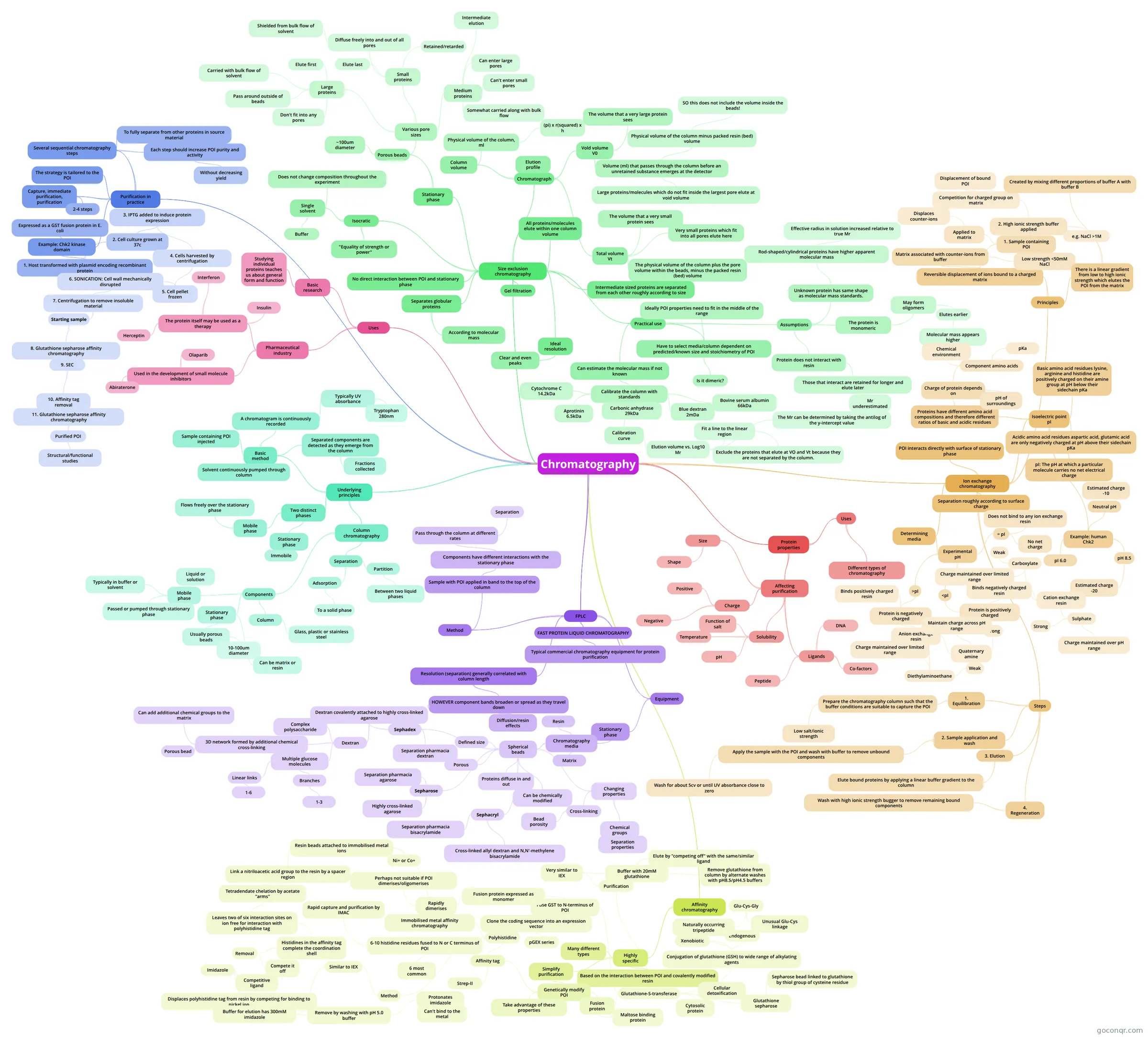
Mind map: Chromatography
Inhalt der Mindmap
Chromatography
Uses
- Basic research
- Studying individual proteins teaches us about general form and function
- Pharmaceutical industry
- The protein itself may be used as a therapy
- Insulin
- Interferon
- Herceptin
- Used in the development of small molecule inhibitors
- Olaparib
- Abiraterone
- The protein itself may be used as a therapy
- Basic research
Underlying principles
- Two distinct phases
- Stationary phase
- Immobile
- Mobile phase
- Flows freely over the stationary phase
- Stationary phase
- Column chromatography
- Separation
- Partition
- Between two liquid phases
- Adsorption
- To a solid phase
- Partition
- Components
- Column
- Glass, plastic or stainless steel
- Stationary phase
- Usually porous beads
- 10-100um diameter
- Can be matrix or resin
- Usually porous beads
- Mobile phase
- Liquid or solution
- Passed or pumped through stationary phase
- Typically in buffer or solvent
- Column
- Separation
- Basic method
- Solvent continuously pumped through column
- Sample containing POI injected
- Separated components are detected as they emerge from the column
- Fractions collected
- A chromatogram is continuously recorded
- Typically UV absorbance
- Tryptophan 280nm
- Typically UV absorbance
- Two distinct phases
FPLC
- FAST PROTEIN LIQUID CHROMATOGRAPHY
- Typical commercial chromatography equipment for protein purification
- Method
- Sample with POI applied in band to the top of the column
- Components have different interactions with the stationary phase
- Pass through the column at different rates
- Separation
- Pass through the column at different rates
- Components have different interactions with the stationary phase
- Sample with POI applied in band to the top of the column
- Resolution (separation) generally correlated with column length
- HOWEVER component bands broaden or spread as they travel down
- Diffusion/resin effects
- HOWEVER component bands broaden or spread as they travel down
- Equipment
- Stationary phase
- Chromatography media
- Spherical beads
- Defined size
- Porous
- Proteins diffuse in and out
- Can be chemically modified
- Sephadex
- Separation pharmacia dextran
- Dextran covalently attached to highly cross-linked agarose
- Dextran
- Complex polysaccharide
- Multiple glucose molecules
- Linear links
- 1-6
- Branches
- 1-3
- Linear links
- 3D network formed by additional chemical cross-linking
- Porous bead
- Can add additional chemical groups to the matrix
- Dextran
- Sepharose
- Separation pharmacia agarose
- Highly cross-linked agarose
- Sephacryl
- Separation pharmacia bisacrylamide
- Cross-linked allyl dextran and N,N'-methylene bisacrylamide
- Changing properties
- Cross-linking
- Bead porosity
- Chemical groups
- Separation properties
- Cross-linking
- Resin
- Matrix
- Spherical beads
- Chromatography media
- Stationary phase
- FAST PROTEIN LIQUID CHROMATOGRAPHY
Protein properties
- Affecting purification
- Size
- Shape
- Charge
- Positive
- Negative
- Solubility
- Function of salt
- pH
- Temperature
- Ligands
- DNA
- Peptide
- Co-factors
- Size
- Uses
- Different types of chromatography
- Affecting purification
Size exclusion chromatography
- Gel filtration
- Separates globular proteins
- According to molecular mass
- No direct interaction between POI and stationary phase
- Isocratic
- "Equality of strength or power"
- Single solvent
- Buffer
- Does not change composition throughout the experiment
- Stationary phase
- Porous beads
- ~100um diameter
- Various pore sizes
- Large proteins
- Don't fit into any pores
- Pass around outside of beads
- Carried with bulk flow of solvent
- Elute first
- Small proteins
- Diffuse freely into and out of all pores
- Shielded from bulk flow of solvent
- Retained/retarded
- Elute last
- Diffuse freely into and out of all pores
- Medium proteins
- Can enter large pores
- Can't enter small pores
- Somewhat carried along with bulk flow
- Intermediate elution
- Large proteins
- Porous beads
- Chromatograph
- Elution profile
- Column volume
- Physical volume of the column, ml
- (pi) x r(squared) x h
- Physical volume of the column, ml
- Vold volume V0
- The volume that a very large protein sees
- Volume (ml) that passes through the column before an unretained substance emerges at the detector
- Physical volume of the column minus packed resin (bed) volume
- SO this does not include the volume inside the beads!
- Large proteins/molecules which do not fit inside the largest pore elute at void volume
- Physical volume of the column minus packed resin (bed) volume
- Total volume Vt
- The volume that a very small protein sees
- The physical volume of the column plus the pore volume within the beads, minus the packed resin (bed) volume
- Very small proteins which fit into all pores elute here
- Intermediate sized proteins are separated from each other roughly according to size
- All proteins/molecules elute within one column volume
- Ideal resolution
- Clear and even peaks
- Practical use
- Have to select media/column dependent on predicted/known size and stoichiometry of POI
- Ideally POI properties need to fit in the middle of the range
- Is it dimeric?
- Can estimate the molecular mass if not known
- Calibrate the column with standards
- Blue dextran 2mDa
- Bovine serum albumin 66kDa
- Carbonic anhydrase 29kDa
- Cytochrome C 14.2kDa
- Aprotinin 6.5kDa
- Calibration curve
- Elution volume vs. Log10 Mr
- Fit a line to the linear region
- Exclude the proteins that elute at VO and Vt because they are not separated by the column.
- The Mr can be determined by taking the antilog of the y-intercept value
- Fit a line to the linear region
- Elution volume vs. Log10 Mr
- Calibrate the column with standards
- Assumptions
- Unknown protein has same shape as molecular mass standards.
- Rod-shaped/cylindrical proteins have higher apparent molecular mass
- Effective radius in solution increased relative to true Mr
- Rod-shaped/cylindrical proteins have higher apparent molecular mass
- Protein does not interact with resin
- Those that interact are retained for longer and elute later
- Mr underestimated
- Those that interact are retained for longer and elute later
- The protein is monomeric
- May form oligomers
- Elutes earlier
- Molecular mass appears higher
- Elutes earlier
- May form oligomers
- Unknown protein has same shape as molecular mass standards.
- Have to select media/column dependent on predicted/known size and stoichiometry of POI
Ion exchange chromatography
- Separation roughly according to surface charge
- POI interacts directly with surface of stationary phase
- Isoelectric point pI
- Basic amino acid residues lysine, arginine and histidine are positively charged on their amine group at pH below their sidechain pKa
- Acidic amino acid residues aspartic acid, glutamic acid are only negatively charged at pH above their sidechain pKa
- Proteins have different amino acid compositions and therefore different ratios of basic and acidic residues
- Charge of protein depends on
- Component amino acids
- pKa
- Chemical environment
- pH of surroundings
- Component amino acids
- Charge of protein depends on
- Example: human Chk2
- Neutral pH
- Estimated charge -10
- pH 8.5
- Estimated charge -20
- pI 6.0
- Neutral pH
- pI: The pH at which a particular molecule carries no net electrical charge
- Determining media
- Experimental pH
- = pI
- No net charge
- Does not bind to any ion exchange resin
- <pI
- Protein is positively charged
- Binds negatively charged resin
- Cation exchange resin
- Sulphate
- Strong
- Charge maintained over pH range
- Carboxylate
- Weak
- Charge maintained over limited range
- Sulphate
- Cation exchange resin
- Binds negatively charged resin
- Protein is positively charged
- >pI
- Protein is negatively charged
- Binds positively charged resin
- Anion exchange resin
- Quaternary amine
- Strong
- Maintain charge across pH range
- Diethylaminoethane
- Weak
- Charge maintained over limited range
- Quaternary amine
- Protein is negatively charged
- = pI
- Experimental pH
- Principles
- Reversible displacement of ions bound to a charged matrix
- Matrix associated with counter-ions from buffer
- Low strength <50mM NaCl
- 1. Sample containing POI
- Applied to matrix
- Displaces counter-ions
- 2. High ionic strength buffer applied
- e.g. NaCl >1M
- Competition for charged group on matrix
- Displacement of bound POI
- Applied to matrix
- Matrix associated with counter-ions from buffer
- There is a linear gradient from low to high ionic strength which elutes the POI from the matrix
- Created by mixing different proportions of buffer A with buffer B
- Reversible displacement of ions bound to a charged matrix
- Steps
- 1. Equilibration
- Prepare the chromatography column such that the buffer conditions are suitable to capture the POI
- Low salt/ionic strength
- Prepare the chromatography column such that the buffer conditions are suitable to capture the POI
- 2. Sample application and wash
- Apply the sample with the POI and wash with buffer to remove unbound components
- Wash for about 5cv or until UV absorbance close to zero
- Apply the sample with the POI and wash with buffer to remove unbound components
- 3. Elution
- Elute bound proteins by applying a linear buffer gradient to the column
- 4. Regeneration
- Wash with high ionic strength bugger to remove remaining bound components
- 1. Equilibration
Affinity chromatography
- Highly specific
- Based on the interaction between POI and covalently modified resin
- Many different types
- Simplify purification
- Genetically modify POI
- Affinity tag
- Polyhistidine
- Immobilised metal affinity chromatography
- Resin beads attached to immobilised metal ions
- Ni+ or Co+
- Link a nitriloacetic acid group to the resin by a spacer region
- Tetradendate chelation by acetate "arms"
- Leaves two of six interaction sites on ion free for interaction with polyhistidine tag
- Histidines in the affinity tag complete the coordination shell
- Removal
- Compete it off
- Competitive ligand
- Imidazole
- Displaces polyhistidine tag from resin by competing for binding to nickel ion
- Imidazole
- Competitive ligand
- Compete it off
- Removal
- Histidines in the affinity tag complete the coordination shell
- Leaves two of six interaction sites on ion free for interaction with polyhistidine tag
- Tetradendate chelation by acetate "arms"
- Resin beads attached to immobilised metal ions
- 6-10 histidine residues fused to N or C terminus of POI
- Rapid capture and purification by IMAC
- 6 most common
- Method
- Similar to IEX
- Buffer for elution has 300mM imidazole
- Remove by washing with pH 5.0 buffer
- Protonates imidazole
- Can't bind to the metal
- Protonates imidazole
- Remove by washing with pH 5.0 buffer
- Buffer for elution has 300mM imidazole
- Similar to IEX
- Immobilised metal affinity chromatography
- Strep-II
- Polyhistidine
- Fusion protein
- Glutathione-S-transferase
- Cytosolic protein
- Cellular detoxification
- Conjugation of glutathione (GSH) to wide range of alkylating agents
- Endogenous
- Xenobiotic
- Naturally occurring tripeptide
- Glu-Cys-Gly
- Unusual Glu-Cys linkage
- Glu-Cys-Gly
- Conjugation of glutathione (GSH) to wide range of alkylating agents
- Glutathione sepharose
- Sepharose bead linked to glutathione by thiol group of cysteine residue
- Fuse GST to N-terminus of POI
- Clone the coding sequence into an expression vector
- pGEX series
- Fusion protein expressed as monomer
- Rapidly dimerises
- Perhaps not suitable if POI dimerises/oligomerises
- Rapidly dimerises
- Clone the coding sequence into an expression vector
- Purification
- Very similar to IEX
- Buffer with 20mM glutathione
- Elute by "competing off" with the same/similar ligand
- Remove glutathione from column by alternate washes with pH8.5/pH4.5 buffers
- Buffer with 20mM glutathione
- Very similar to IEX
- Maltose binding protein
- Glutathione-S-transferase
- Take advantage of these properties
- Affinity tag
- Genetically modify POI
- Highly specific
Purification in practice
- Several sequential chromatography steps
- To fully separate from other proteins in source material
- Each step should increase POI purity and activity
- Without decreasing yield
- The strategy is tailored to the POI
- Capture, immediate purification, purification
- 2-4 steps
- Example: Chk2 kinase domain
- Expressed as a GST fusion protein in E. coli
- 1. Host transformed with plasmid encoding recombinant protein
- 2. Cell culture grown at 37c
- 3. IPTG added to induce protein expression
- 4. Cells harvested by centrifugation
- 5. Cell pellet frozen
- 6. SONICATION: Cell wall mechanically disrupted
- 7. Centrifugation to remove insoluble material
- Starting sample
- 8. Glutathione sepharose affinity chromatography
- 9. SEC
- 10. Affinity tag removal
- 11. Glutathione sepharose affinity chromatography
- Purified POI
- Structural/functional studies
- Purified POI
- 11. Glutathione sepharose affinity chromatography
- 10. Affinity tag removal
- 9. SEC
- 8. Glutathione sepharose affinity chromatography
- Starting sample
- 7. Centrifugation to remove insoluble material
- 6. SONICATION: Cell wall mechanically disrupted
- 5. Cell pellet frozen
- 4. Cells harvested by centrifugation
- 3. IPTG added to induce protein expression
- 2. Cell culture grown at 37c
- Several sequential chromatography steps
Informationen
- Beschreibung
- BSc Protein Form and Function Mindmap am Chromatography, erstellt von Jen Harris am 25/05/2013.
- Erstellt von
- Jen Harris
- Aufrufe
- 50
- Tags
- Bewertung