
Mindmap
Alimentary System (Bolts)
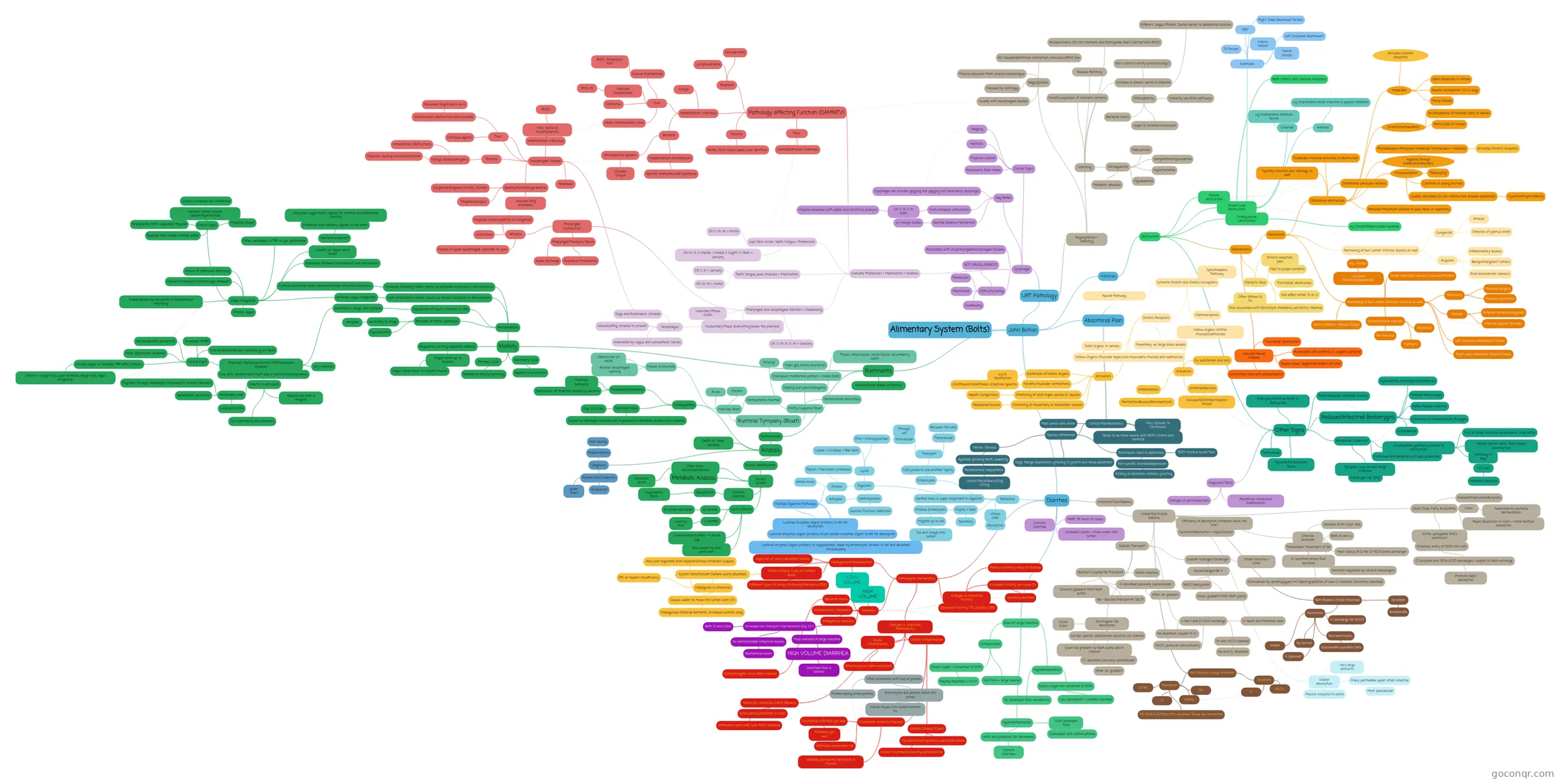
Mind map: Alimentary system (bolts)
Inhalt der Mindmap
Alimentary System (Bolts)
John Bolton
- URT Pathology
- Dysphagia
- Difficulty Eating
- Prehension
- Mastication
- Swallowing
- NOT UNWILLINGNESS
- Associated with Oropharyngeal/Oesophageal Disease
- Gag Reflex
- Normal Defence Mechanism
- vs. Foreign bodies
- From intraoral stimulation
- CN V, IX, X to brain
- impulse elevatese soft palate and constricts pharynx
- CN V, IX, X to brain
- Dysphagia can provoke gagging, but gagging not necessarily dysphagia
- Normal Defence Mechanism
- Clinical Signs
- Reduced/no food intake
- Ptyalism (saliva)
- Halitosis
- Gagging
- Evaluate Prehension > Mastication > Swallow
- Lips, Face, incisor, teeth, tongue = Prehension
- CN V, VII, XII = motor
- CN VII, IX, X (taste), I (smell), II (sight), V (feel) = sensory
- Teeth, tongue, jaws, muscles = Mastication
- CN V, IX = sensory
- CN VII, XII = motor
- Pharyngeal and oesophageal function = Swallowing
- Voluntary Phase (Oral)
- Involuntary Phase (Everything below the pharynx)
- Oesophagus
- Dogs and Ruminants: striated
- Horse/Cat/Pig, striated to smooth
- Innervated by vagus, and sympathetic nerves
- Oesophageal Disease
- Inflammation: Infectious
- Viral: Same as mouth/pharynx
- BVDV
- Viral: Same as mouth/pharynx
- Toxic
- Corrosive agents
- Trauma
- Foreign bodies/iatrogenic
- Intraluminal Obstructions
- Pressure causing necrosis/ulceration
- Foreign bodies/iatrogenic
- Neoplasia
- Developmental/Degenerative
- Vascular Ring anomalies
- Congenital/Acquired motility disorder
- Megaoesophagus
- Extraluminal Obstructions also possible
- Persistent Right Aortic Arch
- Inflammation: Infectious
- Oesophagus
- CN: V, VII, IX, X, XII = Sensory
- Pharyngeal Dysfunction
- Pharyngeal Paralysis: Neuro
- Nasal discharge
- Aspiration Pneumonia
- Achlasia
- Failure of upper oesophageal sphincter to open
- Uncommon
- Acquired (polymyopathy) or Congenital
- Pharyngeal Paralysis: Neuro
- Pathology affecting Function (DAMNITV)
- Toxic
- Uremia/Corrosive Chemicals
- Trauma
- Bones, Wire, Grass seeds, poor dentition
- Inflammation: Infectious
- Bacteria
- Actinobacillus ligniersi
- Wooden Tongue
- Fusobacterium necrophorum
- Necrotic stomatitis/calf diphtheria
- Actinobacillus ligniersi
- Viral
- Feline rhinotracheitis virus
- Calicivirus
- Vesicular Stomatitides
- FMD, VS
- Erosive Stomatitides
- BVDV, Rinderpest, MCF
- Fungal
- Bacteria
- Neoplasia
- Lymphosarcoma
- Fibrosarcoma
- Toxic
- Lips, Face, incisor, teeth, tongue = Prehension
- Difficulty Eating
- Regurgitation + Vomiting
- Regurgitation
- Usually with oesophageal disease
- Followed by retch/gag
- Passive expulsion from pharynx/oesophagus
- NO nausea/abdominal contraction, conscious effort, bile
- Vomiting
- Nausea, Retching
- Forceful expulsion of stomach contents
- Antiperistalsis (SI) into stomach, and Retrograde Giant Contractions (RGC)
- Initiates in Emetic centre in Medulla
- Not a distinct entity (pharmacologic)
- Stimulated by:
- Bacterial toxins
- Upper GI irritation/distension
- Indirectly via other pathways
- Efferent: Vagus, Phrenic, Spinal nerves to abdominal muscles
- Consequences
- Malnutrition
- Dehydration/Hypovolemia
- Hypochloremia
- Hypokalemia
- Metabolic alkalosis
- Regurgitation
- Dysphagia
- Intestines
- Obstruction
- Simple obstruction
- Closed Loop Obstruction
- External
- e.g incarcerated umbilical hernia
- Internal
- e.g incarcerated small intestine in epiploic foramen
- Both stretch and chemical receptors
- External
- Strangulation Obstruction
- Examples
- SI Torsion
- Colonic torsion
- Caecal torsion
- Left Displaced Abomasum
- GDV
- Right Sided Abomasal Torsion
- e.g. Torsion/Pedunculated lipomas
- Examples
- Mechanisms
- Mechanical
- Obturation obstruction
- Typically minimal vasc. damage to wall
- Sometimes pressure necrosis
- Ingested foreign bodies/phytobezoars
- Phytobezoars (fibre/plant material), trichbezoars = hairballs
- Activates Stretch receptors
- Phytobezoars (fibre/plant material), trichbezoars = hairballs
- Distended intestine proximal to obstruction
- Intussusception
- "Telescoping"
- Common in young animals
- Usually secondary to non--obstructive disease (parasties)
- Hypermotility/irritability
- Retained Meconium (Failure to pass feces in neonates)
- Enteroliths/Faecaliths
- Accumulations of mineral salts, or faeces
- Block Colon in horses
- Impaction
- Many Causes
- Severe constipation (LI) in dogs
- Sand impaction in horses
- Activates Stretch receptors
- Narrowing of Gut Lumen: Intrinsic lesions on wall
- Congenital
- Atresia
- Stenosis of pylorus (rare)
- Acquired
- Inflammatory lesions
- Benign/malignant tumors
- Post anostomotic stenosis
- Congenital
- Narrowing of Gut Lumen: Extrinsic Lesions on wall
- Adhesions
- Previous surgery
- Previous peritonitis
- Herniae
- External (umbilical/inguinal)
- Internal (epiploic forman)
- Extraintestinal masses:
- Abscesses
- Tumours
- Fat Necrosis
- Small intestinal Volvulus (Volvulus/Torsion)
- LI/Colonic Torsion/Displacement
- esp,. Horses
- Left Displaced Abomasum (Cows)
- Gastric Dilation Volvulus (Dogs)
- Right sided Abomasal Torsion (Cows)
- Adhesions
- Obturation obstruction
- Paralytic Ileus
- "Functional" obstruction
- Fails to propel contents
- Can affect either SI or LI
- Often follows GI Sx
- Also associated with Electrolyte imbalance, peritonitis, toxemia
- Stretch receptors: pain
- Vascular Bowel Disease
- "Functional" obstruction
- Associated with arteritis: S. vulgaris parasite
- Severe cases: Segmental infarct of colon
- Uncommon now with antiparasitics
- Mechanical
- Other Signs
- Reflex Reduced intestinal motility
- Emptying intestine distal to obstruction
- Reduced/Intestinal Borborygmi
- Distension of intestine with fluid/gas
- Reflex Neural Inhibition
- Reduced blood supply
- Hypovolemia, electrolyte disturbances
- Endotoxemia
- Abdominal Distension
- Accumulated gas/fluid proximal to obstruction
- Fluid in small intestine accumulates, may reflux
- Horses cannot vomit, fluid causes pain/rupture
- Vomiting in dogs
- HCl Loss
- Metabolic alkalosis
- HCl Loss
- Continued fermentation with gas production
- Tympany (esp. horses) large intestine
- Caecal gas cap "ping"
- Accumulated gas/fluid proximal to obstruction
- Tachycardia
- Hypovolemic/Endotoxic Shock
- Diagnostic Tests
- Changes in peritoneal fluid
- Abdominal Ultrasound Examination
- Obstruction
- Abdominal Pain
- Neural Pathway
- Extreme Stretch and Chemo nociceptors
- Spinothalamic Pathway
- Stretch Receptors
- Hollow Organs: Muscular layers b/w muscularis mucosa and submucosa
- Solid Organs: In serosa
- Mesentery: w/ large blood vessels
- Activation
- Distension of Hollow organs
- e.g GI Obstruction
- Forceful muscular contractions
- Urolithiasis/cholelithiasis, intestinal spasms
- Stretching of solid organ serosa or capsule
- Hepatic Congestions
- Stretching of mesentery or mesenteric vessels
- Neoplasia/Volvulus
- Distension of Hollow organs
- Chemoreceptors
- Hollow organs: Within mucosa/submucosa
- Activation
- Inflammation
- Peritonitis/Abscess/Pancreatitis/G
- Ischemia/Necrosis
- Volvulus/GDV/Infarct/splenic torsion
- by substances and ions
- Inflammation
- Extreme Stretch and Chemo nociceptors
- Clinical Manifestations
- Vary: Episodic to Continuous
- Tends to be more severe with BOTH stretch and chemical
- Pain varies with lesion
- Species differences
- Horses: Obvious
- Agitated, grinding teeth, sweating
- Restlessness, inappetance
- Lateral Recumbency/Dog sitting
- Restlessness, inappetance
- Agitated, grinding teeth, sweating
- Ruminants: Hard to determine
- Non-specific: anorexia/depression
- Kicking at abdomen, restless, grunting
- TEST: Positive Grunt Test
- Non-specific: anorexia/depression
- Dogs: Range (depression, growling to grunts and tense abdomen)
- Horses: Obvious
- Neural Pathway
- Diarrhea
- Refresher
- Surface Area is super important in digestion
- Crypts + Cells
- Produce Enterocytes
- Migrate up to villi
- Die and slough into lumen
- Migrate up to villi
- Secretory
- Produce Enterocytes
- Villous Cells
- Absorptive
- Enterocytes
- Cells joined to one another tightly
- Transport
- Intracellular
- Through cell
- Transcellular
- Between the cells
- Intracellular
- Transport
- Cells joined to one another tightly
- Digestion
- Carbohydrates
- Amylase
- Glucose, Fructose, Galactose
- Protein
- Pepsin + Pancreatic proteases
- Amino Acids
- Multiple Digestive Pathways
- Luminal Enzymes digest proteins to AA for absorption
- Luminal enzymes digest proteins, brush border enzymes digest to AA for absorption
- Luminal enzymes digest proteins to oligopeptides, taken by enterocytes, broken to AA and absorbed intracellularly
- Lipids
- Lipase + Co-lipase + Bile Salts
- FFAs + Monoglycerides
- Carbohydrates
- Intestinal Fluid Balance
- Water/Electrolyte balance
- Secretion/Absorption > Input/Output
- Efficiency of absorption increases down the tract
- Sodium Transport
- Nutrient Coupled Na Transport
- Downhill gradient from Na/K pump
- Cl absorbed passively (paracellular)
- other ion gradient
- Na - Glucose transporter SGLT1
- Small Intestine
- Sodium Hydrogen Exchanger
- Small Intestine + Colon
- Na exchanged for H
- NHE3 transporter
- Down gradient from Na/K pump
- // Na H and Cl HCO3 exchange
- In Ileum and Proximal colon
- Na absorbed, coupled to Cl-
- HCO3- produced intracellularly
- H+ and HCO3 released
- Na and CL absorbed
- Electrogenic Na Absorption
- Distal Colon
- via Na+ specific, aldosterone sensitive ion channel
- Down Na gradient by Na/K pump and K channel
- Cl- absorbed passively (paracellular)
- other ion gradient
- Nutrient Coupled Na Transport
- Chloride Secretion
- Both SI and LI
- Secreted from crypt cells
- Paracellular movement of Na
- Cl secretion drives fluid secretion
- Main source of Cl for Cl-HCO3 anion exchanger
- Secretion regulated by second messengers
- Stimulation by secratogogues >>> Opening/addition of new Cl channels (Secretory diarrhea)
- Short Chain Fatty Acids/VFAs
- Colon
- Generated by bacterial fermentation
- Acetate/Proprionate/Butyrate
- Rapid absorption in colon = more Na/fluid resorption
- SCFAs upregulate NHE3 expression
- Enhances entry of SCFA into cells
- Cl butyrate and SCFA HCO3 exchangers coupled to Na/H exchange
- Promote Na/Cl absorption
- Cl butyrate and SCFA HCO3 exchangers coupled to Na/H exchange
- Enhances entry of SCFA into cells
- Colon
- Nett Balance (Small Intestine)
- Absorption
- Water
- Na (active)
- K (passive)
- Cl (exchange for HCO3)
- Non-electrolytes
- Glucose/AA/Lipids/Bile Salts
- Secretion
- Bicarbonate
- Absorption
- Nett Balance (Large Intestine)
- Absorption
- Water
- Na
- Cl
- SCFAs
- NO NON-ELECTROLYTES absorbed. These are fermented
- Secretion
- K
- HCO3-
- Absorption
- Water Absorption
- Passive (respond to salts)
- Freely permeable upper small intestine
- Most paracellular
- Very large amounts
- Water/Electrolyte balance
- Pathological Mechanisms
- Maldigestion/Malabsorption
- Ingestion of poorly absorbed solutes
- Villous atrophy (Loss of Surface Area)
- Different types of atropy (Rotavirus/Parvovirus/TGE)
- Epsom Salts/Sodium Sulfare poorly absorbed
- Maldigesta in intestines
- Causes water to move into lumen (osm D+)
- Maldigested material ferments, increased osmotic drag
- Also poor digestible milk replacer/lactose intolerant puppies
- EPI, or Hepatic Insufficiency
- Causes water to move into lumen (osm D+)
- Maldigesta in intestines
- LOW VOLUME
- Secretion
- Bacterial toxins
- Enterotoxigenic e.Coli (Non-invasive)
- Inflammatory Mediators
- Endogenous laxatives
- Increased ion transport mechanisms (esp. Cl-)
- Both SI and Colon
- No demonstrable intestinal lesions
- Biochemical lesion
- Fluid overload of large intestine
- HIGH VOLUME DIARRHEA
- Diarrheal fluid is isotonic
- HIGH VOLUME DIARRHEA
- HIGH VOLUME
- Bacterial toxins
- Changes in intestinal Permeability
- Acute inflammation
- Enteroinvasive Salmonella/e.coli
- Chronic Inflammation
- Eosinophilic enteritis (Horses)
- Eosinophils infiltrate gut wall
- Thickened gut wall
- Infiltrates mesenteric LN
- Variable granuloma formation in mucosa
- Eosinophils infiltrate gut wall
- Johne's Disease (Cows)
- Chronic D+/emancipation/hypoproteinemia
- Mycobacterium avium/ss. paratuberculosis
- Histiocytic Ulcerative Colitis (Boxers)
- Granulomas/ulceration in colon
- infiltration with mØs with PAS+ material
- Eosinophilic enteritis (Horses)
- Often associated with loss of protein
- Protein-losing enteropathies
- Electrolytes and protein move into lumen
- Water moves into lumen/Osmotic D+
- Acute inflammation
- Changes in intestinal motility
- Rarely a primary cause of disease
- Increased motility can cause D+
- secretory diarrhea
- Decreased motility (SI), possibly SIBO
- Maldigestion/Malabsorption
- Osmotic Diarrhea
- PART OF most D+ cases
- Increased solute = more water into lumen
- Role of Large Intestine
- Compensated
- Gut Flora = large reserve
- Excess sugar = Converted to SCFA
- Rapidly absorbed = no D+
- Hypofermentation
- NO developed flora (newborns)
- Excess sugar not converted to SCFA
- Less absorption = osmotic diarrhea
- Hyperfermentation
- Well developed flora
- Overloaded with carbohydrates
- Lactic acid produced (pH decreases)
- Osmotic Diarrhea
- Well developed flora
- Compensated
- Refresher
- Ruminants
- Fermentation linked to Motility
- Fermentation
- Acidosis
- Excess carbohydrate
- Excess lactate
- Osmotic diarrhea
- Dehydration
- Hypovolemic Shock
- Dehydration
- Metabolic Acidosis
- Even more bacteria/endotoxin
- Endotoxic shock
- Lactic acidosis
- D-Lactate
- In rumen and blood
- L-Lactate
- Used by host
- Overwhelmss buffers --> Anion Gap
- Also caused by poor perfusion
- D-Lactate
- Osmotic diarrhea
- Excess lactate
- Death of "Good" bacteria
- Diagnosis
- Rumen Fluid Collection
- Protozoa normally suspend the fluid, quick settling = protozoa are dead.
- Analyse pH
- gram stain
- Presentations
- Star Gazing
- Rumen Fluid Collection
- Consequences
- Ruminal Stasis
- Due to SCFAs
- Caused by damaged ruminal wall, hypovolemia, metabolic acidosis and toxemia
- Polioencephalomalacia
- Destruction of thiamine producing bacteria
- Thiamine deficiency
- Ruminal Stasis
- Excess carbohydrate
- Ruminal Tympany (Bloat)
- Free-Gas Bloat
- Fermentation Normal
- Acute
- Chronic
- Failure to Eructate
- Blocked oesophageal opening
- Obstruction of cardia
- Frothy (Legume) Bloat
- Fermentation Abnormal
- Feeding lush pasture/legume
- Chloroplast membrane protein = stable foam
- traps gas, blocks eructation
- Chloroplast membrane protein = stable foam
- No"ping"
- Thorax compression, cardio failure, recumbency, death
- Free-Gas Bloat
- Acidosis
- Motility
- Primary Cycle
- Related to emptying/mixing
- Secondary Cycle
- Related to Eructation
- Regulation via long vagovasal reflexes
- Vagus nerve up to medulla
- Vagus nerve down to smooth muscle
- Vagus nerve up to medulla
- Abnormalities
- Depression of Gastric Centers in CNS
- anesthetics, drugs, pain, pyrexia
- Traumatic Reticuloperitonitis (TRP/Hardware Disease)
- Cow eats random hard stuff (esp in parturition/pregnancy)
- Collects in reticulum
- Penetrates wall
- Local peritonitis
- Generalised peritonitis
- Migrates through diaphragm: (myocarditic, thoracic abscess)
- Sits harmlessly and dissolves
- Reduce risk with a magnet
- Penetrates wall
- Collects in reticulum
- very common
- Clinical Signs
- Decreased milk production
- Fever, Depression, Anorexia
- increased HR/RR
- Cranial abdominal pain (positive grunt test)
- Usually vague w/ localised TRP after 24hours
- Chronic = weight loss, poor lactation, rough hair, vagal indigestion
- Cow eats random hard stuff (esp in parturition/pregnancy)
- Traumatic Reticuloperitonitis (TRP/Hardware Disease)
- anesthetics, drugs, pain, pyrexia
- Lack of Excitatory Reflex inputs via tension receptors in forestomach
- anorexia, vagus indigestion
- Vagal Indigestion
- Chronic, vague
- Characterised by disruption to forestomach emptying
- Failure of transport into/through omasum
- Failure of abomasal emptying
- Adhesions between forestomach and peritoneum
- Often secondary to TRP or gut perforation
- Usually no vagus nerve lesion
- mechanoreceptors?
- interferes with sensory signals to the brain
- Disrupted vagal motor signals for normal reticuloruminal motility
- interferes with sensory signals to the brain
- mechanoreceptors?
- Clinical Signs
- Reduced feed intake, normal water
- Bradycardia, from vagovasal impulse
- Variable rumen sounds (absent/hypermotile)
- Usually increased but ineffective
- "Pearpple shape"
- Vagal Indigestion
- anorexia, vagus indigestion
- Blockade of motor pathways
- secondary to drugs
- atropine
- hypocalcemia
- secondary to drugs
- Increased inhibitory reflex inputs via epithelial receptors in forestomachs
- ruminal distension, acids, abomasal/small intestinal distension
- Depression of Gastric Centers in CNS
- Primary Cycle
- URT Pathology
Informationen
- Beschreibung
- VET377 Pathology Mindmap am Alimentary System (Bolts), erstellt von Bertrand Ng am 15/10/2017.
- Erstellt von
- Bertrand Ng
- Aufrufe
- 4
- Bewertung