
Mindmap
Cerebellar microarchitecture

Inhalt der Mindmap
Cerebellar microarchitecture
- See lecture for examples and summary
Cerebellar function
- Early clues
- Cerebellar damage does not cause paralysis, but makes many movements inaccurate, slow and uncoordinated (similar to effects of alcohol)
- No abnormal tremor at rest but dramatic intention tremor (inverse effect to Parkinson‘s disease)
- Cerebellar damage does not cause paralysis, but makes many movements inaccurate, slow and uncoordinated (similar to effects of alcohol)
- Influential suggestion
- Appears that other parts of the brain issue movement commands; the role of cerebellum is to ensure they are carried out properly
- Brindley (1964) suggested in an abstract that the purpose of the cerebellum is to learn motor skills, so that when they have been learned a simple or incomplete message from the cerebrum will suffice to provoke their execution.
- Related to ideas of user-friendliness; automaticity; freeing up cerebral cortex
- Early clues
Cerebellar orginisation
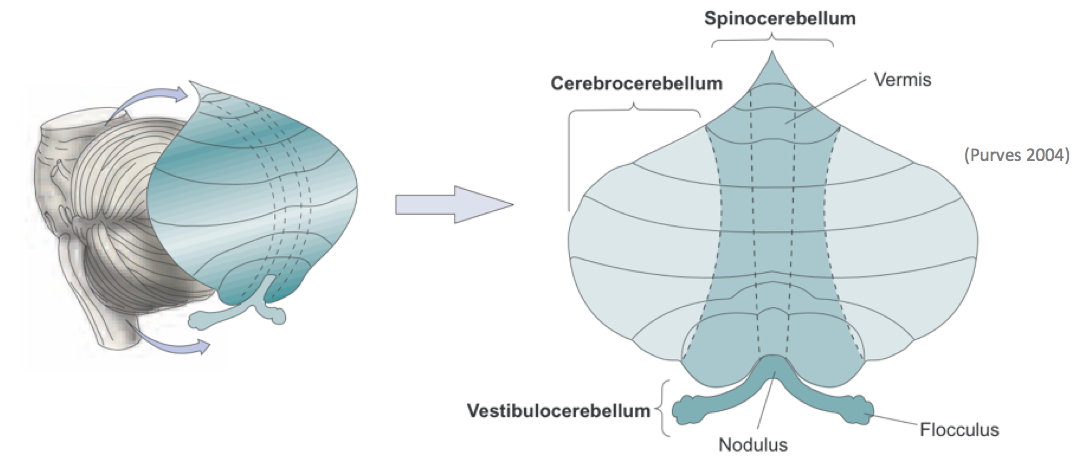
- Two parts
- Extensive cerebellar cortex
- Compact deep nuclei = cerebellar output stage
- Exception: Vestibular nuclei = output of Vestibulocerebellum
- Vestibulocerebellum
- (oldest part, appearing in fish)
- balance, eye movement
- Vestibular input, projects to lateral vestibular nuclei
- Spinocerebellum
- Motor execution
- Spinal cord somatosensory inputs
- Vermis: visual, auditory, vestibular input
- Cerebrocerebellum
- Well developed in primates
- Motor planning
- Exclusive input from cerebral cortex
- Two parts
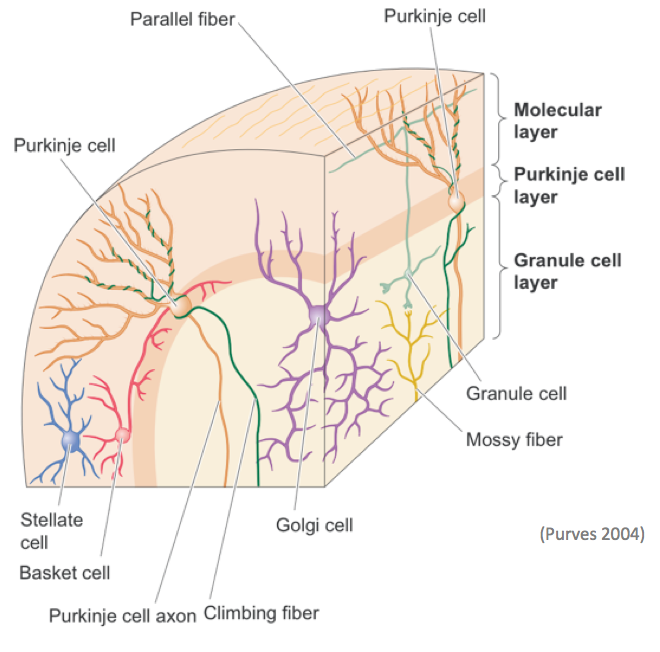
Structure of cortex
- Granule cell layer
- 50 billion granule cells (> 50% neurons in entire brain) + Golgi cells
- Purkinje cell layer
- Only 1 cell thick
- Molecular layer
- Axons of granule cells
- Dendrites of purkinje cells and interneurons
- Granule cell layer
Purkinje cells
- Largest cells in cerebellar cortex
- Distinctive dendritic field - flattened out like a fan
- Sole output cells of cerebellar cortex
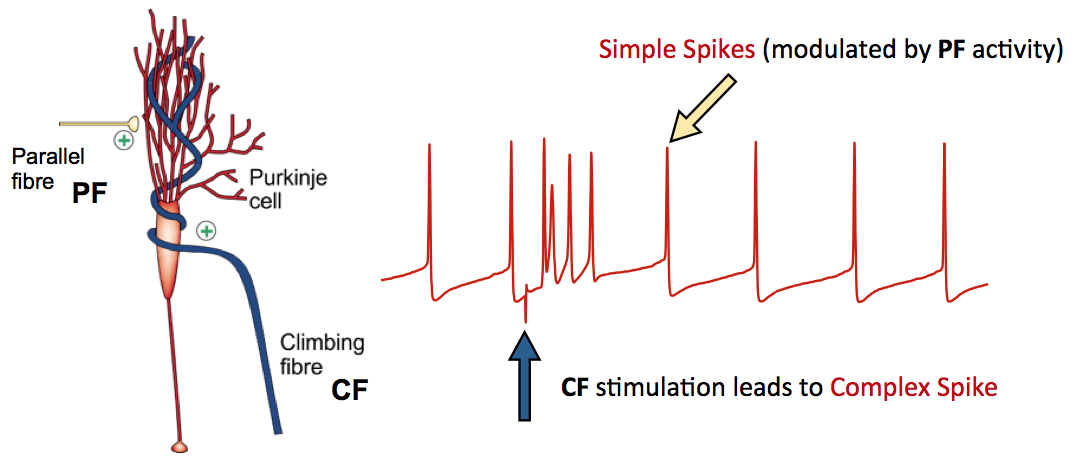
- Spiking activity
- Simple spikes
- spontaneous firing rates ~50 Hz
- Complex spikes
- fire at low frequencies ~1 Hz
- lead to strong Ca2+ influx!
- Simple spikes
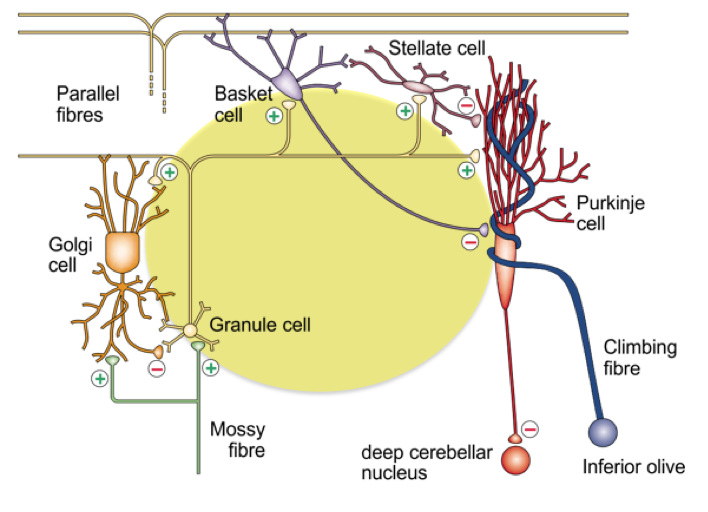
Cerebellar circuitry
- Output
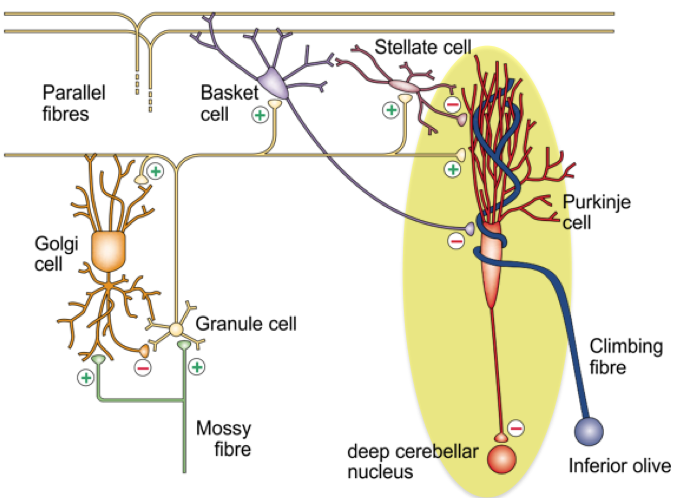
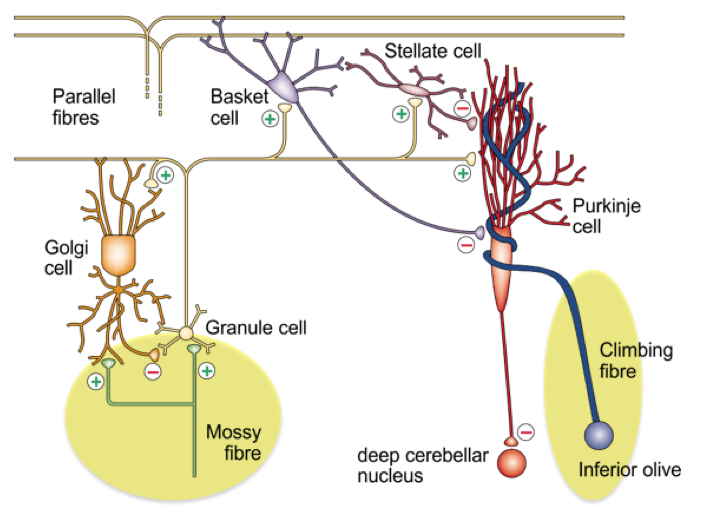
- Purkinje cells inhibit cells in cerebellar nuclei (or vestibular)
- Input
- Basic information flow through cortex is simple
- 2 Inputs
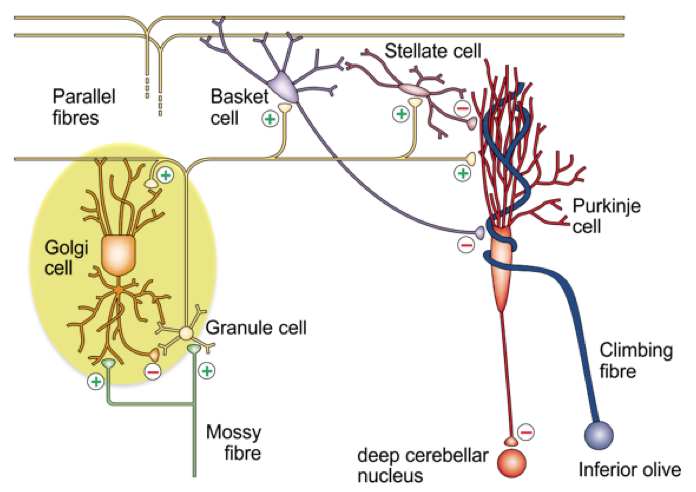
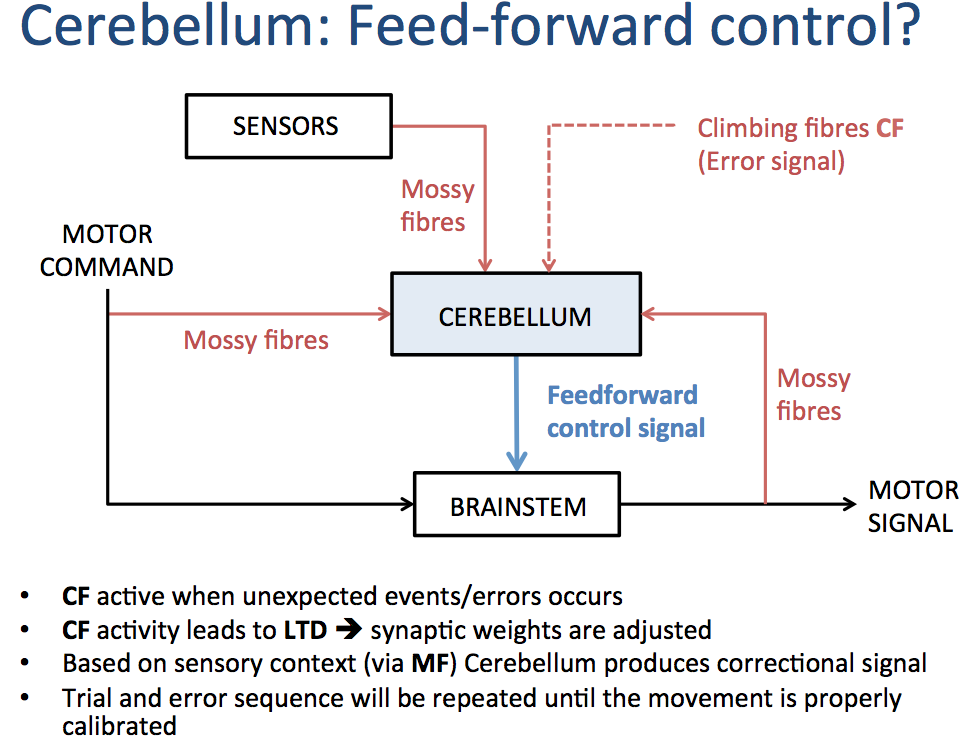
- Mossy fibres excite granule and Golgi cells
- Climbing fibres excite Purkinje cells
- Granule cells
- Granule cells form axons (parallel fibres) that excite all cell types
- Golgi cells
- Project back to the synapses between mossy fibres and granule cells
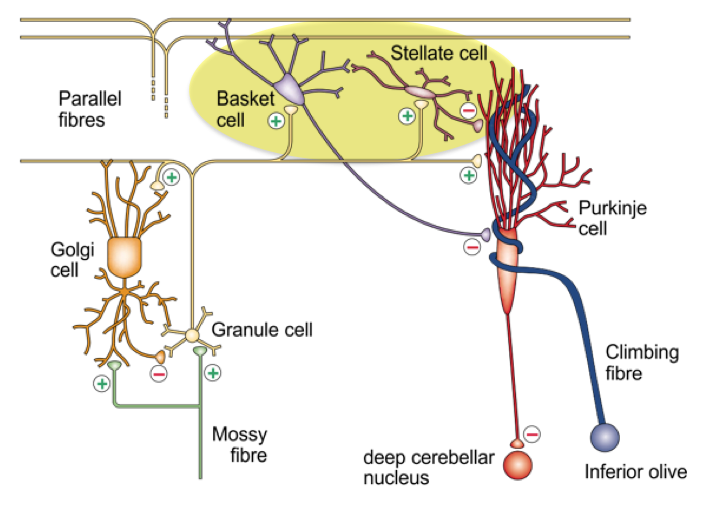
- Stellate and basket cells
- Both inhibitory
- Both get input from parallel fibres
- Basket cells synapse with Purkinje cell BODY
- Stellate cells synapse with Purkinje cell DENDRITES
- Output
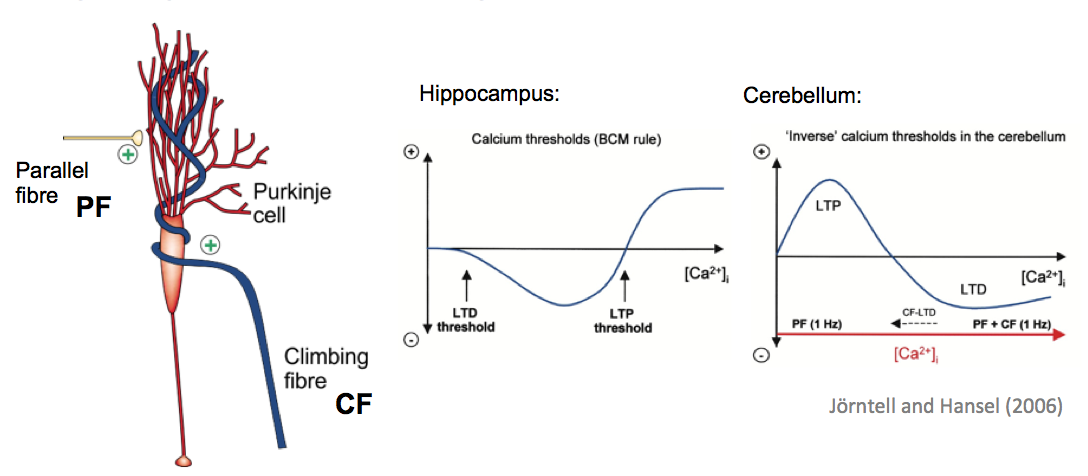
Synaptic Plasticity in the cerebellum
- LTD in cerebellum was found first! LTP only recent discovery
- PF + CF activation > large Ca2+ influx > LTD
- PF activation > less Ca2 influx > LTP
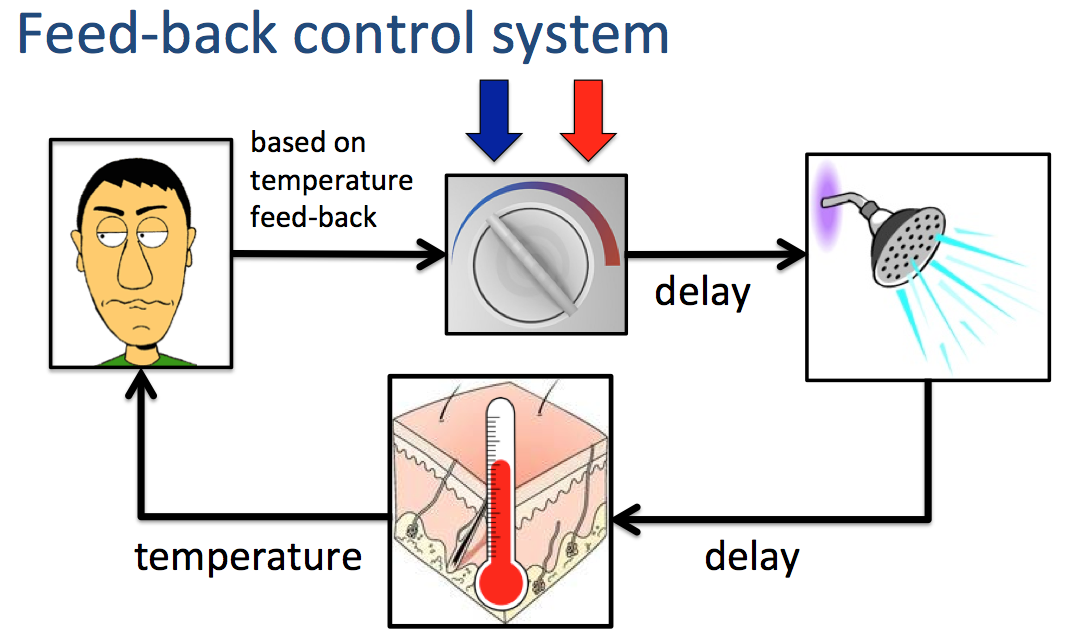
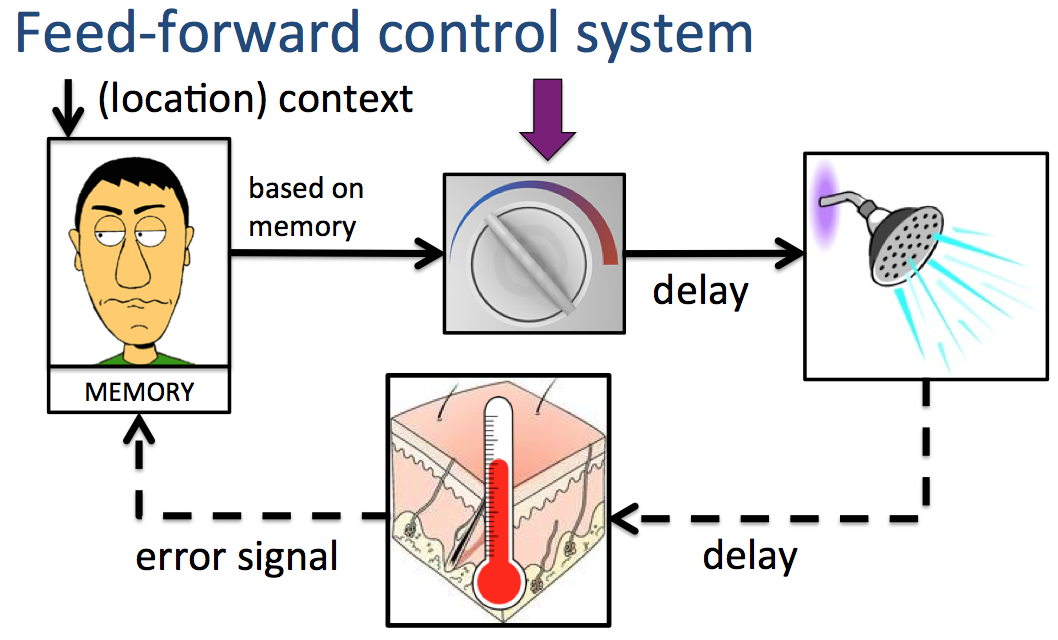
Control system
- Feed-forward
- Requires experience in order to learn the appropriate actions
- Better for fast (movement) tasks
- Feed-back
- Accurate control, but slow (due to delay)!
- Feed-back control is not effective for fast (movement) tasks
- Feed-forward
Bilder und Dateien der Mindmap
Informationen
- Beschreibung
- Undergraduate BMS236 Building Nervous Systems (The cerebellum) Mindmap am Cerebellar microarchitecture, erstellt von Kristi Brogden am 08/08/2014.
- Erstellt von
- Kristi Brogden
- Aufrufe
- 385
- Bewertung