Mindmap
Cálculo Diferencial - Module 1. Probability and statistics.

Inhalt der Mindmap
Cálculo Diferencial - Module 1. Probability and statistics.
Alejandro Baruch Saucedo Esparza - A01400284
- Lic. Saul Garcia
Probability and statistics
- 1.1Probability Basic Concepts
- Deterministic Phenomenon: It can be predicted exactly on the basis of obtainable information
- Random Phenomenon: It fluctuates in such a way that its value cannot be predicted exactly with obtainable information
- Probability
- Basic Concepts
- Outcomes
- Possible Results of the experiment
- Sample Space
- Set of all possible answers
- event
- Any subset of the sample space
- Experiments
- Observation or measurement of a random phenomenon
- Outcomes
- Odds
- Compare the number of favorable outcomes with number of unfavorable outcomes.
- Ex: To get 1 in dais. 1 to 5 favorable outcomes, 5 to one unfavorable, 1/6 probabilities
- Probability Formulas
- Theoretical Formula
- Empirical Formula
- Converting between probability and odds Let E be an event If P(E)= a/b, then the odds in favor of E is (b-a) If the odds in favor of E are a to b, then P(E)=a/(a+b)
- Compare the number of favorable outcomes with number of unfavorable outcomes.
- Properties of Probability
- Let E be an event within the sample space (S). That is E a subset of S then the following properties hold
- Probability of value
- Impossible event
- Certain event
- Let E be an event within the sample space (S). That is E a subset of S then the following properties hold
- Basic Concepts
- Probability
- Events Involving "NOT" and "OR"
- Probability of the complement
- Probability that on event E will not occur (Not E) is equal to 1 minus the probability that will occur. P(not E)=1-P(E)
- Addition rule of probability
- If A and B are any two events then: P(A or B)=P(A) + P(B) - P(A and B). If A and B are mutually Exclusive then: P(A or B)= P(A)+P(B)
- Two events are mutually exclusive if they have no outcomes in common(can´t occur simultaneously)
- If A and B are any two events then: P(A or B)=P(A) + P(B) - P(A and B). If A and B are mutually Exclusive then: P(A or B)= P(A)+P(B)
- Probability of the complement
- Events Involving and
- The probability of event B, Computed on the assumption that event A has happened, is called the conditional probability of B given A and is denoted P(A/B)
- Conditional Probability formula (of B given A)
- Multiplication rule of probability
- Independent events
- Two events are called independent events if the knowledge about the occurrence of one of them has no effect on the probability of the other one, that is, if P(B/A)=P(B), or equivalently, P(A/B)=P(A). (applies in all cases)
- P(A and B)=P(A)P(B)
- Two events are called independent events if the knowledge about the occurrence of one of them has no effect on the probability of the other one, that is, if P(B/A)=P(B), or equivalently, P(A/B)=P(A). (applies in all cases)
- Any two events
- P(A and B)=P(A)P(B/A)
- Independent events
- Venn Diagrams
- Let A and B be any sets, with U the universal set.
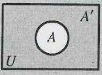
- Complement
- The Complement of A, written A´, is:
- Intersection
- The intersection of A and B is
- Union
- The union of A and B is
- Difference
- The difference of A and B is
- Cartesian product
- The cartesian product of A and B is
- Complement
- Let A and B be any sets, with U the universal set.
- 1.1Probability Basic Concepts