
Mindmap
Debates about new media
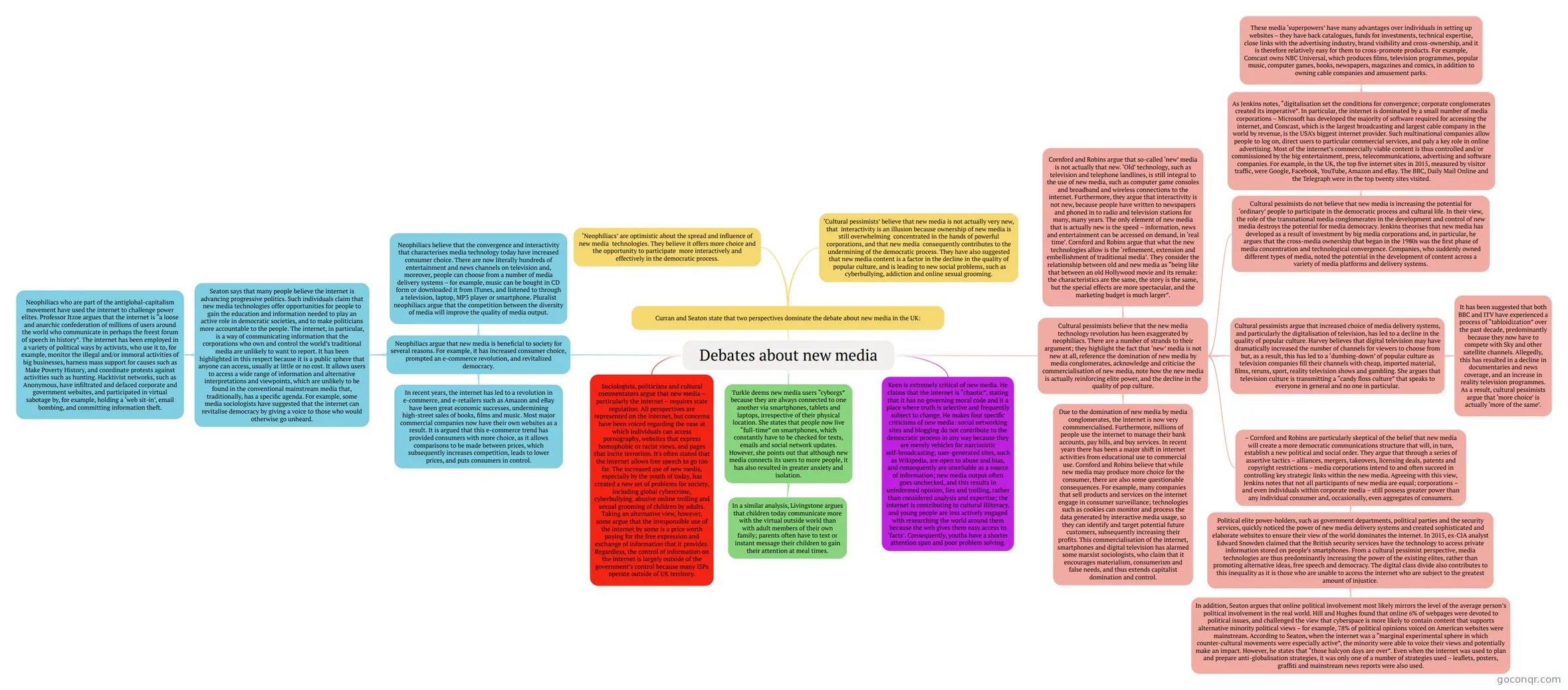
Mind map: Debates about new media
Inhalt der Mindmap
Debates about new media
Curran and Seaton state that two perspectives dominate the debate about new media in the UK:
- ‘Neophiliacs’ are optimistic about the spread and influence of new media technologies. They believe it offers more choice and the opportunity to participate more interactively and effectively in the democratic process.
- ‘Cultural pessimists’ believe that new media is not actually very new, that interactivity is an illusion because ownership of new media is still overwhelming concentrated in the hands of powerful corporations, and that new media consequently contributes to the undermining of the democratic process. They have also suggested that new media content is a factor in the decline in the quality of popular culture, and is leading to new social problems, such as cyberbullying, addiction and online sexual grooming.
Neophiliacs argue that new media is beneficial to society for several reasons. For example, it has increased consumer choice, prompted an e-commerce revolution, and revitalized democracy.
- Neophiliacs believe that the convergence and interactivity that characterises media technology today have increased consumer choice. There are now literally hundreds of entertainment and news channels on television and, moreover, people can choose from a number of media delivery systems – for example, music can be bought in CD form or downloaded it from iTunes, and listened to through a television, laptop, MP3 player or smartphone. Pluralist neophiliacs argue that the competition between the diversity of media will improve the quality of media output.
- In recent years, the internet has led to a revolution in e-commerce, and e-retailers such as Amazon and eBay have been great economic successes, undermining high-street sales of books, films and music. Most major commercial companies now have their own websites as a result. It is argued that this e-commerce trend has provided consumers with more choice, as it allows comparisons to be made between prices, which subsequently increases competition, leads to lower prices, and puts consumers in control.
- Seaton says that many people believe the internet is advancing progressive politics. Such individuals claim that new media technologies offer opportunities for people to gain the education and information needed to play an active role in democratic societies, and to make politicians more accountable to the people. The internet, in particular, is a way of communicating information that the corporations who own and control the world’s traditional media are unlikely to want to report. It has been highlighted in this respect because it is a public sphere that anyone can access, usually at little or no cost. It allows users to access a wide range of information and alternative interpretations and viewpoints, which are unlikely to be found in the conventional mainstream media that, traditionally, has a specific agenda. For example, some media sociologists have suggested that the internet can revitalise democracy by giving a voice to those who would otherwise go unheard.
- Neophiliacs who are part of the antiglobal-capitalism movement have used the internet to challenge power elites. Professor Itzoe argues that the internet is “a loose and anarchic confederation of millions of users around the world who communicate in perhaps the freest forum of speech in history”. The internet has been employed in a variety of political ways by activists, who use it to, for example, monitor the illegal and/or immoral activities of big businesses, harness mass support for causes such as Make Poverty History, and coordinate protests against activities such as hunting. Hacktivist networks, such as Anonymous, have infiltrated and defaced corporate and government websites, and participated in virtual sabotage by, for example, holding a ‘web sit-in’, email bombing, and committing information theft.
Cultural pessimists believe that the new media technology revolution has been exaggerated by neophiliacs. There are a number of strands to their argument; they highlight the fact that ‘new’ media is not new at all, reference the domination of new media by media conglomerates, acknowledge and criticise the commercialisation of new media, note how the new media is actually reinforcing elite power, and the decline in the quality of pop culture.
- Cornford and Robins argue that so-called ‘new’ media is not actually that new. ‘Old’ technology, such as television and telephone landlines, is still integral to the use of new media, such as computer game consoles and broadband and wireless connections to the internet. Furthermore, they argue that interactivity is not new, because people have written to newspapers and phoned in to radio and television stations for many, many years. The only element of new media that is actually new is the speed – information, news and entertainment can be accessed on demand, in ‘real time’. Cornford and Robins argue that what the new technologies allow is the ‘refinement, extension and embellishment of traditional media’. They consider the relationship between old and new media as “being like that between an old Hollywood movie and its remake: the characteristics are the same, the story is the same, but the special effects are more spectacular, and the marketing budget is much larger”.
- Cultural pessimists do not believe that new media is increasing the potential for ‘ordinary’ people to participate in the democratic process and cultural life. In their view, the role of the transnational media conglomerates in the development and control of new media destroys the potential for media democracy. Jenkins theorises that new media has developed as a result of investment by big media corporations and, in particular, he argues that the cross-media ownership that began in the 1980s was the first phase of media concentration and technological convergence. Companies, who suddenly owned different types of media, noted the potential in the development of content across a variety of media platforms and delivery systems.
- As Jenkins notes, “digitalisation set the conditions for convergence; corporate conglomerates created its imperative”. In particular, the internet is dominated by a small number of media corporations – Microsoft has developed the majority of software required for accessing the internet, and Comcast, which is the largest broadcasting and largest cable company in the world by revenue, is the USA’s biggest internet provider. Such multinational companies allow people to log on, direct users to particular commercial services, and paly a key role in online advertising. Most of the internet’s commercially viable content is thus controlled and/or commissioned by the big entertainment, press, telecommunications, advertising and software companies. For example, in the UK, the top five internet sites in 2015, measured by visitor traffic, were Google, Facebook, YouTube, Amazon and eBay. The BBC, Daily Mail Online and the Telegraph were in the top twenty sites visited.
- These media ‘superpowers’ have many advantages over individuals in setting up websites – they have back catalogues, funds for investments, technical expertise, close links with the advertising industry, brand visibility and cross-ownership, and it is therefore relatively easy for them to cross-promote products. For example, Comcast owns NBC Universal, which produces films, television programmes, popular music, computer games, books, newspapers, magazines and comics, in addition to owning cable companies and amusement parks.
- As Jenkins notes, “digitalisation set the conditions for convergence; corporate conglomerates created its imperative”. In particular, the internet is dominated by a small number of media corporations – Microsoft has developed the majority of software required for accessing the internet, and Comcast, which is the largest broadcasting and largest cable company in the world by revenue, is the USA’s biggest internet provider. Such multinational companies allow people to log on, direct users to particular commercial services, and paly a key role in online advertising. Most of the internet’s commercially viable content is thus controlled and/or commissioned by the big entertainment, press, telecommunications, advertising and software companies. For example, in the UK, the top five internet sites in 2015, measured by visitor traffic, were Google, Facebook, YouTube, Amazon and eBay. The BBC, Daily Mail Online and the Telegraph were in the top twenty sites visited.
- Due to the domination of new media by media conglomerates, the internet is now very commmercialised. Furthermore, millions of people use the internet to manage their bank accounts, pay bills, and buy services. In recent years there has been a major shift in internet activities from educational use to commercial use. Cornford and Robins believe that while new media may produce more choice for the consumer, there are also some questionable consequences. For example, many companies that sell products and services on the internet engage in consumer surveillance; technologies such as cookies can monitor and process the data generated by interactive media usage, so they can identify and target potential future customers, subsequently increasing their profits. This commercialisation of the internet, smartphones and digital television has alarmed some marxist sociologists, who claim that it encourages materialism, consumerism and false needs, and thus extends capitalist domination and control.
- – Cornford and Robins are particularly skeptical of the belief that new media will create a more democratic communications structure that will, in turn, establish a new political and social order. They argue that through a series of assertive tactics – alliances, mergers, takeovers, licensing deals, patents and copyright restrictions – media corporations intend to and often succeed in controlling key strategic links within the new media. Agreeing with this view, Jenkins notes that not all participants of new media are equal; corporations – and even individuals within corporate media – still possess greater power than any individual consumer and, occasionally, even aggregates of consumers.
- Political elite power-holders, such as government departments, political parties and the security services, quickly noticed the power of new media delivery systems and created sophisticated and elaborate websites to ensure their view of the world dominates the internet. In 2015, ex-CIA analyst Edward Snowden claimed that the British security services have the technology to access private information stored on people’s smartphones. From a cultural pessimist perspective, media technologies are thus predominantly increasing the power of the existing elites, rather than promoting alternative ideas, free speech and democracy. The digital class divide also contributes to this inequality as it is those who are unable to access the internet who are subject to the greatest amount of injustice.
- In addition, Seaton argues that online political involvement most likely mirrors the level of the average person’s political involvement in the real world. Hill and Hughes found that online 6% of webpages were devoted to political issues, and challenged the view that cyberspace is more likely to contain content that supports alternative minority political views – for example, 78% of political opinions voiced on American websites were mainstream. According to Seaton, when the internet was a “marginal experimental sphere in which counter-cultural movements were especially active”, the minority were able to voice their views and potentially make an impact. However, he states that “those halcyon days are over”. Even when the internet was used to plan and prepare anti-globalisation strategies, it was only one of a number of strategies used – leaflets, posters, graffiti and mainstream news reports were also used.
- Political elite power-holders, such as government departments, political parties and the security services, quickly noticed the power of new media delivery systems and created sophisticated and elaborate websites to ensure their view of the world dominates the internet. In 2015, ex-CIA analyst Edward Snowden claimed that the British security services have the technology to access private information stored on people’s smartphones. From a cultural pessimist perspective, media technologies are thus predominantly increasing the power of the existing elites, rather than promoting alternative ideas, free speech and democracy. The digital class divide also contributes to this inequality as it is those who are unable to access the internet who are subject to the greatest amount of injustice.
- Cultural pessimists argue that increased choice of media delivery systems, and particularly the digitalisation of television, has led to a decline in the quality of popular culture. Harvey believes that digital television may have dramatically increased the number of channels for viewers to choose from but, as a result, this has led to a ‘dumbing-down’ of popular culture as television companies fill their channels with cheap, imported material, films, reruns, sport, reality television shows and gambling. She argues that television culture is transmitting a “candy floss culture” that speaks to everyone in general and no one in particular.
- It has been suggested that both BBC and ITV have experienced a process of “tabloidization” over the past decade, predominantly because they now have to compete with Sky and other satellite channels. Allegedly, this has resulted in a decline in documentaries and news coverage, and an increase in reality television programmes. As a result, cultural pessimists argue that ‘more choice’ is actually ‘more of the same’.
Sociologists, politicians and cultural commentators argue that new media – particularly the internet – requires state regulation. All perspectives are represented on the internet, but concerns have been voiced regarding the ease at which individuals can access pornography, websites that express homophobic or racist views, and pages that incite terrorism. It's often stated that the internet allows free speech to go too far. The increased use of new media, especially by the youth of today, has created a new set of problems for society, including global cybercrime, cyberbullying, abusive online trolling and sexual grooming of children by adults. Taking an alternative view, however, some argue that the irresponsible use of the internet by some is a price worth paying for the free expression and exchange of information that it provides. Regardless, the control of information on the internet is largely outside of the government’s control because many ISPs operate outside of UK territory.
Turkle deems new media users “cyborgs” because they are always connected to one another via smartphones, tablets and laptops, irrespective of their physical location. She states that people now live “full-time” on smartphones, which constantly have to be checked for texts, emails and social network updates. However, she points out that although new media connects its users to more people, it has also resulted in greater anxiety and isolation.
- In a similar analysis, Livingstone argues that children today communicate more with the virtual outside world than with adult members of their own family; parents often have to text or instant message their children to gain their attention at meal times.
Keen is extremely critical of new media. He claims that the internet is “chaotic”, stating that it has no governing moral code and it a place where truth is selective and frequently subject to change. He makes four specific criticisms of new media: social networking sites and blogging do not contribute to the democratic process in any way because they are merely vehicles for narcissistic self-broadcasting; user-generated sites, such as Wikipedia, are open to abuse and bias, and consequently are unreliable as a source of information; new media output often goes unchecked, and this results in uninformed opinion, lies and trolling, rather than considered analysis and expertise; the internet is contributing to cultural illiteracy, and young people are less actively engaged with researching the world around them because the web gives them easy access to ‘facts’. Consequently, youths have a shorter attention span and poor problem solving.
Informationen
- Beschreibung
- A level Socoiology A2 - The Media (The New Media) Mindmap am Debates about new media, erstellt von Em Maskrey am 28/12/2017.
- Erstellt von
- Em Maskrey
- Aufrufe
- 0
- Bewertung
Mehr zu New Media and Digital Technology