
Mindmap
RO12
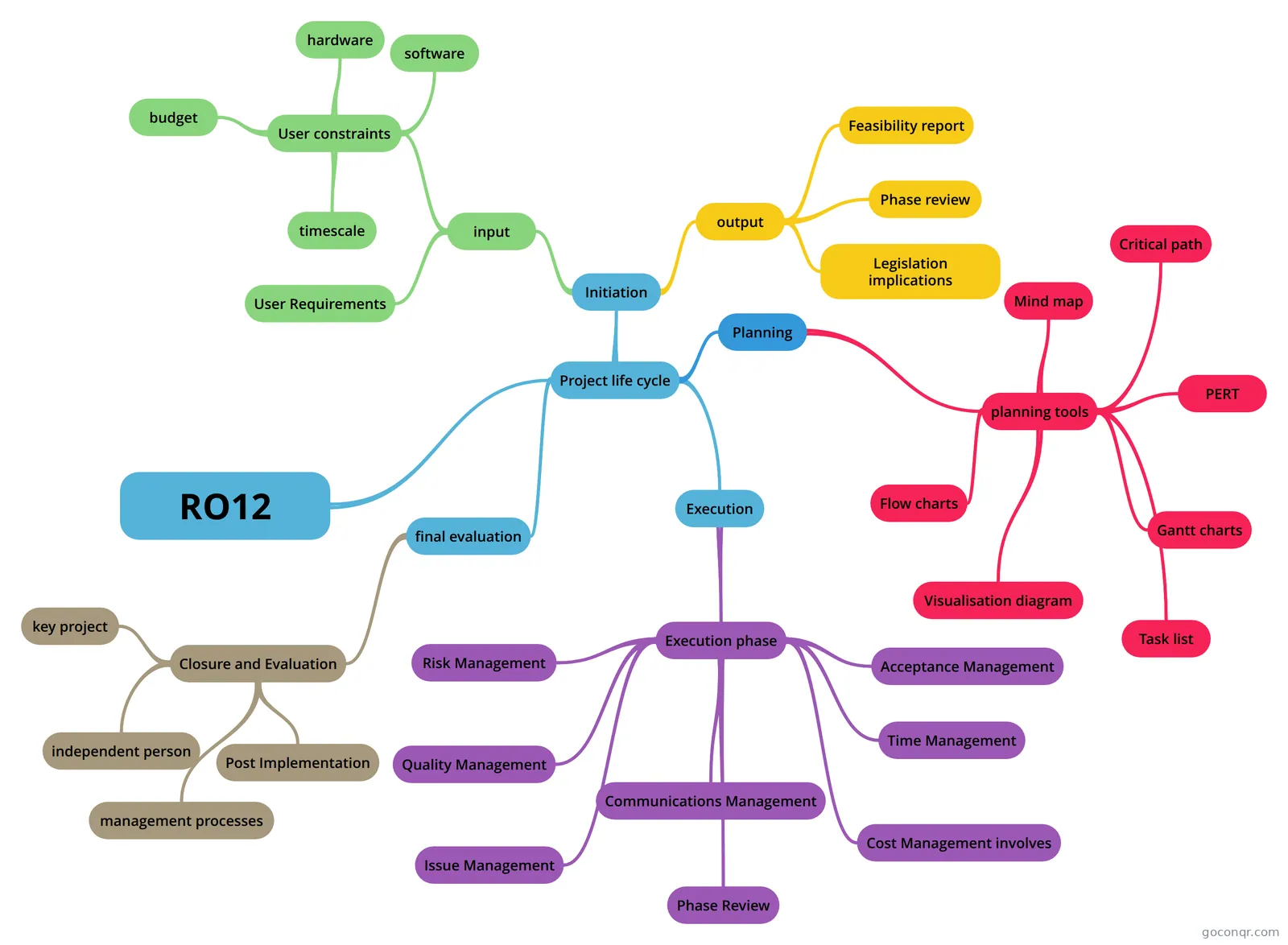
Mind map: project life cycle
Inhalt der Mindmap
RO12
Project life cycle
- Initiation
- input
- User Requirements
- The user requirements define what the client wants the product to achieve. It is important to remember that a client may not have the specialist skills needed to clearly define the requirements for a product The client will liaise with the project manager to discuss the user requirements of the product.
- User constraints
- timescale
- the start and end date for the project. The end date is when the deliverable product is released to the client.
- budget
- the amount of money that can be spent during the project. If the project is planned in enough detail then the budget should not be exceeded. There are, however, always exceptions to this.
- hardware
- the hardware that the client wants the deliverable product to be installed or run on. The hardware to be used during the creation of the product may also be defined by the client.
- software
- the software that the client wants the deliverable product to use to run on. The software to be used during the creation of the product may also be defined by the client.
- timescale
- User Requirements
- output
- Feasibility report
- The feasibility report includes the answers to all the questions that are asked during the initiation phase. The report can also include different solutions for the client.
- Legislation implications
- The legislation implications will need to be considered at the start of the project. Which Acts, legislation and regulations need to be considered will depend on the type of product that is to be created
- Phase review
- The phase review for the initiation phase will consider the feasibility report. A decision will be taken by the project manager and the client about whether the project is to carry on. The phase review for the initiation phase may find some omissions in the information collected and so the initiation phase will be repeated.
- Feasibility report
- input
- Planning
- The Project Planning Phase is the second phase in the project life cycle. It involves creating of a set of plans to help guide your team through the execution and closure phases of the project. The plans created during this phase will help you to manage time, cost, quality, change, risk and issues. They will also help you manage staff and external suppliers, to ensure that you deliver the project on time and within budget
- planning tools
- Gantt charts
- PERT
- Critical path
- Visualisation diagram
- Flow charts
- Mind map
- Task list
- Execution
- These Project Execution Templates provide you with all of the documents required to monitor and control the Project Execution phase within a project. It will also help you manage risk, changes, quality, costs, time and issues more effectively than before.
- Execution phase
- Time Management
- involves monitoring and controlling the time spent by staff on the project. Timesheets are used to track and record time spent, so that the project manager can ascertain the overall progress of the project
- Cost Management involves
- identifying project costs and recording the rate of consumption of the project budget.
- Quality Management
- involves undertaking the Quality Assurance and Control activities specified in the Quality Plan, to manage a project's level of quality and ensure that the project deliverables meet customer requirements
- Risk Management
- involves monitoring and controlling project risks by taking the steps necessary to prevent risks and minimise the impact on the project should those risks occur.
- Issue Management
- involves resolving any unforeseen issues that may arise before they affect the ability of the project to meet its stated objectives.
- Acceptance Management
- involves carrying out Acceptance Reviews to gain the customer's approval of each deliverable. If the customer does not accept that the deliverables meet their requirements the success of the project will be compromised.
- Communications Management
- involves completing the activities specified in the Communications Plan to ensure that every stakeholder receives the right information, at the right time.
- Phase Review
- is undertaken to ensure that all of the required activities in the Execution phase have been completed and the project is ready to proceed to the next phase.
- Time Management
- final evaluation
- Evaluation should not be considered a stand-alone activity. It should rather be thought of as a set of linked tasks that are undertaken from the start to the end (and beyond) of a project. This is diagrammatically represented in the project evaluation cycle below.
- Closure and Evaluation
- Post Implementation
- independent person
- key project
- management processes
- Initiation
Informationen
- Beschreibung
- Mindmap am RO12, erstellt von ryan barber am 29/01/2018.
- Erstellt von
- ryan barber
- Aufrufe
- 0
- Bewertung
Mehr zu Project Life Cycle and Process Groups