
Mindmap
Aggregate Planning
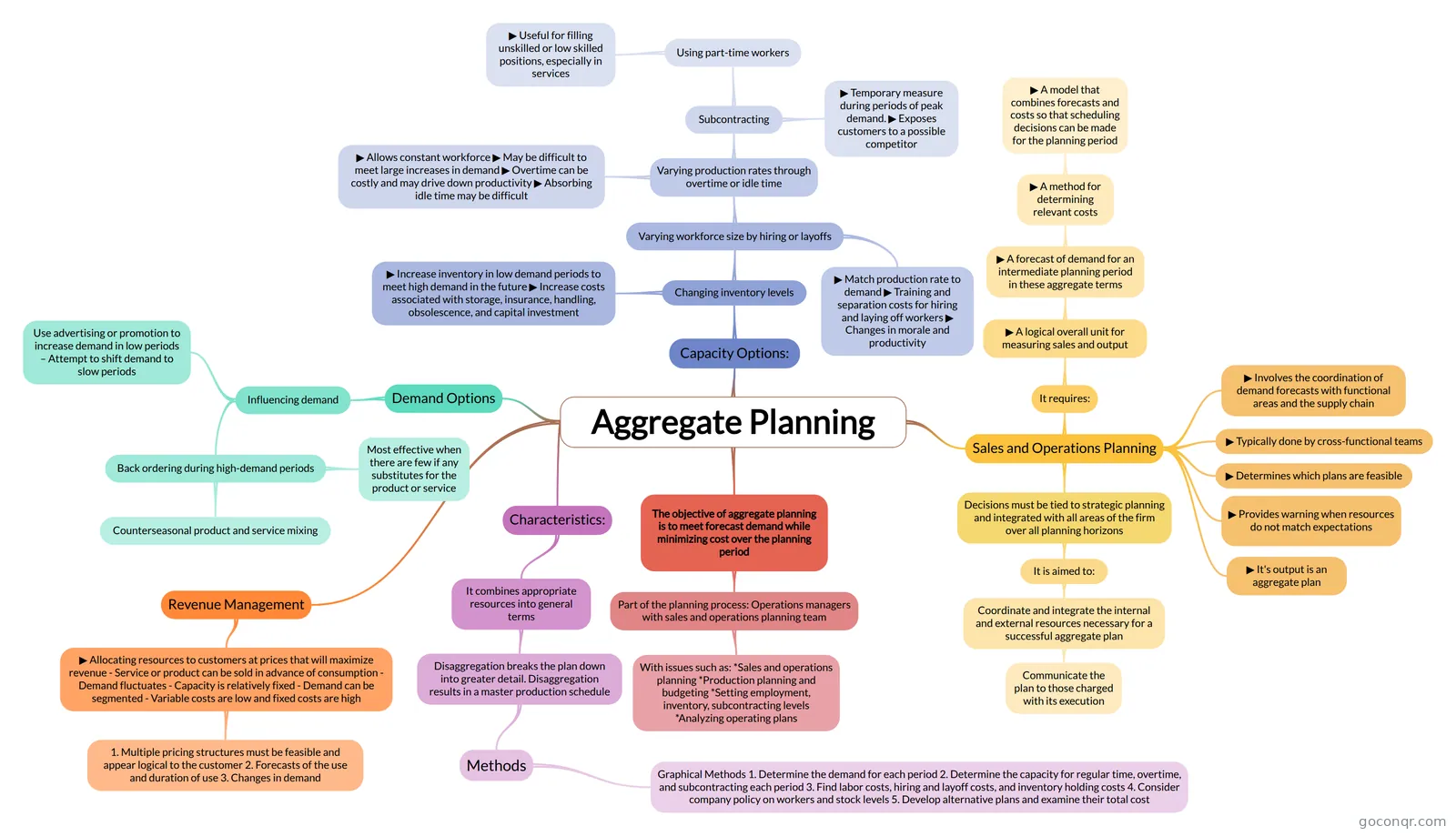
Mind map: Aggregate planning
Inhalt der Mindmap
Aggregate Planning
The objective of aggregate planning is to meet forecast demand while minimizing cost over the planning period
- Part of the planning process: Operations managers with sales and operations planning team
- With issues such as: *Sales and operations planning *Production planning and budgeting *Setting employment, inventory, subcontracting levels *Analyzing operating plans
- Part of the planning process: Operations managers with sales and operations planning team
Sales and Operations Planning
- ▶ Involves the coordination of demand forecasts with functional areas and the supply chain
- ▶ Typically done by cross-functional teams
- ▶ Determines which plans are feasible
- ▶ Provides warning when resources do not match expectations
- ▶ It's output is an aggregate plan
- Decisions must be tied to strategic planning and integrated with all areas of the firm over all planning horizons
- It is aimed to:
- Coordinate and integrate the internal and external resources necessary for a successful aggregate plan
- Communicate the plan to those charged with its execution
- Coordinate and integrate the internal and external resources necessary for a successful aggregate plan
- It is aimed to:
- It requires:
- ▶ A logical overall unit for measuring sales and output
- ▶ A forecast of demand for an intermediate planning period in these aggregate terms
- ▶ A method for determining relevant costs
- ▶ A model that combines forecasts and costs so that scheduling decisions can be made for the planning period
- ▶ A method for determining relevant costs
- ▶ A forecast of demand for an intermediate planning period in these aggregate terms
- ▶ A logical overall unit for measuring sales and output
Characteristics:
- It combines appropriate resources into general terms
- Disaggregation breaks the plan down into greater detail. Disaggregation results in a master production schedule
- Methods
- Graphical Methods 1. Determine the demand for each period 2. Determine the capacity for regular time, overtime, and subcontracting each period 3. Find labor costs, hiring and layoff costs, and inventory holding costs 4. Consider company policy on workers and stock levels 5. Develop alternative plans and examine their total cost
- Methods
- Disaggregation breaks the plan down into greater detail. Disaggregation results in a master production schedule
- It combines appropriate resources into general terms
Capacity Options:
- Changing inventory levels
- ▶ Increase inventory in low demand periods to meet high demand in the future ▶ Increase costs associated with storage, insurance, handling, obsolescence, and capital investment
- Varying workforce size by hiring or layoffs
- Varying production rates through overtime or idle time
- ▶ Allows constant workforce ▶ May be difficult to meet large increases in demand ▶ Overtime can be costly and may drive down productivity ▶ Absorbing idle time may be difficult
- Subcontracting
- ▶ Temporary measure during periods of peak demand. ▶ Exposes customers to a possible competitor
- Using part-time workers
- ▶ Useful for filling unskilled or low skilled positions, especially in services
- ▶ Match production rate to demand ▶ Training and separation costs for hiring and laying off workers ▶ Changes in morale and productivity
- Varying production rates through overtime or idle time
- Changing inventory levels
Demand Options
- Influencing demand
- Back ordering during high-demand periods
- Counterseasonal product and service mixing
- Most effective when there are few if any substitutes for the product or service
- Use advertising or promotion to increase demand in low periods – Attempt to shift demand to slow periods
- Back ordering during high-demand periods
- Influencing demand
Revenue Management
- ▶ Allocating resources to customers at prices that will maximize revenue - Service or product can be sold in advance of consumption - Demand fluctuates - Capacity is relatively fixed - Demand can be segmented - Variable costs are low and fixed costs are high
- 1. Multiple pricing structures must be feasible and appear logical to the customer 2. Forecasts of the use and duration of use 3. Changes in demand
- ▶ Allocating resources to customers at prices that will maximize revenue - Service or product can be sold in advance of consumption - Demand fluctuates - Capacity is relatively fixed - Demand can be segmented - Variable costs are low and fixed costs are high
Informationen
- Beschreibung
- Mindmap am Aggregate Planning, erstellt von ilenia verdugo am 22/03/2018.
- Erstellt von
- ilenia verdugo
- Aufrufe
- 0
- Bewertung
Mehr zu Aggregate Planning and Sales and Operations Planning