
Mindmap
Topic 12: Human Resource Management
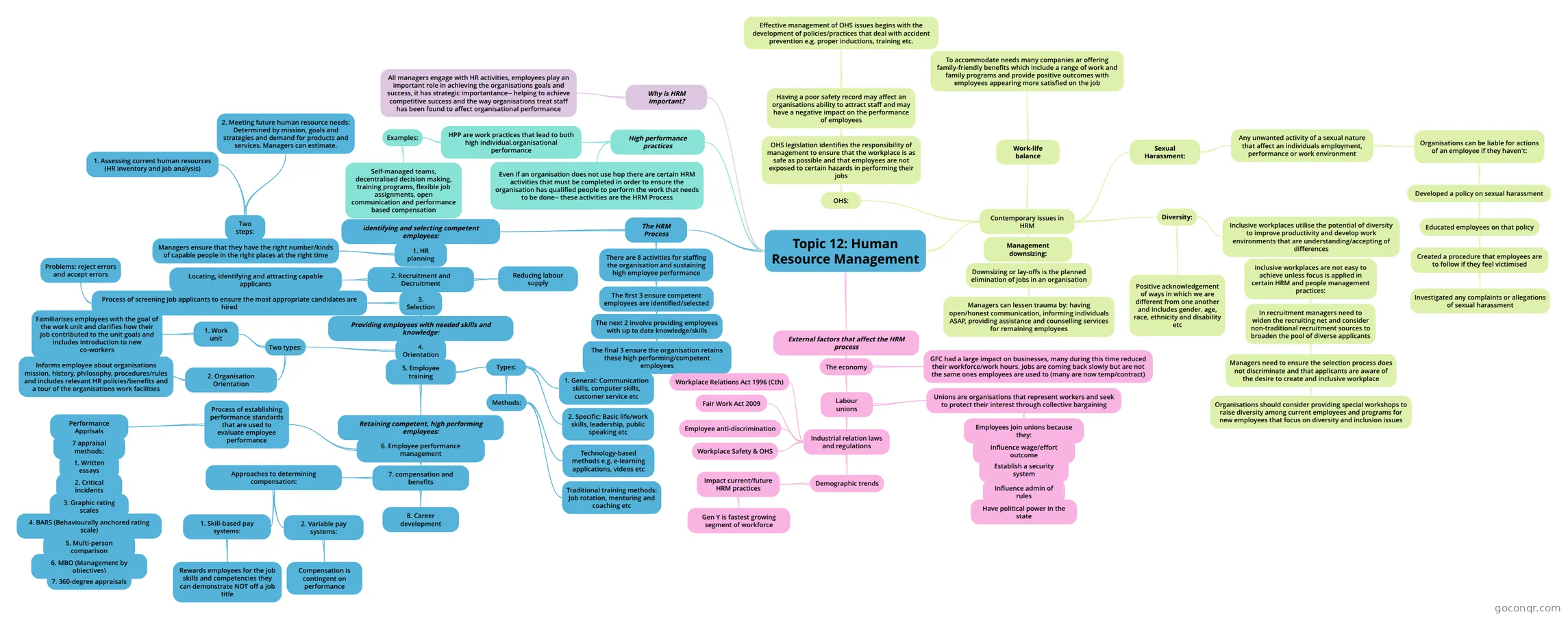
Mind map: Human resource management
Inhalt der Mindmap
Topic 12: Human Resource Management
Why is HRM important?
- All managers engage with HR activities, employees play an important role in achieving the organisations goals and success, it has strategic importantance-- helping to achieve competitive success and the way organisations treat staff has been found to affect organisational performance
High performance practices
- HPP are work practices that lead to both high individual.organisational performance
- Examples:
- Self-managed teams, decentralised decision making, training programs, flexible job assignments, open communication and performance based compensation
- Examples:
- Even if an organisation does not use hop there are certain HRM activities that must be completed in order to ensure the organisation has qualified people to perform the work that needs to be done-- these activities are the HRM Process
- HPP are work practices that lead to both high individual.organisational performance
The HRM Process
- There are 8 activities for staffing the organisation and sustaining high employee performance
- The first 3 ensure competent employees are identified/selected
- The next 2 involve providing employees with up to date knowledge/skills
- The final 3 ensure the organisation retains these high performing/competent employees
- The next 2 involve providing employees with up to date knowledge/skills
- The first 3 ensure competent employees are identified/selected
- identifying and selecting competent employees:
- 1. HR planning
- Managers ensure that they have the right number/kinds of capable people in the right places at the right time
- Two steps:
- 1. Assessing current human resources (HR inventory and job analysis)
- 2. Meeting future human resource needs: Determined by mission, goals and strategies and demand for products and services. Managers can estimate.
- Two steps:
- 2. Recruitment and Decruitment
- Reducing labour supply
- Locating, identifying and attracting capable applicants
- 3. Selection
- Process of screening job applicants to ensure the most appropriate candidates are hired
- Problems: reject errors and accept errors
- Providing employees with needed skills and knowledge:
- 4. Orientation
- Two types:
- 1. Work unit
- Familiarises employees with the goal of the work unit and clarifies how their job contributed to the unit goals and includes introduction to new co-workers
- 2. Organisation Orientation
- Informs employee about organisations mission, history, philosophy, procedures/rules and includes relevant HR policies/benefits and a tour of the organisations work facilities
- 1. Work unit
- 5. Employee training
- Types:
- 1. General: Communication skills, computer skills, customer service etc
- 2. Specific: Basic life/work skills, leadership, public speaking etc
- Methods:
- Technology-based methods e.g. e-learning applications, videos etc
- Traditional training methods: Job rotation, mentoring and coaching etc
- Retaining competent, high performing employees:
- 6. Employee performance management
- Process of establishing performance standards that are used to evaluate employee performance
- Performance Apprisals
- 7 appraisal methods:
- 1. Written essays
- 2. Critical incidents
- 3. Graphic rating scales
- 4. BARS (Behaviourally anchored rating scale)
- 5. Multi-person comparison
- 6. MBO (Management by objectives)
- 7. 360-degree appraisals
- 6. MBO (Management by objectives)
- 5. Multi-person comparison
- 4. BARS (Behaviourally anchored rating scale)
- 3. Graphic rating scales
- 2. Critical incidents
- 1. Written essays
- 7 appraisal methods:
- Performance Apprisals
- 7. compensation and benefits
- Approaches to determining compensation:
- 1. Skill-based pay systems:
- Rewards employees for the job skills and competencies they can demonstrate NOT off a job title
- 2. Variable pay systems:
- Compensation is contingent on performance
- 1. Skill-based pay systems:
- 8. Career development
- Approaches to determining compensation:
- Process of establishing performance standards that are used to evaluate employee performance
- 6. Employee performance management
- Types:
- Two types:
- 4. Orientation
- Process of screening job applicants to ensure the most appropriate candidates are hired
- Managers ensure that they have the right number/kinds of capable people in the right places at the right time
- 1. HR planning
- There are 8 activities for staffing the organisation and sustaining high employee performance
External factors that affect the HRM process
- The economy
- GFC had a large impact on businesses, many during this time reduced their workforce/work hours. Jobs are coming back slowly but are not the same ones employees are used to (many are now temp/contract)
- Labour unions
- Unions are organisations that represent workers and seek to protect their interest through collective bargaining
- Employees join unions because they:
- Influence wage/effort outcome
- Establish a security system
- Influence admin of rules
- Have political power in the state
- Influence admin of rules
- Establish a security system
- Influence wage/effort outcome
- Employees join unions because they:
- Industrial relation laws and regulations
- Workplace Relations Act 1996 (Cth)
- Fair Work Act 2009
- Employee anti-discrimination
- Workplace Safety & OHS
- Demographic trends
- Impact current/future HRM practices
- Gen Y is fastest growing segment of workforce
- Impact current/future HRM practices
- Unions are organisations that represent workers and seek to protect their interest through collective bargaining
- The economy
Contemporary issues in HRM
- Management downsizing:
- Downsizing or lay-offs is the planned elimination of jobs in an organisation
- Managers can lessen trauma by: having open/honest communication, informing individuals ASAP, providing assistance and counselling services for remaining employees
- Downsizing or lay-offs is the planned elimination of jobs in an organisation
- Diversity:
- Positive acknowledgement of ways in which we are different from one another and includes gender, age, race, ethnicity and disability etc
- Inclusive workplaces utilise the potential of diversity to improve productivity and develop work environments that are understanding/accepting of differences
- inclusive workplaces are not easy to achieve unless focus is applied in certain HRM and people management practices:
- In recruitment managers need to widen the recruiting net and consider non-traditional recruitment sources to broaden the pool of diverse applicants
- Managers need to ensure the selection process does not discriminate and that applicants are aware of the desire to create and inclusive workplace
- Organisations should consider providing special workshops to raise diversity among current employees and programs for new employees that focus on diversity and inclusion issues
- Managers need to ensure the selection process does not discriminate and that applicants are aware of the desire to create and inclusive workplace
- In recruitment managers need to widen the recruiting net and consider non-traditional recruitment sources to broaden the pool of diverse applicants
- inclusive workplaces are not easy to achieve unless focus is applied in certain HRM and people management practices:
- Sexual Harassment:
- Any unwanted activity of a sexual nature that affect an individuals employment, performance or work environment
- Organisations can be liable for actions of an employee if they haven't:
- Developed a policy on sexual harassment
- Educated employees on that policy
- Created a procedure that employees are to follow if they feel victimised
- Investigated any complaints or allegations of sexual harassment
- Created a procedure that employees are to follow if they feel victimised
- Educated employees on that policy
- Developed a policy on sexual harassment
- Organisations can be liable for actions of an employee if they haven't:
- Any unwanted activity of a sexual nature that affect an individuals employment, performance or work environment
- Work-life balance
- To accommodate needs many companies ar offering family-friendly benefits which include a range of work and family programs and provide positive outcomes with employees appearing more satisfied on the job
- OHS:
- OHS legislation identifies the responsibility of management to ensure that the workplace is as safe as possible and that employees are not exposed to certain hazards in performing their jobs
- Having a poor safety record may affect an organisations ability to attract staff and may have a negative impact on the performance of employees
- Effective management of OHS issues begins with the development of policies/practices that deal with accident prevention e.g. proper inductions, training etc.
- Having a poor safety record may affect an organisations ability to attract staff and may have a negative impact on the performance of employees
- OHS legislation identifies the responsibility of management to ensure that the workplace is as safe as possible and that employees are not exposed to certain hazards in performing their jobs
- Management downsizing:
Informationen
- Beschreibung
- Mindmap am Topic 12: Human Resource Management, erstellt von nataliewilliams3 am 09/10/2014.
- Erstellt von
- nataliewilliams3
- Aufrufe
- 54
- Bewertung
Mehr zu HR Roles, Functions and Processes