
Mindmap
Particles
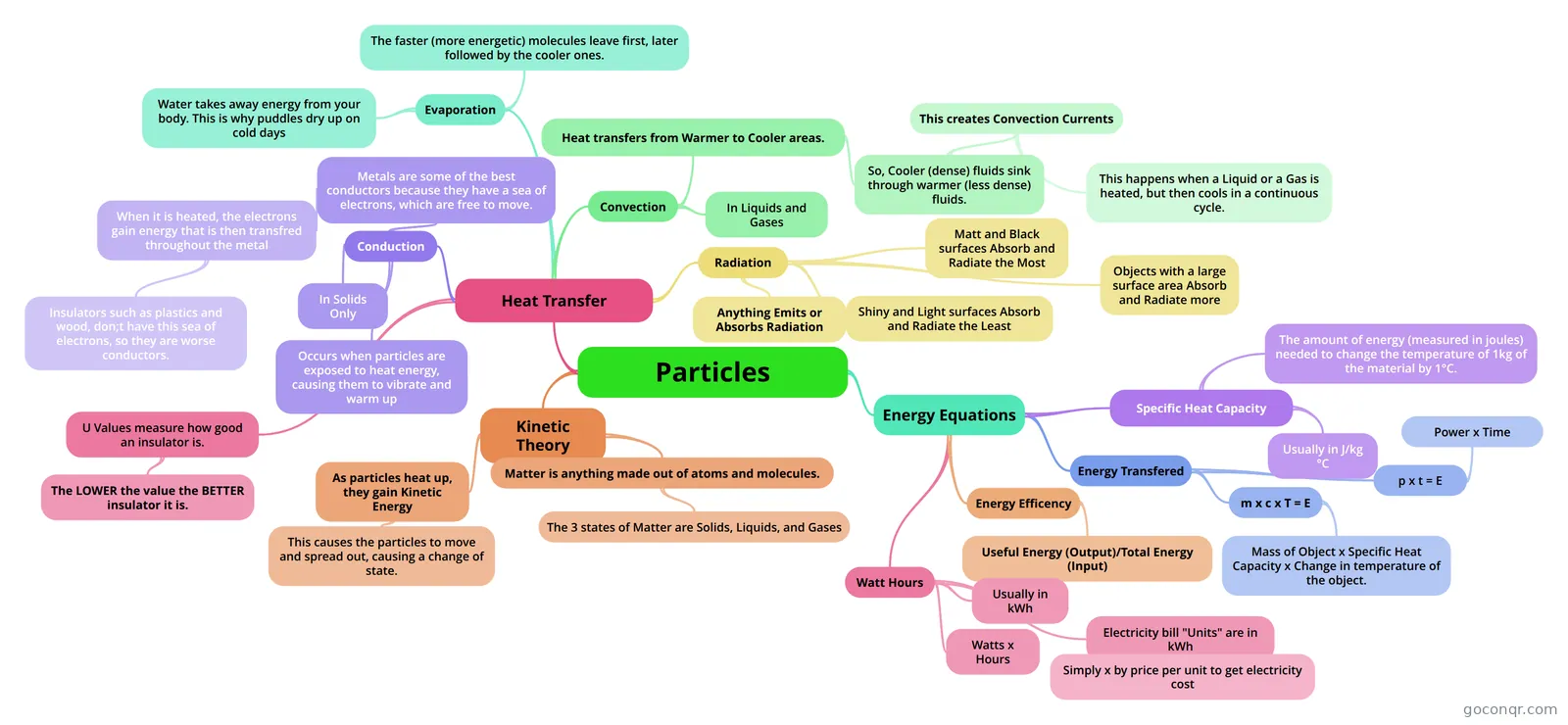
Mind map: Particles
Inhalt der Mindmap
Particles
Heat Transfer
- Conduction
- In Solids Only
- Occurs when particles are exposed to heat energy, causing them to vibrate and warm up
- Metals are some of the best conductors because they have a sea of electrons, which are free to move.
- When it is heated, the electrons gain energy that is then transfred throughout the metal
- Insulators such as plastics and wood, don;t have this sea of electrons, so they are worse conductors.
- When it is heated, the electrons gain energy that is then transfred throughout the metal
- Convection
- Heat transfers from Warmer to Cooler areas.
- So, Cooler (dense) fluids sink through warmer (less dense) fluids.
- This creates Convection Currents
- This happens when a Liquid or a Gas is heated, but then cools in a continuous cycle.
- This creates Convection Currents
- So, Cooler (dense) fluids sink through warmer (less dense) fluids.
- In Liquids and Gases
- Heat transfers from Warmer to Cooler areas.
- Radiation
- Anything Emits or Absorbs Radiation
- Matt and Black surfaces Absorb and Radiate the Most
- Shiny and Light surfaces Absorb and Radiate the Least
- Objects with a large surface area Absorb and Radiate more
- U Values measure how good an insulator is.
- The LOWER the value the BETTER insulator it is.
- U values really show how good it is at transfering heat, that its why a lower value is better when looking at how good an insulator a material is/
- The LOWER the value the BETTER insulator it is.
- Evaporation
- Water takes away energy from your body. This is why puddles dry up on cold days
- The faster (more energetic) molecules leave first, later followed by the cooler ones.
- Conduction
Energy Equations
- Specific Heat Capacity
- Usually in J/kg °C
- The amount of energy (measured in joules) needed to change the temperature of 1kg of the material by 1°C.
- Energy Transfered
- m x c x T = E
- Mass of Object x Specific Heat Capacity x Change in temperature of the object.
- p x t = E
- Power x Time
- m x c x T = E
- Energy Efficency
- Useful Energy (Output)/Total Energy (Input)
- Watt Hours
- Watts x Hours
- Usually in kWh
- Electricity bill "Units" are in kWh
- Simply x by price per unit to get electricity cost
- Specific Heat Capacity
Kinetic Theory
- Matter is anything made out of atoms and molecules.
- The 3 states of Matter are Solids, Liquids, and Gases
- As particles heat up, they gain Kinetic Energy
- This causes the particles to move and spread out, causing a change of state.
- Matter is anything made out of atoms and molecules.
Informationen
- Beschreibung
- Science (Physics) Mindmap am Particles, erstellt von Tom Gill am 09/07/2013.
- Erstellt von
- Tom Gill
- Aufrufe
- 131
- Tags
- Bewertung