
Mindmap
Practitioner’s Section Patent License Negotiation: Best Practices
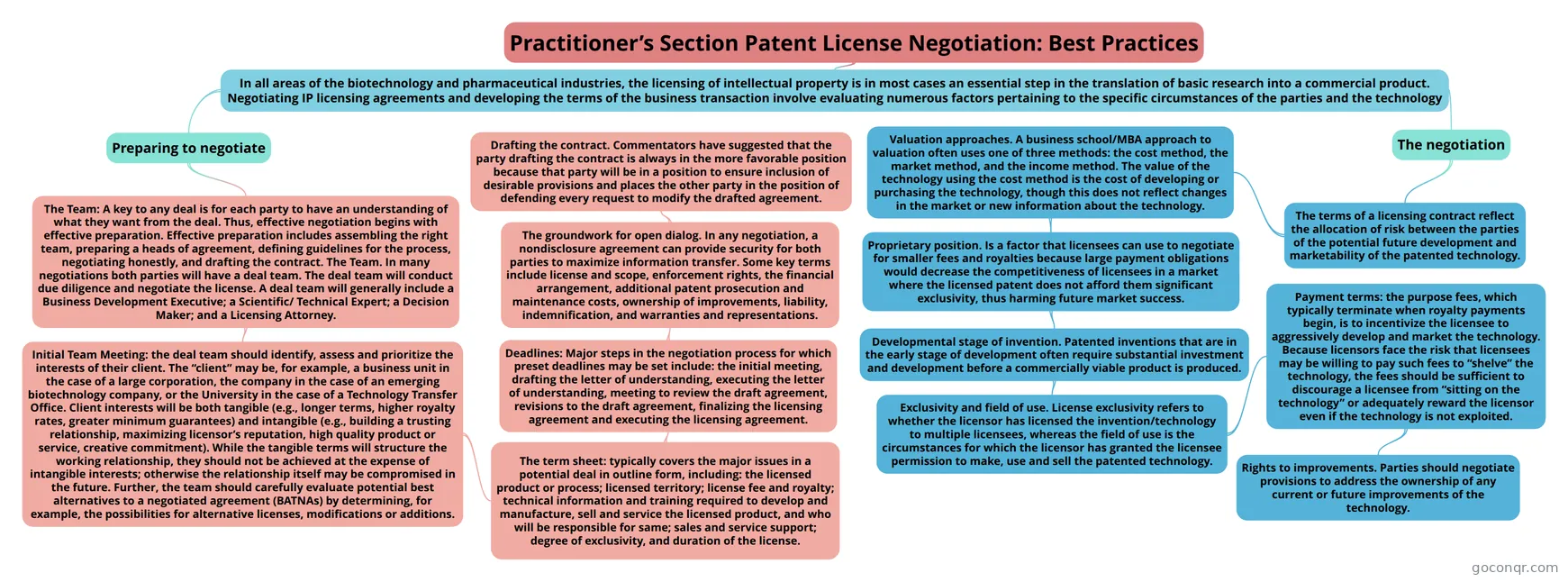
Mind map: Patent license negotiation best practices
Inhalt der Mindmap
Practitioner’s Section Patent License Negotiation: Best Practices
In all areas of the biotechnology and pharmaceutical industries, the licensing of intellectual property is in most cases an essential step in the translation of basic research into a commercial product. Negotiating IP licensing agreements and developing the terms of the business transaction involve evaluating numerous factors pertaining to the specific circumstances of the parties and the technology
- Preparing to negotiate
- The Team: A key to any deal is for each party to have an understanding of what they want from the deal. Thus, effective negotiation begins with effective preparation. Effective preparation includes assembling the right team, preparing a heads of agreement, defining guidelines for the process, negotiating honestly, and drafting the contract. The Team. In many negotiations both parties will have a deal team. The deal team will conduct due diligence and negotiate the license. A deal team will generally include a Business Development Executive; a Scientific/ Technical Expert; a Decision Maker; and a Licensing Attorney.
- Initial Team Meeting: the deal team should identify, assess and prioritize the interests of their client. The “client” may be, for example, a business unit in the case of a large corporation, the company in the case of an emerging biotechnology company, or the University in the case of a Technology Transfer Office. Client interests will be both tangible (e.g., longer terms, higher royalty rates, greater minimum guarantees) and intangible (e.g., building a trusting relationship, maximizing licensor’s reputation, high quality product or service, creative commitment). While the tangible terms will structure the working relationship, they should not be achieved at the expense of intangible interests; otherwise the relationship itself may be compromised in the future. Further, the team should carefully evaluate potential best alternatives to a negotiated agreement (BATNAs) by determining, for example, the possibilities for alternative licenses, modifications or additions.
- The term sheet: typically covers the major issues in a potential deal in outline form, including: the licensed product or process; licensed territory; license fee and royalty; technical information and training required to develop and manufacture, sell and service the licensed product, and who will be responsible for same; sales and service support; degree of exclusivity, and duration of the license.
- Deadlines: Major steps in the negotiation process for which preset deadlines may be set include: the initial meeting, drafting the letter of understanding, executing the letter of understanding, meeting to review the draft agreement, revisions to the draft agreement, finalizing the licensing agreement and executing the licensing agreement.
- The groundwork for open dialog. In any negotiation, a nondisclosure agreement can provide security for both parties to maximize information transfer. Some key terms include license and scope, enforcement rights, the financial arrangement, additional patent prosecution and maintenance costs, ownership of improvements, liability, indemnification, and warranties and representations.
- Drafting the contract. Commentators have suggested that the party drafting the contract is always in the more favorable position because that party will be in a position to ensure inclusion of desirable provisions and places the other party in the position of defending every request to modify the drafted agreement.
- The groundwork for open dialog. In any negotiation, a nondisclosure agreement can provide security for both parties to maximize information transfer. Some key terms include license and scope, enforcement rights, the financial arrangement, additional patent prosecution and maintenance costs, ownership of improvements, liability, indemnification, and warranties and representations.
- Deadlines: Major steps in the negotiation process for which preset deadlines may be set include: the initial meeting, drafting the letter of understanding, executing the letter of understanding, meeting to review the draft agreement, revisions to the draft agreement, finalizing the licensing agreement and executing the licensing agreement.
- The term sheet: typically covers the major issues in a potential deal in outline form, including: the licensed product or process; licensed territory; license fee and royalty; technical information and training required to develop and manufacture, sell and service the licensed product, and who will be responsible for same; sales and service support; degree of exclusivity, and duration of the license.
- Initial Team Meeting: the deal team should identify, assess and prioritize the interests of their client. The “client” may be, for example, a business unit in the case of a large corporation, the company in the case of an emerging biotechnology company, or the University in the case of a Technology Transfer Office. Client interests will be both tangible (e.g., longer terms, higher royalty rates, greater minimum guarantees) and intangible (e.g., building a trusting relationship, maximizing licensor’s reputation, high quality product or service, creative commitment). While the tangible terms will structure the working relationship, they should not be achieved at the expense of intangible interests; otherwise the relationship itself may be compromised in the future. Further, the team should carefully evaluate potential best alternatives to a negotiated agreement (BATNAs) by determining, for example, the possibilities for alternative licenses, modifications or additions.
- The Team: A key to any deal is for each party to have an understanding of what they want from the deal. Thus, effective negotiation begins with effective preparation. Effective preparation includes assembling the right team, preparing a heads of agreement, defining guidelines for the process, negotiating honestly, and drafting the contract. The Team. In many negotiations both parties will have a deal team. The deal team will conduct due diligence and negotiate the license. A deal team will generally include a Business Development Executive; a Scientific/ Technical Expert; a Decision Maker; and a Licensing Attorney.
- The negotiation
- The terms of a licensing contract reflect the allocation of risk between the parties of the potential future development and marketability of the patented technology.
- Valuation approaches. A business school/MBA approach to valuation often uses one of three methods: the cost method, the market method, and the income method. The value of the technology using the cost method is the cost of developing or purchasing the technology, though this does not reflect changes in the market or new information about the technology.
- Proprietary position. Is a factor that licensees can use to negotiate for smaller fees and royalties because large payment obligations would decrease the competitiveness of licensees in a market where the licensed patent does not afford them significant exclusivity, thus harming future market success.
- Developmental stage of invention. Patented inventions that are in the early stage of development often require substantial investment and development before a commercially viable product is produced.
- Exclusivity and field of use. License exclusivity refers to whether the licensor has licensed the invention/technology to multiple licensees, whereas the field of use is the circumstances for which the licensor has granted the licensee permission to make, use and sell the patented technology.
- Payment terms: the purpose fees, which typically terminate when royalty payments begin, is to incentivize the licensee to aggressively develop and market the technology. Because licensors face the risk that licensees may be willing to pay such fees to “shelve” the technology, the fees should be sufficient to discourage a licensee from “sitting on the technology” or adequately reward the licensor even if the technology is not exploited.
- Rights to improvements. Parties should negotiate provisions to address the ownership of any current or future improvements of the technology.
- Payment terms: the purpose fees, which typically terminate when royalty payments begin, is to incentivize the licensee to aggressively develop and market the technology. Because licensors face the risk that licensees may be willing to pay such fees to “shelve” the technology, the fees should be sufficient to discourage a licensee from “sitting on the technology” or adequately reward the licensor even if the technology is not exploited.
- Exclusivity and field of use. License exclusivity refers to whether the licensor has licensed the invention/technology to multiple licensees, whereas the field of use is the circumstances for which the licensor has granted the licensee permission to make, use and sell the patented technology.
- Developmental stage of invention. Patented inventions that are in the early stage of development often require substantial investment and development before a commercially viable product is produced.
- Proprietary position. Is a factor that licensees can use to negotiate for smaller fees and royalties because large payment obligations would decrease the competitiveness of licensees in a market where the licensed patent does not afford them significant exclusivity, thus harming future market success.
- Valuation approaches. A business school/MBA approach to valuation often uses one of three methods: the cost method, the market method, and the income method. The value of the technology using the cost method is the cost of developing or purchasing the technology, though this does not reflect changes in the market or new information about the technology.
- The terms of a licensing contract reflect the allocation of risk between the parties of the potential future development and marketability of the patented technology.
- Preparing to negotiate
Informationen
- Beschreibung
- Valoración y negociación Mindmap am Practitioner’s Section Patent License Negotiation: Best Practices, erstellt von andres ramirez am 04/10/2018.
- Erstellt von
- andres ramirez
- Aufrufe
- 0
- Bewertung
Mehr zu Patent License Agreements and Negotiation