
Mindmap
Preparing for Disruptions
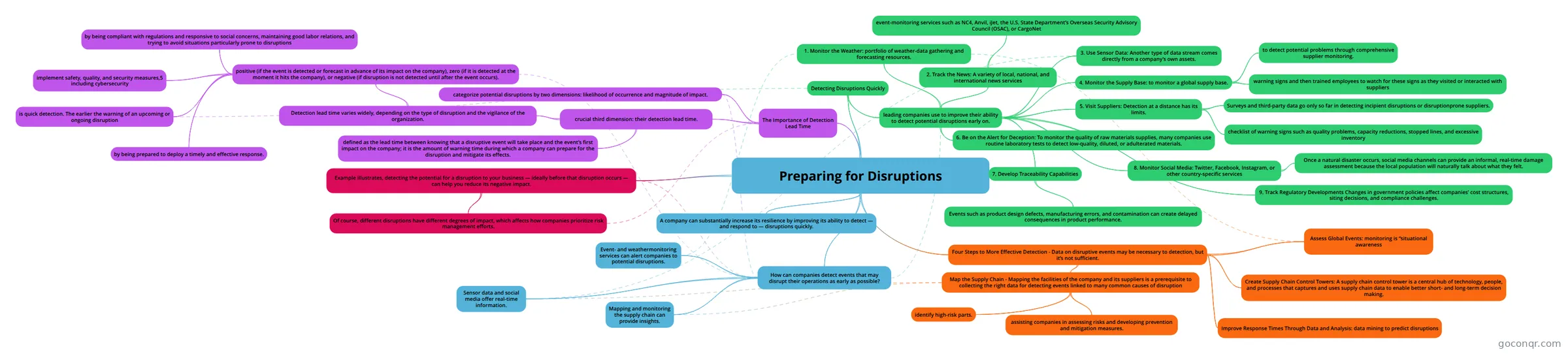
Mind map: preparing for disruptions
Inhalt der Mindmap
Preparing for Disruptions
A company can substantially increase its resilience by improving its ability to detect — and respond to — disruptions quickly.
How can companies detect events that may disrupt their operations as early as possible?
- Event- and weathermonitoring services can alert companies to potential disruptions.
- Sensor data and social media offer real-time information.
- Mapping and monitoring the supply chain can provide insights.
Example illustrates, detecting the potential for a disruption to your business — ideally before that disruption occurs — can help you reduce its negative impact.
- Of course, different disruptions have different degrees of impact, which affects how companies prioritize risk management efforts.
The Importance of Detection Lead Time
- categorize potential disruptions by two dimensions: likelihood of occurrence and magnitude of impact.
- crucial third dimension: their detection lead time.
- defined as the lead time between knowing that a disruptive event will take place and the event’s first impact on the company; it is the amount of warning time during which a company can prepare for the disruption and mitigate its effects.
- Detection lead time varies widely, depending on the type of disruption and the vigilance of the organization.
- positive (if the event is detected or forecast in advance of its impact on the company), zero (if it is detected at the moment it hits the company), or negative (if disruption is not detected until after the event occurs).
- by being compliant with regulations and responsive to social concerns, maintaining good labor relations, and trying to avoid situations particularly prone to disruptions
- implement safety, quality, and security measures,5 including cybersecurity
- by being prepared to deploy a timely and effective response.
- is quick detection. The earlier the warning of an upcoming or ongoing disruption
- positive (if the event is detected or forecast in advance of its impact on the company), zero (if it is detected at the moment it hits the company), or negative (if disruption is not detected until after the event occurs).
Detecting Disruptions Quickly
- leading companies use to improve their ability to detect potential disruptions early on.
- 1. Monitor the Weather: portfolio of weather-data gathering and forecasting resources.
- 2. Track the News: A variety of local, national, and international news services
- event-monitoring services such as NC4, Anvil, iJet, the U.S. State Department’s Overseas Security Advisory Council (OSAC), or CargoNet
- 3. Use Sensor Data: Another type of data stream comes directly from a company’s own assets.
- 4. Monitor the Supply Base: to monitor a global supply base.
- to detect potential problems through comprehensive supplier monitoring.
- warning signs and then trained employees to watch for these signs as they visited or interacted with suppliers
- 5. Visit Suppliers: Detection at a distance has its limits.
- Surveys and third-party data go only so far in detecting incipient disruptions or disruptionprone suppliers.
- checklist of warning signs such as quality problems, capacity reductions, stopped lines, and excessive inventory
- 6. Be on the Alert for Deception: To monitor the quality of raw materials supplies, many companies use routine laboratory tests to detect low-quality, diluted, or adulterated materials.
- 7. Develop Traceability Capabilities
- Events such as product design defects, manufacturing errors, and contamination can create delayed consequences in product performance.
- 8. Monitor Social Media: Twitter, Facebook, Instagram, or other country-specific services
- Once a natural disaster occurs, social media channels can provide an informal, real-time damage assessment because the local population will naturally talk about what they felt.
- 9. Track Regulatory Developments Changes in government policies affect companies’ cost structures, siting decisions, and compliance challenges.
- leading companies use to improve their ability to detect potential disruptions early on.
Four Steps to More Effective Detection - Data on disruptive events may be necessary to detection, but it’s not sufficient.
- Map the Supply Chain - Mapping the facilities of the company and its suppliers is a prerequisite to collecting the right data for detecting events linked to many common causes of disruption
- identify high-risk parts.
- assisting companies in assessing risks and developing prevention and mitigation measures.
- Assess Global Events: monitoring is “situational awareness
- Create Supply Chain Control Towers: A supply chain control tower is a central hub of technology, people, and processes that captures and uses supply chain data to enable better short- and long-term decision making.
- Improve Response Times Through Data and Analysis: data mining to predict disruptions
- Map the Supply Chain - Mapping the facilities of the company and its suppliers is a prerequisite to collecting the right data for detecting events linked to many common causes of disruption
Informationen
- Beschreibung
- Mindmap am Preparing for Disruptions, erstellt von Luis Rdz am 08/02/2019.
- Erstellt von
- Luis Rdz
- Aufrufe
- 5
- Bewertung
Mehr zu Supply Chain Resilience and Disruption Response