
Mindmap
GCSE Edexcel Physics - Motion and Forces
Inhalt der Mindmap
GCSE Edexcel Physics - Motion and Forces
A scalar has a magnitude but no direction
A vector has a magnitude and a direction
Velocity is speed in a stated direction
Speed = distance / time
On a distance time graph, the gradient is the speed
Acceleration = change in velocity / time
On a velocity time graph, the gradient is acceleration
On a velocity time graph, the area under the graph is the distance
Acceleration in free fall is 10ms^-2 due to gravity
Newtons first law - where the resultant force is 0, the object will remain stationary / at a constant velocity
Newton's second law - Force = mass x acceleration
Weight = mass x gravity
Weight can be measured using a newton meter
The higher the weight of a body, the higher it's gravitational field strength
An object moving in a circular motion has a constant speed but a changing velocity as it changes direction
For circular motion there must be a centripetal force towards the centre of the circle
Walking - 1.4m/s
Running - 3m/s
Cycling - 5.5 m/s
Cars (built up) - 13m/s
Cars (motorway) - 31m/s
Planes - 250m/s
Trains - 55m/s
Wind - 5-20m/s
Sound in air - 340m/s
Ferries - 15m/s
Weight is the force acting on an object due to gravity
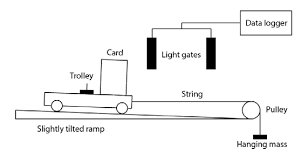
1) Record the mass of the trolley, unit masses and hanging hook
2) Mark a line on the ramp before the first light gate so the trolley moves the same distance
3) Attach the trolley to the hanging mass and let go of it at the start line
4) Each light gate records the time that the trolley passes through and the speed of it at that time
5) Acceleration can be calculated by using the initial speed (1st gate), final speed (last gate) and the time taken to move between them
Bilder und Dateien der Mindmap
Informationen
- Beschreibung
- Brief notes on topic 2 - motion and forces for edexcel physics higher tier students
- Erstellt von
- cc .
- Aufrufe
- 99
- Tags
- Bewertung