
Mindmap
VERBS TENSES I
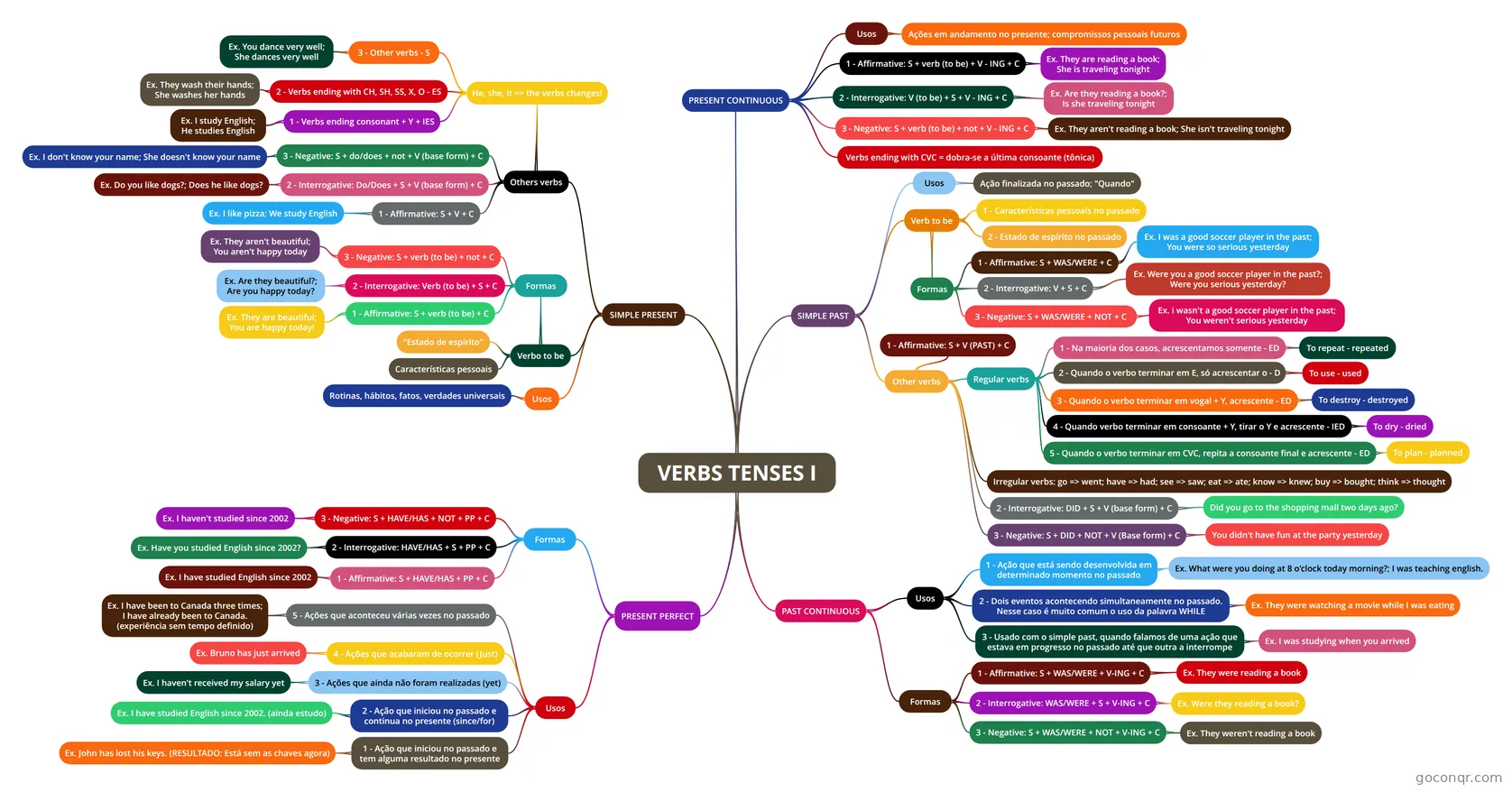
Mapa mental: Tempos verbais em inglês
Inhalt der Mindmap
VERBS TENSES I
SIMPLE PRESENT
- Usos
- Rotinas, hábitos, fatos, verdades universais
- Verbo to be
- Características pessoais
- "Estado de espírito"
- Formas
- 1 - Affirmative: S + verb (to be) + C
- Ex. They are beautiful; You are happy today!
- 2 - Interrogative: Verb (to be) + S + C
- Ex. Are they beautiful?; Are you happy today?
- 3 - Negative: S + verb (to be) + not + C
- Ex. They aren't beautiful; You aren't happy today
- 1 - Affirmative: S + verb (to be) + C
- Others verbs
- 1 - Affirmative: S + V + C
- Ex. I like pizza; We study English
- He, she, it => the verbs changes!
- 1 - Verbs ending consonant + Y + IES
- Ex. I study English; He studies English
- 2 - Verbs ending with CH, SH, SS, X, O - ES
- Ex. They wash their hands; She washes her hands
- 3 - Other verbs - S
- Ex. You dance very well; She dances very well
- 1 - Verbs ending consonant + Y + IES
- 2 - Interrogative: Do/Does + S + V (base form) + C
- Ex. Do you like dogs?; Does he like dogs?
- 3 - Negative: S + do/does + not + V (base form) + C
- Ex. I don't know your name; She doesn't know your name
- 1 - Affirmative: S + V + C
- Usos
PRESENT CONTINUOUS
- Usos
- Ações em andamento no presente; compromissos pessoais futuros
- 1 - Affirmative: S + verb (to be) + V - ING + C
- Ex. They are reading a book; She is traveling tonight
- 2 - Interrogative: V (to be) + S + V - ING + C
- Ex. Are they reading a book?; Is she traveling tonight
- 3 - Negative: S + verb (to be) + not + V - ING + C
- Ex. They aren't reading a book; She isn't traveling tonight
- Verbs ending with CVC = dobra-se a última consoante (tônica)
- Usos
SIMPLE PAST
- Usos
- Ação finalizada no passado; "Quando"
- Verb to be
- 1 - Características pessoais no passado
- 2 - Estado de espírito no passado
- Formas
- 1 - Affirmative: S + WAS/WERE + C
- Ex. I was a good soccer player in the past; You were so serious yesterday
- 2 - Interrogative: V + S + C
- Ex. Were you a good soccer player in the past?; Were you serious yesterday?
- 3 - Negative: S + WAS/WERE + NOT + C
- Ex. i wasn't a good soccer player in the past; You weren't serious yesterday
- 1 - Affirmative: S + WAS/WERE + C
- Other verbs
- 1 - Affirmative: S + V (PAST) + C
- Regular verbs
- 1 - Na maioria dos casos, acrescentamos somente - ED
- To repeat - repeated
- 2 - Quando o verbo terminar em E, só acrescentar o - D
- To use - used
- 3 - Quando o verbo terminar em vogal + Y, acrescente - ED
- To destroy - destroyed
- 4 - Quando verbo terminar em consoante + Y, tirar o Y e acrescente - IED
- To dry - dried
- 5 - Quando o verbo terminar em CVC, repita a consoante final e acrescente - ED
- To plan - planned
- 1 - Na maioria dos casos, acrescentamos somente - ED
- Irregular verbs: go => went; have => had; see => saw; eat => ate; know => knew; buy => bought; think => thought
- 2 - Interrogative: DID + S + V (base form) + C
- Did you go to the shopping mall two days ago?
- 3 - Negative: S + DID + NOT + V (Base form) + C
- You didn't have fun at the party yesterday
- Usos
PAST CONTINUOUS
- Usos
- 1 - Ação que está sendo desenvolvida em determinado momento no passado
- Ex. What were you doing at 8 o'clock today morning?; I was teaching english.
- 2 - Dois eventos acontecendo simultaneamente no passado. Nesse caso é muito comum o uso da palavra WHILE
- Ex. They were watching a movie while I was eating
- 3 - Usado com o simple past, quando falamos de uma ação que estava em progresso no passado até que outra a interrompe
- Ex. I was studying when you arrived
- 1 - Ação que está sendo desenvolvida em determinado momento no passado
- Formas
- 1 - Affirmative: S + WAS/WERE + V-ING + C
- Ex. They were reading a book
- 2 - Interrogative: WAS/WERE + S + V-ING + C
- Ex. Were they reading a book?
- 3 - Negative: S + WAS/WERE + NOT + V-ING + C
- Ex. They weren't reading a book
- 1 - Affirmative: S + WAS/WERE + V-ING + C
- Usos
PRESENT PERFECT
- Usos
- 1 - Ação que iniciou no passado e tem alguma resultado no presente
- Ex. John has lost his keys. (RESULTADO: Está sem as chaves agora)
- 2 - Ação que iniciou no passado e continua no presente (since/for)
- Ex. I have studied English since 2002. (ainda estudo)
- 3 - Ações que ainda não foram realizadas (yet)
- Ex. I haven't received my salary yet
- 4 - Ações que acabaram de ocorrer (Just)
- Ex. Bruno has just arrived
- 5 - Ações que aconteceu várias vezes no passado
- Ex. I have been to Canada three times; I have already been to Canada. (experiência sem tempo definido)
- 1 - Ação que iniciou no passado e tem alguma resultado no presente
- Formas
- 1 - Affirmative: S + HAVE/HAS + PP + C
- Ex. I have studied English since 2002
- 2 - Interrogative: HAVE/HAS + S + PP + C
- Ex. Have you studied English since 2002?
- 3 - Negative: S + HAVE/HAS + NOT + PP + C
- Ex. I haven't studied since 2002
- 1 - Affirmative: S + HAVE/HAS + PP + C
- Usos
Informationen
- Beschreibung
- Inglês Mindmap am VERBS TENSES I, erstellt von Erickson Santos am 21/10/2019.
- Erstellt von
- Erickson Santos
- Aufrufe
- 0
- Bewertung