
Mindmap
Haskell Modules
Inhalt der Mindmap
Haskell Modules
concepts
- Haskell Modules are a collection of related functions, types and type classes.
- Standard Haskell module is named prelude
- Modules are used to manipulate lists, concurrent programming, complex numbers, etc.
- Standard Haskell module is named prelude
- Haskell Modules are a collection of related functions, types and type classes.
why use modules
- Modules becomes reusables if they are enough generic
- Modules make programs loosely coupled
- Modules make more manageable by having it split into several parts
How to used
- Aggregate import clause and the name of Module at the beginning of your script
- Add as imports as you need in separate lines
- When you do import Data.List, all the functions that Data.List exports become available in the global namespace
- Add as imports as you need in separate lines
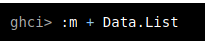
- From ghci terminal you may use :m + <name module>
- |
- If you just need a couple of functions from a module, you can selectively import just those functions.
- You might use hiding to exclude functions within modeles
- You can use qualified imports to deal with clashes and add an alias to imports
- Aggregate import clause and the name of Module at the beginning of your script
Haskell Included modules
- Data.List
- imterparse takes an element and a list and put the first arguent and put it between each element of the second argument list
- Intercalate function receives a list and a list of list and intercalate each element
- transpose function transposes a list of list
- concat function flatten a list of list in a single list
- concatMap: mapping a functionin a list and the concatenate
- 'and' and 'or' functions evaluates a predicate and return a boolean if condition accomplish
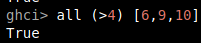
- any and all take a predicate and then check if any or all the elements in a list satisfy the predicate
- splitAt takes a number and a list. It then splits the list at that many elements
- takeWhile takes elements from a list while the predicate holds and then when an element is encountered that doesn't satisfy the predicate, it's cut off
- dropWhile drops all the elements while the predicate is true
- imterparse takes an element and a list and put the first arguent and put it between each element of the second argument list
- Data.Map
- Association lists (also called dictionaries) are lists that are used to store key-value pairs where ordering doesn't matter.
- The fromList function takes an association list
- empty represents an empty map. It takes no arguments, it just returns an empty map.
- insert takes a key, a value and a map and returns a new map that's just like the old one, only with the key and value inserted
- null checks if a map is empty.
- size reports the size of a map.
- singleton takes a key and a value and creates a map that has exactly one mapping.
- member is a predicate takes a key and a map and reports whether the key is in the map or not.
- keys and elems return lists of keys and values respectively. keys is the equivalent of map fst . Map.toList and elems is the equivalent of map snd . Map.toList.
- fromListWith is a cool little function. It acts like fromList, only it doesn't discard duplicate keys but it uses a function supplied to it to decide what to do with them. Let's say that a girl can have several numbers and we have an association list set up like this.
- insertWith is to insert what fromListWith is to fromList. It inserts a key-value pair into a map, but if that map already contains the key, it uses the function passed to it to determine what to do.
- Association lists (also called dictionaries) are lists that are used to store key-value pairs where ordering doesn't matter.
- Data.Char
- The Data.Char module does what its name suggests. It exports functions that deal with characters. It's also helpful when filtering and mapping over strings because they're just lists of characters.
- This module exports a bunch of predicates over characters
- isControl checks whether a character is a control character.
- isSpace checks whether a character is a white-space characters. That includes spaces, tab characters, newlines, etc.
- isLower and is Upper check is a character is upper or Lower case
- isAlpha checks whether a character is a letter.
- isAlphaNum checks whether a character is a letter or a number.
- isPrint checks whether a character is printable. Control characters, for instance, are not printable.
- isDigit checks whether a character is a digit.
- isLetter checks whether a character is a letter.
- isNumber checks whether a character is numeric.
- isSymbol checks whether a character is a fancy mathematical or currency symbol.
- isSeparator checks for Unicode spaces and separators.
- isAscii checks whether a character falls into the first 128 characters of the Unicode character set.
- isAsciiUpper or isAsciiLower check if is an ASCII is upper or lower case
- This module exports a bunch of predicates over characters
- The Data.Char module does what its name suggests. It exports functions that deal with characters. It's also helpful when filtering and mapping over strings because they're just lists of characters.
- Data.Set
- Sets are kind of like a cross between lists and maps. All the elements in a set are unique. And because they're internally implemented with trees (much like maps in Data.Map), they're ordered.
- The fromList function works much like you would expect.
- We can use the difference function to see which letters are in the first set but aren't in the second one and vice versa.
- we can see all the unique letters used in both sentences by using union.
- Sets are kind of like a cross between lists and maps. All the elements in a set are unique. And because they're internally implemented with trees (much like maps in Data.Map), they're ordered.
- Data.List
Making our own modules
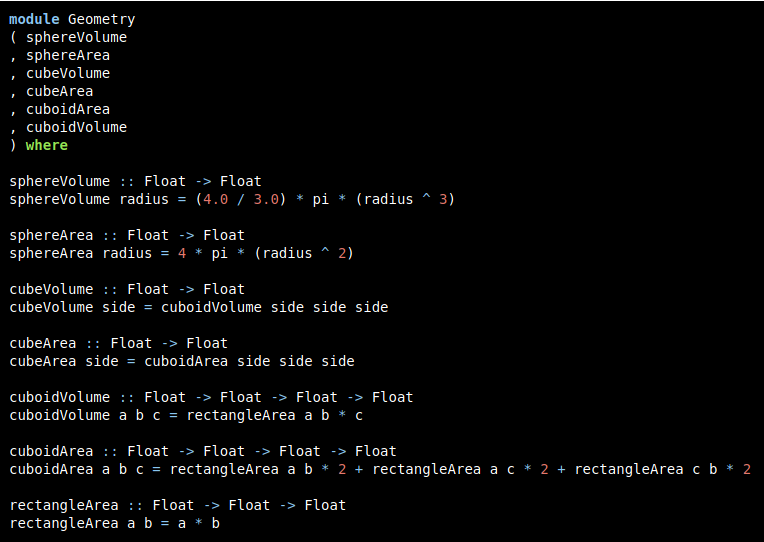
- Haskell allow us as many other lenguages to create our own modules
- We should create a file named with *.hs, the fist letter of the file should be in upper case
- At the beginning of a module, we specify the module name
- Then we defined the functions the will be included within de module
- Following we shold implement the functions we alredy define at the beginning of the module
- Following we shold implement the functions we alredy define at the beginning of the module
- Then we defined the functions the will be included within de module
- At the beginning of a module, we specify the module name
- We should create a file named with *.hs, the fist letter of the file should be in upper case
- Haskell allow us as many other lenguages to create our own modules
Bilder und Dateien der Mindmap














Informationen
- Beschreibung
- Haskell Modules
- Erstellt von
- TABARES ROMERO DIEGO MAURICIO
- Aufrufe
- 21
- Tags
- Bewertung