
Mindmap
Communicative Methods

Inhalt der Mindmap
Communicative Methods
they see it now as an approach (and not a method)
- Goal
- Make communicative competence the goal of language teaching and develop procedures for teaching the four language skills that recognize the interdependence of language and communication.
- Methods
- Cooperative language learning
- Meaning
- Cooperative learning is a group learning activity organized so that learning depends on the socially structured exchange of information between students in groups and in which each student is responsible for their own learning and is motivated to enhance the learning of others. (Olsen and Kagan 1992: 8)
- Characteristics
- Opportunities for naturalistic second language acquisition through the use of interactive peer and group activities
- - Provide teachers with a methodology that enables them to achieve this world and one that can be applied in a variety of curricular settings (for example, content-based foreign language classrooms;
- - To allow focused attention to particular lexical elements, the struc-tures language, and the communicative functions through the use of interactive tasks
- - Opportunities for students to develop successful learning and communication strategies
- - To improve student motivation and reduce student stress and create a positive affective classroom climate
- Focus
- Cooperative Language Learning is based on some basic premises about the interactive / cooperative nature of language learning
- Teachers
- A progressive format or sequencing of strategies in the conversation class that carefully prepares students, systematically breaks stereotypes of classroom procedure and allows them to begin to interact democratically and independently.
- Support structural and functional models, as well as language interaction models
- Example
- WIRTING
- SPEAKING
- READING
- LISENING
- Example
- Cooperative Learning emphasizes another important dimension of LLC: It seeks to develop classrooms that foster cooperation rather than competition in learning.
- Motivate students to increase each other's learning
- The teacher has to create a highly structured and well-organized learning environment in the classroom, setting goals, planning and structuring tasks
- Activity
- Question Matrix (Wiederhold 1995). Wiederhold has developed a battery of cooperative activities built on the matrix that encourages students to ask and answer a deeper range of alternative question types.
- Team practice from common contributions in which skills are developed and facts are mastered.
- materials
- Requires direct and active participation and participation of students
- Restructure lessons so that students can work on them cooperatively
- Modified from existing materials or taken from other disciplines.
- Activity
- Students
- Students learn step-by-step functional interaction techniques while building group spirit or trust
- The cooperation is working together to achieve shared goals.
- People seek beneficial results for themselves and for all other members of the group
- student-selected topics / resources - discovery learning
- Teachers
- Cooperative Language Learning is based on some basic premises about the interactive / cooperative nature of language learning
- Meaning
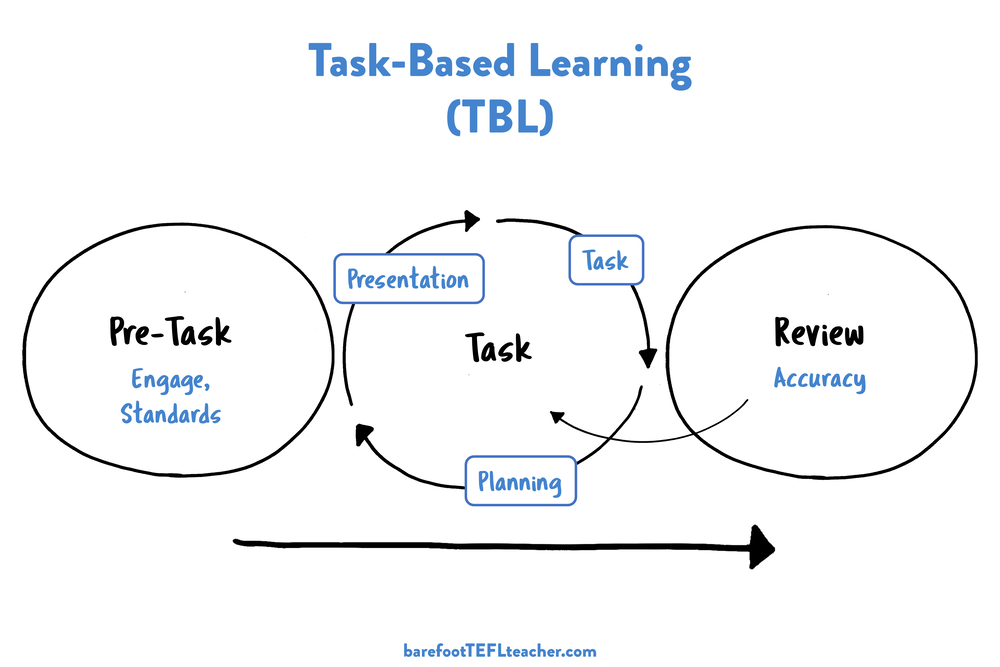
- Task-based language teaching
- Characteristics
- - Core elements are specific activities and tasks that emphasize communication and meaning.
- - Students learn language by interacting in a communicative and posed manner while participating in activities and tasks.
- - Activities and tasks can be: those that students might need to accomplish in real life; those that have a specific pedagogical purpose for the classroom.
- - The activities and tasks of a task-based curriculum are sequenced according to the difference.
- - The difficulty of a task depends on a number of factors, such as the student's previous experience, the complexity of the task, the language required to carry out the task, and the degree of support available.
- - The focus is on the process rather than the product.
- Focus
- TBLT is primarily motivated by a theory of learning rather than a theory of language. However, it can be said that various assumptions about the nature of language underlie current approaches to TBLT.
- Students
- Draw on the student's past experience, tolerate and encourage a variety of communication styles
- Students arrive at a result of an information
- include physical activity, involve partnership and collaboration.
- Motivation of the student and, therefore, promote learning
- Teachers
- Activity
- should be based on a careful analysis of the real-world needs of students
- The study plan
- conventional study plan has
- language structures
- Functions
- themes and themes
- macro-skills (reading, writing, listening, speaking)
- Competences
- text types
- vocabulary goals
- conventional study plan has
- ability to communicate accurately and effectively in the most common activities in the English language in which may be involved
- materials
- The materials that can be exploited for instruction in TBLT are limited only by the imagination of the task designer.
- can be adapted to a variety of situations
- Designing tasks there is a balance between cognitive processing and focus on form
- Pedagogical tasks, which have a psycholinguistic basis in SLA theory and research, but do not necessarily reflect real-world tasks
- Real-world tasks, which are designed to practice or rehearse those that are important in a needs analysis and are found to be important and useful in the real world.
- Activity
- Students
- TBLT is primarily motivated by a theory of learning rather than a theory of language. However, it can be said that various assumptions about the nature of language underlie current approaches to TBLT.
- Meaning
- The communicative task [is] a piece of work in the classroom that involves students in understanding, manipulating, producing, or interacting in the target language.
- Characteristics
- Cooperative language learning
- Methods
- Make communicative competence the goal of language teaching and develop procedures for teaching the four language skills that recognize the interdependence of language and communication.
- Goal
Bilder und Dateien der Mindmap


Informationen
- Beschreibung
- Communicative Methods
- Erstellt von
- harrizonfor la pelicula
- Aufrufe
- 21
- Bewertung