
Mindmap
ENGLISH - M1
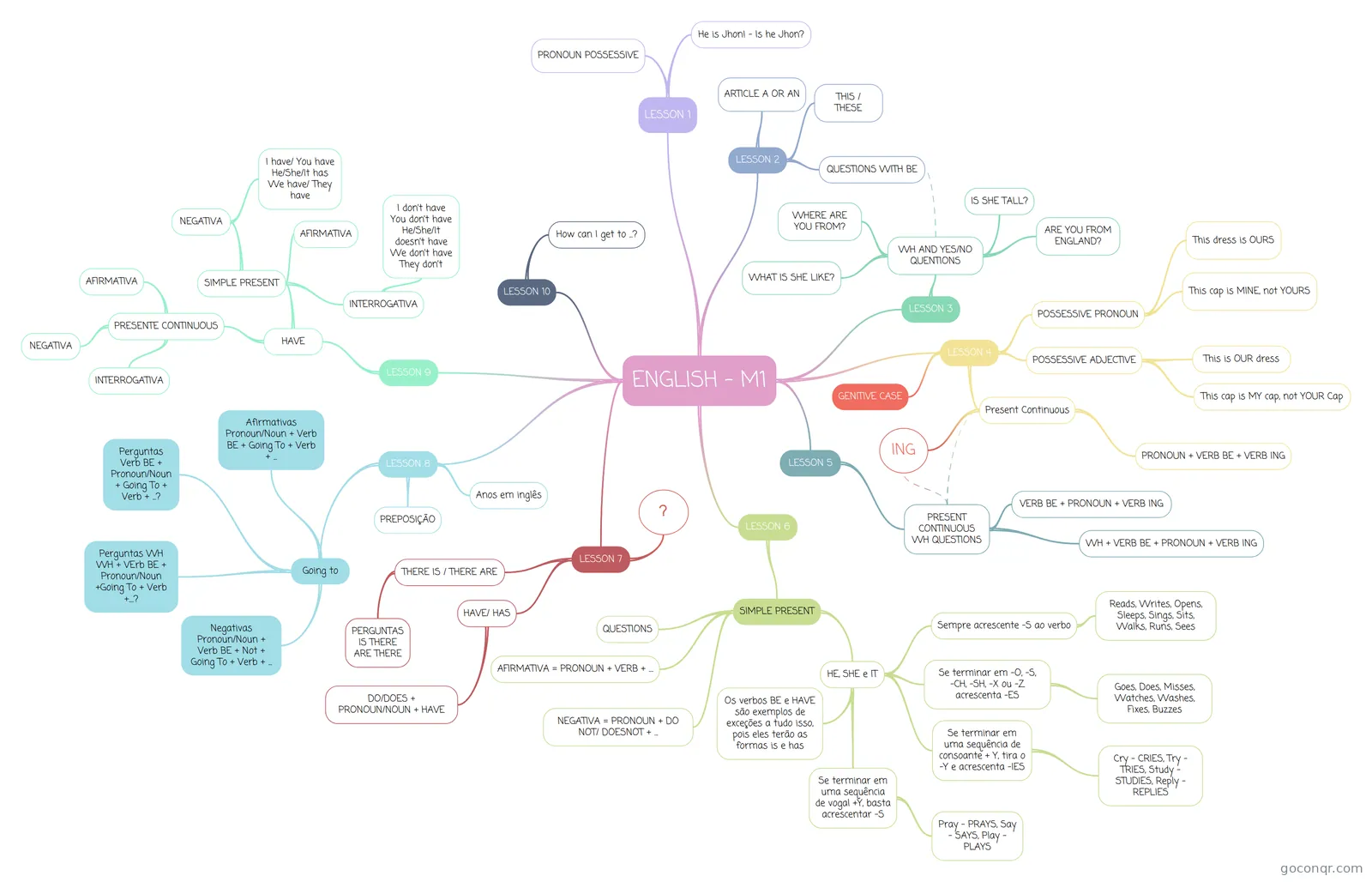
Mapa mental: Inglês módulo 1
Inhalt der Mindmap
ENGLISH - M1
LESSON 1
- PRONOUN POSSESSIVE
- MY - AM YOUR - ARE HER - IS HIS - IS ITS - IS OUR - ARE THEIR - ARE
- He is Jhon! - Is he Jhon?
- PRONOUN POSSESSIVE
LESSON 2
- ARTICLE A OR AN
- AN + Vowel sound A + Consonant sound This is A purse This is An umbrella
- THIS / THESE
- THIS - SINGULAR WHAT´S THIS? IT´S A CELLPHONE THESE - PLURAL WHAT ARE THESE? THEY ARE LAPTOPS
- QUESTIONS WITH BE
- YES/NO QUESTIONS IS this your wallet? ARE these your sunglasses? WHERE QUSTIONS WHERE is your wallet? WHERE are my sunglasses?
- ARTICLE A OR AN
LESSON 3
- WH AND YES/NO QUENTIONS
- WHERE ARE YOU FROM?
- WHAT IS SHE LIKE?
- ARE YOU FROM ENGLAND?
- IS SHE TALL?
- WH AND YES/NO QUENTIONS
LESSON 4
- POSSESSIVE PRONOUN
- MINE YOURS HIS HERS - OURS THEIRS Usado separado da "coisa"
- This cap is MINE, not YOURS
- This dress is OURS
- POSSESSIVE ADJECTIVE
- MY YOUR HIS HER ITS OUR THEIR Usada junto da "coisa"
- This is OUR dress
- This cap is MY cap, not YOUR Cap
- GENITIVE CASE
- - nome do dono + ‘s; -SER ANIMADO: pessoas e animais, nomes próprios, parentes em todos os graus, títulos, cargos, funções, profissões, e outros substantivos que só podem se referir a pessoas, como criança, menino(a), amigo(a), vizinho(a), colega de escola ou trabalho; Giovana’s boyfriend - SERES INANIMADOS. É o caso de tempo, medidas, lugares com nomes de pessoas, países, corpos celestes, a erra, o mundo, nomes que representam um grupo de pessoas(company, team, government, etc.),pessoas jurídicas e similares; St. Peter's Cathedral -Com nomes próprios reconhecidamente históricos, clássicos ou bíblicos terminados em -s: é mais comum a estrutura substantivo + of + substantivo, mas também pode ser usado o apóstrofo'.The teachings of Jesus ou Jesus' teachings; The laws of Moses ou Moses' laws
- Present Continuous
- PRONOUNS + VERB BE + (VERB ING) AFIRMATIVA: IT IS SNOWING I AM WEARING A DRESS SHE IS WEARING A SKIT IT IS RAINING PERGUNTA: IS IT SNOWING? AM I WEARING A DRESS? IS SHE WARING A SKIT? IT IS RAINING?
- ING
- PRONOUN + VERB BE + VERB ING
- POSSESSIVE PRONOUN
LESSON 5
- PRESENT CONTINUOUS WH QUESTIONS
- VERB BE + PRONOUN + VERB ING
- IS SHE SLEEPING?
- WH + VERB BE + PRONOUN + VERB ING
- WHAT are Lya and Erin doing? WHAT is Sarah doing? WHAT is Andy doing? WHAT is Anne doing?
- VERB BE + PRONOUN + VERB ING
- PRESENT CONTINUOUS WH QUESTIONS
LESSON 6
- SIMPLE PRESENT
- HE, SHE e IT
- Sempre acrescente -S ao verbo
- Reads, Writes, Opens, Sleeps, Sings, Sits, Walks, Runs, Sees
- Se terminar em -O, -S, -CH, -SH, -X ou -Z acrescenta -ES
- Goes, Does, Misses, Watches, Washes, Fixes, Buzzes
- Se terminar em uma sequência de consoante + Y, tira o -Y e acrescenta -IES
- Cry - CRIES, Try - TRIES, Study - STUDIES, Reply - REPLIES
- Se terminar em uma sequência de vogal +Y, basta acrescentar -S
- Pray - PRAYS, Say - SAYS, Play - PLAYS
- Os verbos BE e HAVE são exemplos de exceções a tudo isso, pois eles terão as formas is e has
- Sempre acrescente -S ao verbo
- AFIRMATIVA = PRONOUN + VERB + ....
- I walk to school; You ride your bike to school;He works near here; She takes the bus to work;
- NEGATIVA = PRONOUN + DO NOT/ DOESNOT + ...
- I don’t walk to school; You don’t ride your bike to school; He doesn’t work near here; Shedoesn’ttake the bus to work
- QUESTIONS
- What time DO you get up? When DO they take the bus? What time DOES she take the train?
- Do you get up early? Do they take the bus? Does she take the train?
- HE, SHE e IT
- SIMPLE PRESENT
LESSON 7
- THERE IS / THERE ARE
- quando a ideia é de haver/existir.
- PERGUNTAS IS THERE ARE THERE
- HAVE/ HAS
- Usamos HAS/HAVE quando estamos transmitindo a ideia de possuir
- DO/DOES + PRONOUN/NOUN + HAVE
- ?
- Use SOME em afirmativas quando o substantivo envolvido for incontável e queremos dar o sentido de “um pouco de”. I have some money in my wallet. (Eu tenho um pouco de dinheiro na minha carteira) Também é possível usar em substantivos contáveis, quando não queremos especificar a quantidade envolvida: “algumas/alguns”. There are some chairs in the kitchen. Use ANY em sentenças negativas quando o significado for de “nenhum/nenhuma”. There aren’t any chairs in the kitchen (Têm/Há algumas cadeiras na cozinha) There are some chairs in the kitchen.
- THERE IS NOT (ISN'T) / THERE IS NO; THERE ARE NOT (AREN'T) / THERE ARE NO; DO NOT (DON'T) HAVE; DOES NOT (DOSEN'T) HAVE
- Use ANY em sentenças negativas quando o significado for de “nenhum/nenhuma”. There aren’t any chairs in the kitchen (Têm/Há algumas cadeiras na cozinha) (Não têm/há nenhuma cadeira na cozinha) Não use ANY com substantivos singulares e contáveis (singular countable nouns). “There isn’t a single biscuit left in the packet.” “There isn’t any single biscuit left in the packet.” “There isn’t a freezerin the kitchen.” (singular, countable noun) “There isn’t any money in my wallet.” (uncountable noun) “There aren’t any students in the classroom.” (plural noun) “We don't have any food left” (uncountable nou
- O ANY também pode ser usado em perguntas com o significado de “alguma/algum”. Are there any chairs in the kitchen? (Tem/há alguma cadeira na cozinha?)
- THERE IS / THERE ARE
LESSON 8
- PREPOSIÇÃO
- Preposição para meses: IN “I was born in September” Quando escrevemos uma data mais detalhada, com o mês e o dia, usamos a preposição ON “I was born on September9th” Preposição para dias da semana: ON “I liketo work out on Mondays”
- Anos em inglês
- Para falar os anos antes de 2000, basta ler os primeiros dois dígitos e depois os últimos dois dígitos: 1817 se lê “eighteen seveteen”. A partir de 2000, usamos o “thousand” que é o “mil” em inglês: 2010 se lê “two thousand (and) teen”.
- Going to
- Afirmativas Pronoun/Noun + Verb BE + Going To + Verb + ...
- She is going to go to the supermarket tomorrow night. They are going to travel to Europe on March 2nd, 2020.
- Negativas Pronoun/Noun + Verb BE + Not + Going To + Verb + ...
- She is not going to go to thesupermarket tomorrow night. They are not going to travel to Europe on March 2nd, 2020.
- Perguntas Verb BE + Pronoun/Noun + Going To + Verb + ...?
- Where Is she going to go? She is going to thesupermarket. Where Are they going to travel? They are going to travel to Europe When Are they going to travel? They are going to travel on March 2nd, 2020.
- Perguntas WH WH + VErb BE + Pronoun/Noun +Going To + Verb +....?
- Is she going to go to thesupermarket tomorrow night? Are they going to travel to Europe on March 2nd, 2020?
- Afirmativas Pronoun/Noun + Verb BE + Going To + Verb + ...
- PREPOSIÇÃO
LESSON 9
- HAVE
- SIMPLE PRESENT
- AFIRMATIVA
- Do I have...? Do you have...?Does she/he/ithave...? Do we have...? Do they have..?
- NEGATIVA
- I have/ You have He/She/It has We have/ They have
- INTERROGATIVA
- I don’t have You don’t have He/She/It doesn’t have We don’t have They don’t
- AFIRMATIVA
- PRESENTE CONTINUOUS
- AFIRMATIVA
- I am having You are having He/She/It is having We are having They are having
- INTERROGATIVA
- Am I having...? Are you having...? Is he/she/it having...? Are they having...?
- NEGATIVA
- I am not having You are not having He/She/It is not having We are not having They are not having
- AFIRMATIVA
- SIMPLE PRESENT
- HAVE
LESSON 10
- How can I get to ...?
- Para pedir direções, usamos:
- How can I get to ...?
Informationen
- Beschreibung
- Mindmap am ENGLISH - M1, erstellt von Maria Laura Canuto am 04/05/2020.
- Erstellt von
- Maria Laura Canuto
- Aufrufe
- 5
- Bewertung
Mehr zu Simple present e present continuous