
Mindmap
Colombian Education
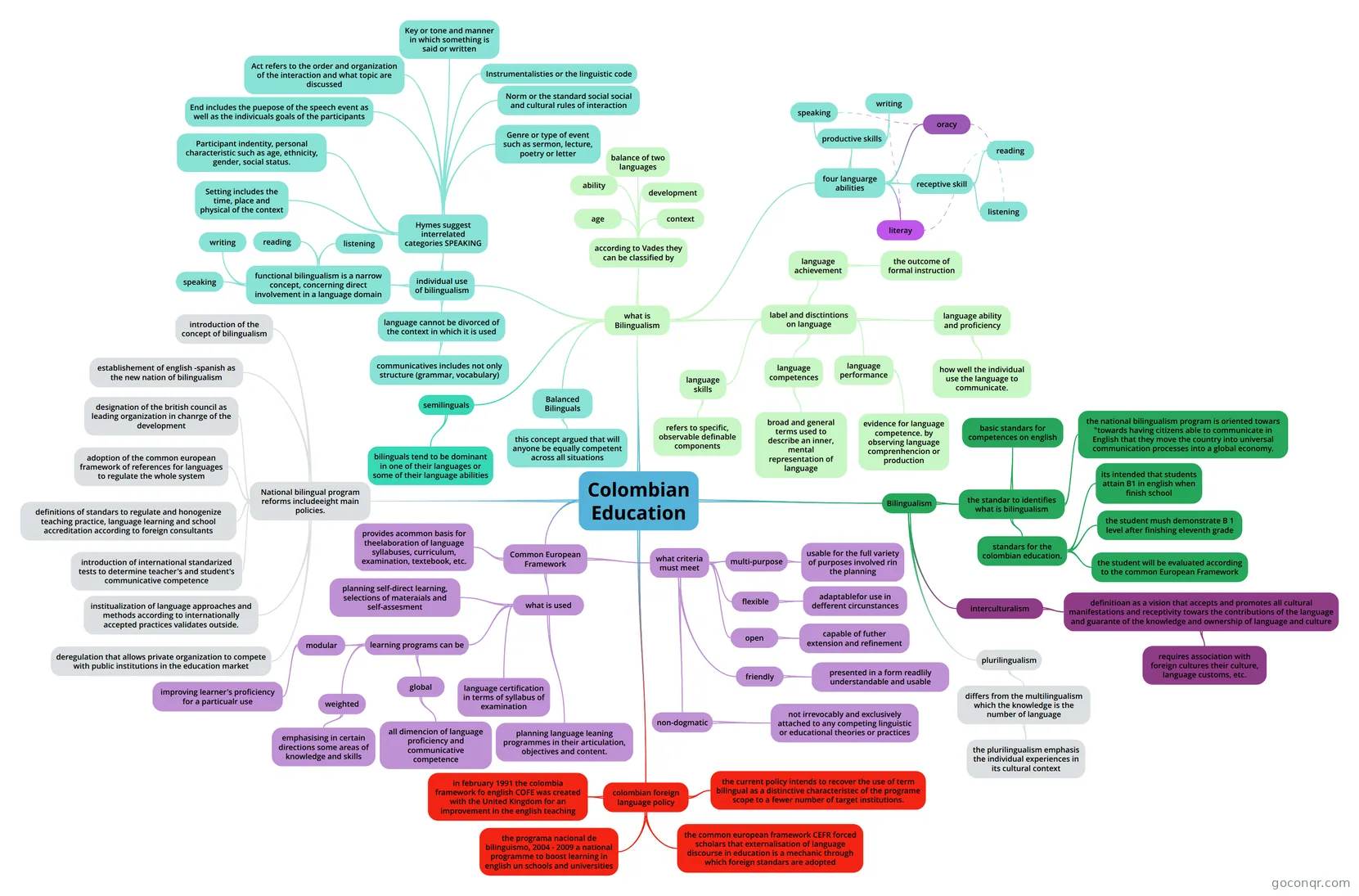
Mind map: Colombian education
Inhalt der Mindmap
Colombian Education
colombian foreign language policy
- in february 1991 the colombia framework fo english COFE was created with the United Kingdom for an improvement in the english teaching
- the programa nacional de bilinguismo, 2004 - 2009 a national programme to boost learning in english un schools and universities
- the common european framework CEFR forced scholars that externalisation of language discourse in education is a mechanic through which foreign standars are adopted
- the current policy intends to recover the use of term bilingual as a distinctive characteristec of the programe scope to a fewer number of target institutions.
Bilingualism
- the standar to identifies what is bilingualism
- basic standars for competences on english
- the national bilingualism program is oriented towars "towards having citizens able to communicate in English that they move the country into universal communication processes into a global economy.
- standars for the colombian education.
- its intended that students attain B1 in english when finish school
- the student mush demonstrate B 1 level after finishing eleventh grade
- the student will be evaluated according to the common European Framework
- interculturalism
- definitioan as a vision that accepts and promotes all cultural manifestations and receptivity towars the contributions of the language and guarante of the knowledge and ownership of language and culture
- requires association with foreign cultures their culture, language customs, etc.
- definitioan as a vision that accepts and promotes all cultural manifestations and receptivity towars the contributions of the language and guarante of the knowledge and ownership of language and culture
- plurilingualism
- differs from the multilingualism which the knowledge is the number of language
- the plurilingualism emphasis the individual experiences in its cultural context
- differs from the multilingualism which the knowledge is the number of language
- the standar to identifies what is bilingualism
National bilingual program reforms includeeight main policies.
- introduction of the concept of bilingualism
- establishement of english -spanish as the new nation of bilingualism
- designation of the british council as leading organization in chanrge of the development
- adoption of the common european framework of references for languages to regulate the whole system
- definitions of standars to regulate and honogenize teaching practice, language learning and school accreditation according to foreign consultants
- introduction of international standarized tests to determine teacher's and student's communicative competence
- institualization of language approaches and methods according to internationally accepted practices validates outside.
- deregulation that allows private organization to compete with public institutions in the education market
what is Bilingualism
- label and disctintions on language
- language skills
- refers to specific, observable definable components
- language competences
- broad and general terms used to describe an inner, mental representation of language
- language performance
- evidence for language competence. by observing language comprenhencion or production
- language ability and proficiency
- how well the individual use the language to communicate.
- language achievement
- the outcome of formal instruction
- language skills
- four languarge abilities
- receptive skill
- listening
- reading
- productive skills
- speaking
- writing
- oracy
- literay
- receptive skill
- according to Vades they can be classified by
- age
- ability
- balance of two languages
- development
- context
- Balanced Bilinguals
- this concept argued that will anyone be equally competent across all situations
- semilinguals
- bilinguals tend to be dominant in one of their languages or some of their language abilities
- individual use of bilingualism
- language cannot be divorced of the context in which it is used
- communicatives includes not only structure (grammar, vocabulary)
- functional bilingualism is a narrow concept, concerning direct involvement in a language domain
- speaking
- writing
- reading
- listening
- Hymes suggest interrelated categories SPEAKING
- Setting includes the time, place and physical of the context
- Participant indentity, personal characteristic such as age, ethnicity, gender, social status.
- End includes the puepose of the speech event as well as the indivicuals goals of the participants
- Act refers to the order and organization of the interaction and what topic are discussed
- Key or tone and manner in which something is said or written
- Instrumentalisties or the linguistic code
- Norm or the standard social social and cultural rules of interaction
- Genre or type of event such as sermon, lecture, poetry or letter
- language cannot be divorced of the context in which it is used
- label and disctintions on language
Common European Framework
- provides acommon basis for theelaboration of language syllabuses, curriculum, examination, textebook, etc.
- what is used
- planning language leaning programmes in their articulation, objectives and content.
- language certification in terms of syllabus of examination
- planning self-direct learning, selections of materaials and self-assesment
- learning programs can be
- global
- all dimencion of language proficiency and communicative competence
- modular
- improving learner's proficiency for a particualr use
- weighted
- emphasising in certain directions some areas of knowledge and skills
- global
- what criteria must meet
- multi-purpose
- usable for the full variety of purposes involved rin the planning
- flexible
- adaptablefor use in defferent circunstances
- open
- capable of futher extension and refinement
- friendly
- presented in a form readlily understandable and usable
- non-dogmatic
- not irrevocably and exclusively attached to any competing linguistic or educational theories or practices
- multi-purpose
Informationen
- Beschreibung
- Mindmap am Colombian Education, erstellt von leonardo olaya am 12/05/2020.
- Erstellt von
- leonardo olaya
- Aufrufe
- 2
- Bewertung
Mehr zu Bilingual Education Policy in Colombia