
Mindmap
Physics Exam 1
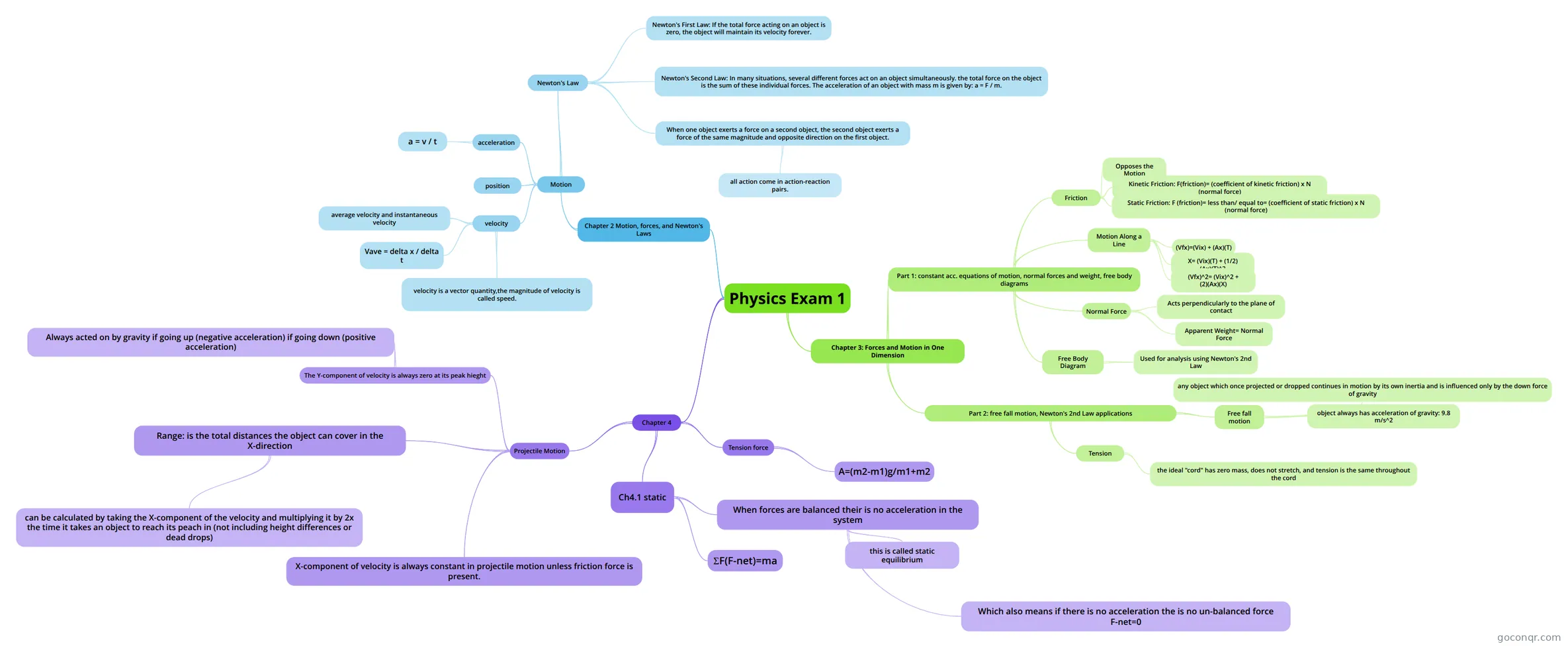
Mind map: Physics exam 1: motion and forces
Inhalt der Mindmap
Physics Exam 1
Chapter 2 Motion, forces, and Newton's Laws
- Motion
- acceleration
- a = v / t
- position
- velocity
- velocity is a vector quantity,the magnitude of velocity is called speed.
- Vave = delta x / delta t
- average velocity and instantaneous velocity
- Newton's Law
- Newton's First Law: If the total force acting on an object is zero, the object will maintain its velocity forever.
- Newton's Second Law: In many situations, several different forces act on an object simultaneously. the total force on the object is the sum of these individual forces. The acceleration of an object with mass m is given by: a = F / m.
- When one object exerts a force on a second object, the second object exerts a force of the same magnitude and opposite direction on the first object.
- all action come in action-reaction pairs.
- acceleration
- Motion
Chapter 3: Forces and Motion in One Dimension
- Part 1: constant acc. equations of motion, normal forces and weight, free body diagrams
- Motion Along a Line
- (Vfx)=(Vix) + (Ax)(T)
- X= (Vix)(T) + (1/2) (Ax)(T)^2
- (Vfx)^2= (Vix)^2 + (2)(Ax)(X)
- Normal Force
- Acts perpendicularly to the plane of contact
- Apparent Weight= Normal Force
- Free Body Diagram
- Used for analysis using Newton's 2nd Law
- Friction
- Opposes the Motion
- Kinetic Friction: F(friction)= (coefficient of kinetic friction) x N (normal force)
- Static Friction: F (friction)= less than/ equal to= (coefficient of static friction) x N (normal force)
- Motion Along a Line
- Part 2: free fall motion, Newton's 2nd Law applications
- Free fall motion
- any object which once projected or dropped continues in motion by its own inertia and is influenced only by the down force of gravity
- object always has acceleration of gravity: 9.8 m/s^2
- Tension
- the ideal "cord" has zero mass, does not stretch, and tension is the same throughout the cord
- Free fall motion
- Part 1: constant acc. equations of motion, normal forces and weight, free body diagrams
Chapter 4
- Ch4.1 static
- ΣF(F-net)=ma
- When forces are balanced their is no acceleration in the system
- this is called static equilibrium
- Which also means if there is no acceleration the is no un-balanced force F-net=0
- Projectile Motion
- X-component of velocity is always constant in projectile motion unless friction force is present.
- The Y-component of velocity is always zero at its peak hieght
- Always acted on by gravity if going up (negative acceleration) if going down (positive acceleration)
- Range: is the total distances the object can cover in the X-direction
- can be calculated by taking the X-component of the velocity and multiplying it by 2x the time it takes an object to reach its peach in (not including height differences or dead drops)
- Tension force
- A=(m2-m1)g/m1+m2
- Ch4.1 static
Informationen
- Beschreibung
- Mindmap am Physics Exam 1, erstellt von oliviab am 24/09/2013.
- Erstellt von
- oliviab
- Aufrufe
- 93
- Bewertung