
Mindmap
Six Concepts of Discrete Mathematics MAT1348
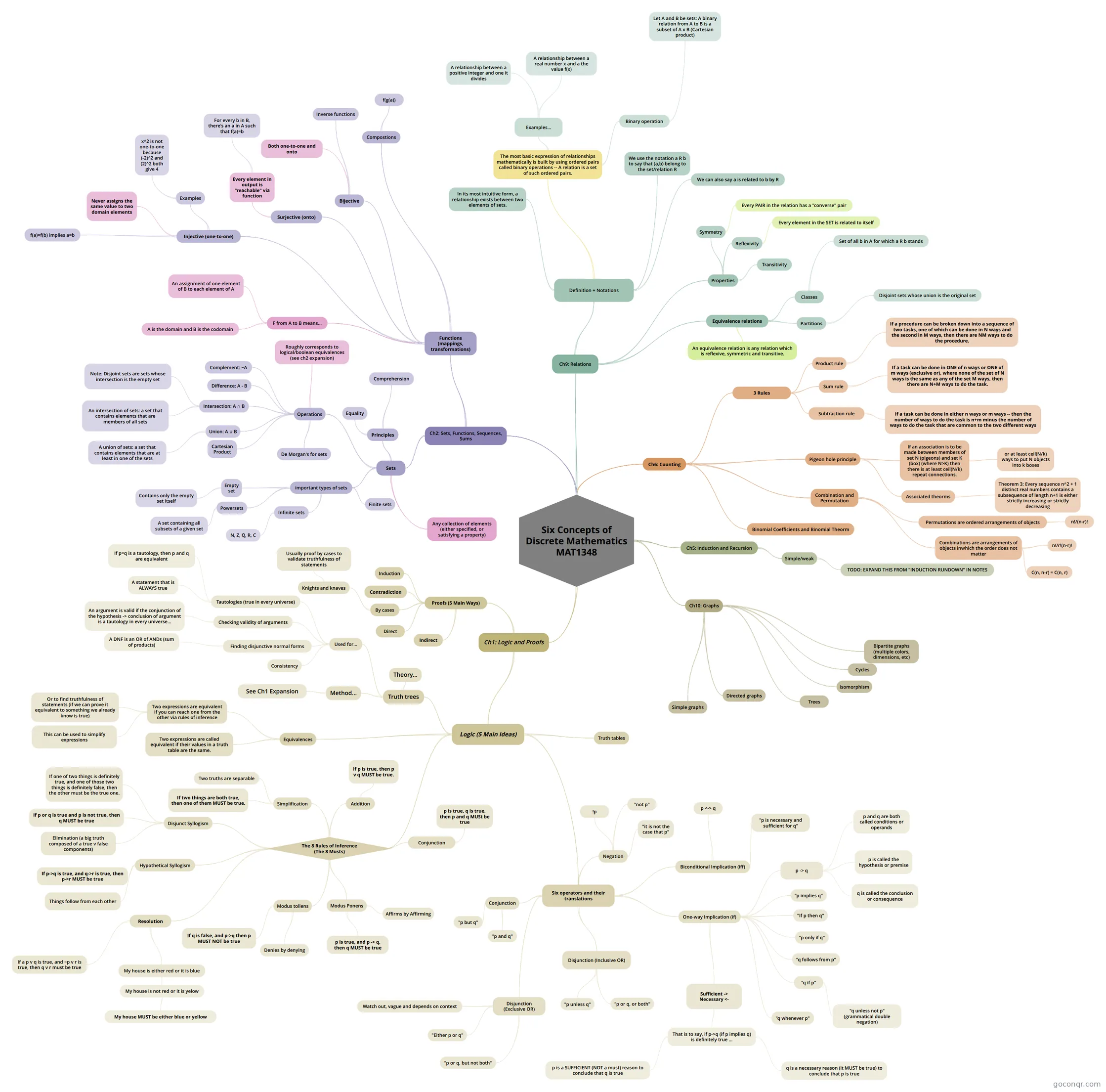
Mind map: Six concepts of discrete mathematics
Inhalt der Mindmap
Six Concepts of Discrete Mathematics MAT1348
Ch1: Logic and Proofs
- Logic (5 Main Ideas)
- Truth tables
- Equivalences
- Two expressions are called equivalent if their values in a truth table are the same.
- Two expressions are equivalent if you can reach one from the other via rules of inference
- This can be used to simplify expressions
- Or to find truthfulness of statements (if we can prove it equivalent to something we already know is true)
- The 8 Rules of Inference (The 8 Musts)
- Modus Ponens
- Affirms by Affirming
- p is true, and p -> q, then q MUST be true
- Modus tollens
- Denies by denying
- If q is false, and p->q then p MUST NOT be true
- Hypothetical Syllogism
- Things follow from each other
- If p->q is true, and q->r is true, then p->r MUST be true
- Disjunct Syllogism
- If p or q is true and p is not true, then q MUST be true
- If one of two things is definitely true, and one of those two things is definitely false, then the other must be the true one.
- Elimination (a big truth composed of a true v false components)
- Addition
- If p is true, then p v q MUST be true.
- Simplification
- If two things are both true, then one of them MUST be true.
- Two truths are separable
- Conjunction
- p is true, q is true, then p and q MUSt be true
- Resolution
- My house is either red or it is blue
- My house is not red or it is yelow
- My house MUST be either blue or yellow
- My house is not red or it is yelow
- If a p v q is true, and ~p v r is true, then q v r must be true
- My house is either red or it is blue
- Modus Ponens
- Six operators and their translations
- Negation
- !p
- "not p"
- "it is not the case that p"
- Conjunction
- "p and q"
- "p but q"
- Disjunction (Inclusive OR)
- "p or q, or both"
- "p unless q"
- Disjunction (Exclusive OR)
- Watch out, vague and depends on context
- "Either p or q"
- "p or q, but not both"
- Biconditional Implication (iff)
- p <-> q
- "p is necessary and sufficient for q"
- One-way Implication (if)
- p -> q
- p is called the hypothesis or premise
- q is called the conclusion or consequence
- p and q are both called conditions or operands
- "p implies q"
- "If p then q"
- "p only if q"
- "q follows from p"
- Sufficient -> Necessary <-
- That is to say, if p->q (if p implies q) is definitely true ...
- p is a SUFFICIENT (NOT a must) reason to conclude that q is true
- q is a necessary reason (it MUST be true) to conclude that p is true
- That is to say, if p->q (if p implies q) is definitely true ...
- "q if p"
- "q unless not p" (grammatical double negation)
- "q whenever p"
- p -> q
- Negation
- Truth trees
- Used for...
- Finding disjunctive normal forms
- A DNF is an OR of ANDs (sum of products)
- Consistency
- Tautologies (true in every universe)
- A statement that is ALWAYS true
- If p=q is a tautology, then p and q are equivalent
- Checking validity of arguments
- An argument is valid if the conjunction of the hypothesis -> conclusion of argument is a tautology in every universe...
- Finding disjunctive normal forms
- Method...
- See Ch1 Expansion
- Theory...
- Used for...
- Proofs (5 Main Ways)
- Direct
- By cases
- Knights and knaves
- Usually proof by cases to validate truthfulness of statements
- Knights and knaves
- Induction
- Indirect
- Contradiction
- Logic (5 Main Ideas)
Ch2: Sets, Functions, Sequences, Sums
- Functions (mappings, transformations)
- Injective (one-to-one)
- f(a)=f(b) implies a=b
- Never assigns the same value to two domain elements
- Examples
- x^2 is not one-to-one because (-2)^2 and (2)^2 both give 4
- Bijective
- Inverse functions
- Both one-to-one and onto
- Surjective (onto)
- Every element in output is "reachable" via function
- For every b in B, there's an a in A such that f(a)=b
- Every element in output is "reachable" via function
- Compostions
- f(g(a))
- F from A to B means...
- An assignment of one element of B to each element of A
- A is the domain and B is the codomain
- Injective (one-to-one)
- Sets
- Operations
- Cartesian Product
- Union: A ∪ B
- A union of sets: a set that contains elements that are at least in one of the sets
- Intersection: A ∩ B
- Note: Disjoint sets are sets whose intersection is the empty set
- An intersection of sets: a set that contains elements that are members of all sets
- Difference: A - B
- Complement: ~A
- Roughly corresponds to logical/boolean equivalences (see ch2 expansion)
- De Morgan's for sets
- important types of sets
- Powersets
- A set containing all subsets of a given set
- Empty set
- Contains only the empty set itself
- Infinite sets
- N, Z, Q, R, C
- Finite sets
- Powersets
- Principles
- Equality
- Comprehension
- Any collection of elements (either specified, or satisfying a property)
- Operations
- Functions (mappings, transformations)
Ch9: Relations
- Equivalence relations
- Classes
- Set of all b in A for which a R b stands
- Partitions
- Disjoint sets whose union is the original set
- An equivalence relation is any relation which is reflexive, symmetric and transitive.
- Classes
- Definition + Notations
- The most basic expression of relationships mathematically is built by using ordered pairs called binary operations -- A relation is a set of such ordered pairs.
- Examples...
- A relationship between a positive integer and one it divides
- A relationship between a real number x and a the value f(x)
- Binary operation
- Let A and B be sets: A binary relation from A to B is a subset of A x B (Cartesian product)
- Examples...
- In its most intuitive form, a relationship exists between two elements of sets.
- We use the notation a R b to say that (a,b) belong to the set/relation R
- We can also say a is related to b by R
- The most basic expression of relationships mathematically is built by using ordered pairs called binary operations -- A relation is a set of such ordered pairs.
- Properties
- Symmetry
- Every PAIR in the relation has a "converse" pair
- Reflexivity
- Every element in the SET is related to itself
- Transitivity
- Symmetry
- Equivalence relations
Ch6: Counting
- Pigeon hole principle
- If an association is to be made between members of set N (pigeons) and set K (box) (where N>K) then there is at least ceil(N/k) repeat connections.
- or at least ceil(N/k) ways to put N objects into k boxes
- Associated theorms
- Theorem 3: Every sequence n^2 + 1 distinct real numbers contains a subsequence of length n+1 is either strictly increasing or strictly decreasing
- If an association is to be made between members of set N (pigeons) and set K (box) (where N>K) then there is at least ceil(N/k) repeat connections.
- Combination and Permutation
- Permutations are ordered arrangements of objects
- n!/(n-r)!
- Combinations are arrangements of objects inwhich the order does not matter
- n!/r!(n-r)!
- C(n, n-r) = C(n, r)
- Permutations are ordered arrangements of objects
- 3 Rules
- Product rule
- If a procedure can be broken down into a sequence of two tasks, one of which can be done in N ways and the second in M ways, then there are NM ways to do the procedure.
- Sum rule
- If a task can be done in ONE of n ways or ONE of m ways (exclusive or), where none of the set of N ways is the same as any of the set M ways, then there are N+M ways to do the task.
- Subtraction rule
- If a task can be done in either n ways or m ways -- then the number of ways to do the task is n+m minus the number of ways to do the task that are common to the two different ways
- Product rule
- Binomial Coefficients and Binomial Theorm
- Pigeon hole principle
Ch5: Induction and Recursion
- Simple/weak
- TODO: EXPAND THIS FROM "INDUCTION RUNDOWN" IN NOTES
- Simple/weak
Ch10: Graphs
- Isomorphism
- Cycles
- Trees
- Directed graphs
- Simple graphs
- Bipartite graphs (multiple colors, dimensions, etc)
Informationen
- Beschreibung
- finals mat1348 Mindmap am Six Concepts of Discrete Mathematics MAT1348, erstellt von gargantua am 05/04/2015.
- Erstellt von
- gargantua
- Aufrufe
- 76
- Bewertung