
Mindmap
Ethics second partial
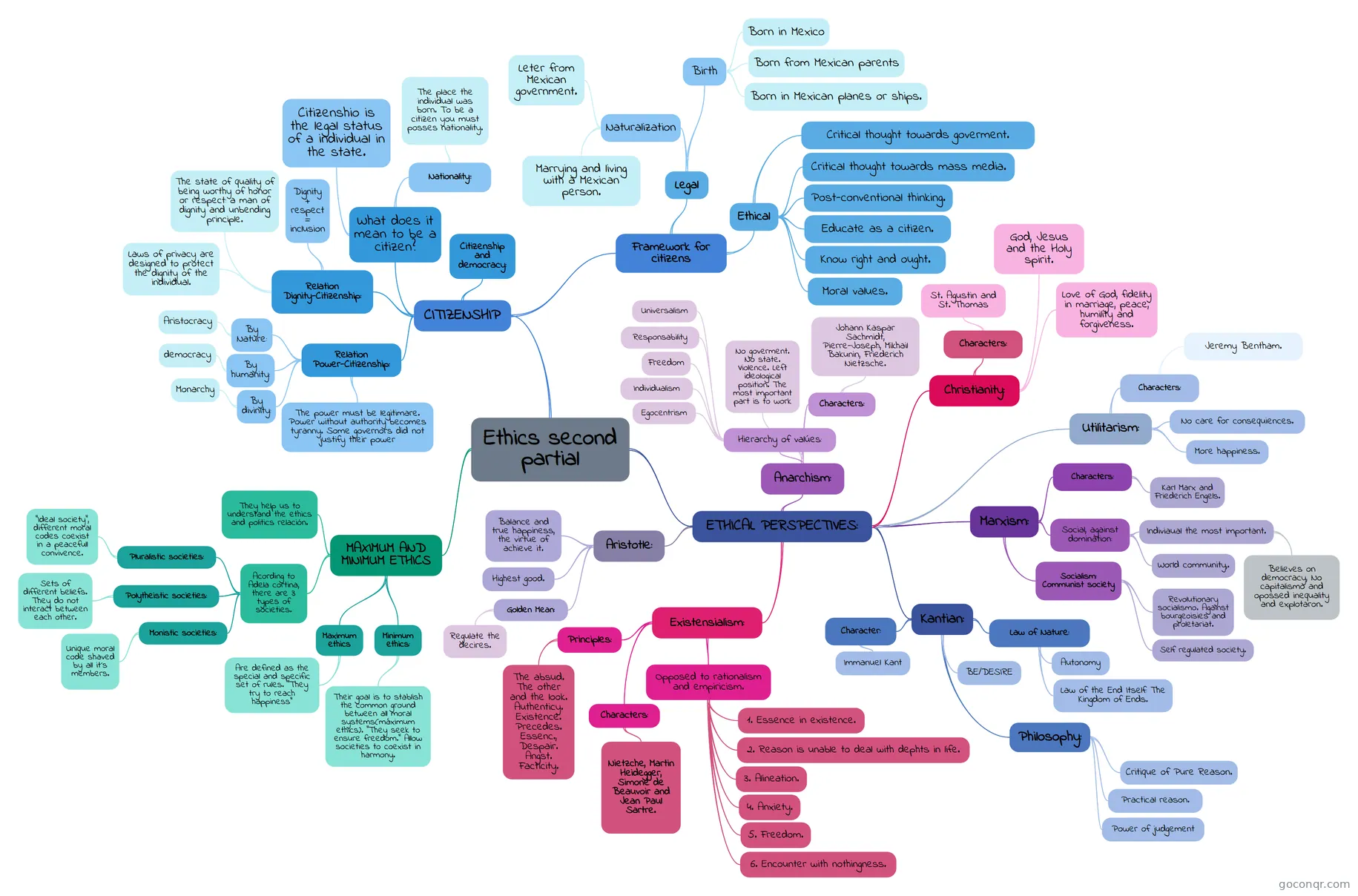
Mind map: Ethics second partial
Inhalt der Mindmap
Ethics second partial
MAXIMUM AND MINIMUM ETHICS
- They help us to understand the ethics and politics relación.
- Maximum ethics
- Are defined as the special and specific set of rules. "They try to reach happiness"
- Minimum ethics:
- Their goal is to stablish the common ground between all moral systems(máximum ethics). "They seek to ensure freedom." Allow societies to coexist in harmony.
- Acording to Adela cortina, there are 3 types of societies.
- Pluralistic societies:
- "Ideal society", different moral codes coexist in a peacefull convivence.
- Polytheistic societies:
- Sets of different beliefs. They do not interact between each other.
- Monistic societies:
- Unique moral code shaved by all it´s members.
- Pluralistic societies:
CITIZENSHIP
- Relation Power-Citizenship:
- The power must be legitimare. Power without authority becomes tyranny. Some governors did not justify their power
- By humanity:
- democracy
- By divinity:
- Monarchy
- By Nature:
- Aristocracy
- Relation Dignity-Citizenship:
- Laws of privacy are designed to protect the dignity of the individual.
- The state of quality of being worthy of honor or respect: a man of dignity and unbending principle.
- Dignity + respect = inclusion
- What does it mean to be a citizen?
- Citizenshio is the legal status of a individual in the state.
- Nationality::
- The place the individual was born. To be a citizen you must posses nationality.
- Citizenship and democracy:
- Framework for citizens
- Legal
- Birth
- Born in Mexico
- Born from Mexican parents
- Born in Mexican planes or ships.
- Naturalization
- Leter from Mexican government.
- Marrying and living with a Mexican person.
- Birth
- Ethical
- Educate as a citizen.
- Moral values.
- Critical thought towards goverment.
- Know right and ought.
- Post-conventional thinking.
- Critical thought towards mass media.
- Legal
- Relation Power-Citizenship:
ETHICAL PERSPECTIVES:
- Aristotle:
- Balance and true happiness, the virtue of achieve it.
- Highest good.
- Golden Mean:
- Regulate the decires.
- Anarchism:
- Hierarchy of valúes:
- Individualism
- Egocentrism
- Responsability
- Freedom
- Universalism
- No goverment. No state. Violence. Left ideological position. The most important part is to work
- Characters:
- Johann Kaspar Sachmidt, Pierre-Joseph, Mikhail Bakunin, Friederich Nietzsche.
- Hierarchy of valúes:
- Christianity:
- Characters:
- St. Agustin and St. Thomas
- God, Jesus and the Holy spirit.
- Love of God, fidelity in marriage, peace, humility and forgiveness.
- Characters:
- Utilitarism:
- Characters:
- Jeremy Bentham.
- No care for consequiences.
- More happiness.
- Characters:
- Marxism:
- Characters:
- Karl Marx and Friederich Engels.
- Social, against domination:
- Indiviaual the most important.
- Believes on democracy, No capitalismo and opossed inequality and explotaron.
- World community,.
- Indiviaual the most important.
- Socialism: Communist society
- Revolutionary socialismo. Against bourgeoisies and proletariat.
- Self regulated society.
- Characters:
- Kantian:
- Character:
- Immanuel Kant
- Law of Nature:
- Autonomy
- Law of the End Itself: The Kingdom of Ends.
- BE/DESIRE
- Philosophy:
- Critique of Pure Reason.
- Practical reason.
- Power of judgement
- Character:
- Existensialism:
- Opposed to rationalism and empiricism.
- 1. Essence in existence.
- 2. Reason is unable to deal with dephts in life.
- 3. Alineation.
- 4. Anxiety.
- 5. Freedom.
- 6. Encounter with nothingness.
- Principles:
- The absud. The other and the look. Authenticy. Existence. Precedes. Essenc., Despair. Angst. Facticity.
- Characters:
- Nietzche, Martin Heidegger, Simone de Beauvoir and Jean Paul Sartre.
- Opposed to rationalism and empiricism.
- Aristotle:
Informationen
- Beschreibung
- Mapa mental de temas vistos en clase de ética.
- Erstellt von
- Litza Poblano
- Aufrufe
- 32
- Tags
- Bewertung