
Mindmap
Calcium homeostasis
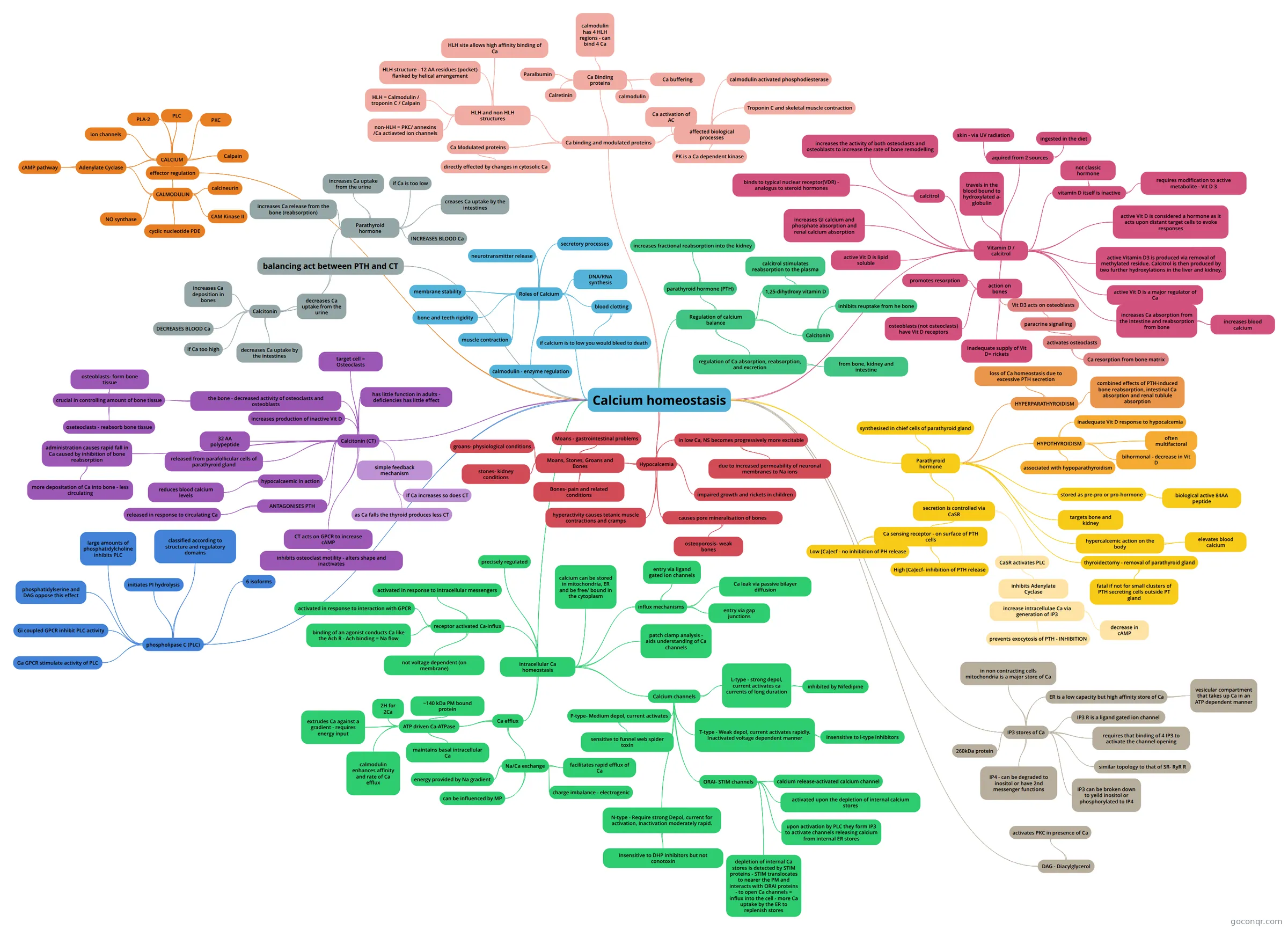
Mind map: Calcium homeostasis
Inhalt der Mindmap
Calcium homeostasis
Hypocalcemia
- in low Ca, NS becomes progressively more excitable
- due to increased permeability of neuronal membranes to Na ions
- hyperactivity causes tetanic muscle contractions and cramps
- causes pore mineralisation of bones
- osteoporosis- weak bones
- impaired growth and rickets in children
- Moans, Stones, Groans and Bones
- Moans - gastrointestinal problems
- stones- kidney conditions
- groans- physiological conditions
- Bones- pain and related conditions
- in low Ca, NS becomes progressively more excitable
Roles of Calcium
- bone and teeth rigidity
- muscle contraction
- membrane stability
- neurotransmitter release
- secretory processes
- DNA/RNA synthesis
- blood clotting
- if calcium is to low you would bleed to death
- calmodulin - enzyme regulation
Regulation of calcium balance
- parathyroid hormone (PTH)
- increases fractional reabsorption into the kidney
- 1,25-dihydroxy vitamin D
- calcitrol stimulates reabsorption to the plasma
- Calcitonin
- inhibits reuptake from he bone
- regulation of Ca absorption, reabsorption, and excretion
- from bone, kidney and intestine
- parathyroid hormone (PTH)
Parathyroid hormone
- synthesised in chief cells of parathyroid gland
- stored as pre-pro or pro-hormone
- biological active 84AA peptide
- targets bone and kidney
- hypercalcemic action on the body
- elevates blood calcium
- thyroidectomy - removal of parathyroid gland
- fatal if not for small clusters of PTH secreting cells outside PT gland
- secretion is controlled via CaSR
- Ca sensing receptor - on surface of PTH cells
- High [Ca]ecf- inhibition of PTH release
- Low [Ca]ecf - no inhibition of PH release
- CaSR activates PLC
- inhibits Adenylate Cyclase
- increase intracellulae Ca via generation of IP3
- decrease in cAMP
- prevents exocytosis of PTH - INHIBITION
- increase intracellulae Ca via generation of IP3
- inhibits Adenylate Cyclase
- Ca sensing receptor - on surface of PTH cells
- HYPERPARATHYROIDISM
- loss of Ca homeostasis due to excessive PTH secretion
- combined effects of PTH-induced bone reabsorption, intestinal Ca absorption and renal tublule absorption
- HYPOTHYROIDISM
- inadequate Vit D response to hypocalcemia
- often multifactoral
- associated with hypoparathyroidism
- bihormonal - decrease in Vit D
Calcitonin (CT)
- 32 AA polypeptide
- released from parafollicular cells of parathyroid gland
- hypocalcaemic in action
- reduces blood calcium levels
- ANTAGONISES PTH
- released in response to circulating Ca
- the bone - decreased activity of osteoclasts and osteoblasts
- crucial in controlling amount of bone tissue
- osteoblasts- form bone tissue
- oseteoclasts - reabsorb bone tissue
- crucial in controlling amount of bone tissue
- increases production of inactive Vit D
- has little function in adults - deficiencies has little effect
- simple feedback mechanism
- If Ca increases so does CT
- as Ca falls the thyroid produces less CT
- target cell = Osteoclasts
- CT acts on GPCR to increase cAMP
- inhibits osteoclast motility - alters shape and inactivates
- administration causes rapid fall in Ca caused by inhibition of bone reabsorption
- more depositation of Ca into bone - less circulating
balancing act between PTH and CT
- Calcitonin
- if Ca too high
- increases Ca deposition in bones
- decreases Ca uptake by the intestines
- decreases Ca uptake from the urine
- DECREASES BLOOD Ca
- Parathyroid hormone
- if Ca is too low
- increases Ca release from the bone (reabsorption)
- increases Ca uptake from the urine
- creases Ca uptake by the intestines
- INCREASES BLOOD Ca
- Calcitonin
Vitamin D / calcitrol
- aquired from 2 sources
- skin - via UV radiation
- ingested in the diet
- vitamin D itself is inactive
- requires modification to active metabolite - Vit D 3
- not classic hormone
- active Vit D is considered a hormone as it acts upon distant target cells to evoke responses
- active Vitamin D3 is produced via removal of methylated residue. Calcitrol is then produced by two further hydroxylations in the liver and kidney.
- increases GI calcium and phosphate absorption and renal calcium absorption
- calcitrol
- increases the activity of both osteoclasts and osteoblasts to increase the rate of bone remodelling
- active Vit D is a major regulator of Ca
- increases Ca absorption from the intestine and reabsorption from bone
- increases blood calcium
- active Vit D is lipid soluble
- binds to typical nuclear receptor(VDR) - analogus to steroid hormones
- travels in the blood bound to hydroxylated a- globulin
- action on bones
- promotes resorption
- osteoblasts (not osteoclasts) have Vit D receptors
- Vit D3 acts on osteoblasts
- paracrine signalling
- activates osteoclasts
- Ca resorption from bone matrix
- activates osteoclasts
- paracrine signalling
- inadequate supply of Vit D= rickets
- aquired from 2 sources
intracellular Ca homeostasis
- precisely regulated
- calcium can be stored in mitochondria, ER and be free/ bound in the cytoplasm
- influx mechanisms
- entry via ligand gated ion channels
- Ca leak via passive bilayer diffusion
- entry via gap junctions
- patch clamp analysis - aids understanding of Ca channels
- Calcium channels
- L-type - strong depol, current activates ca currents of long duration
- inhibited by Nifedipine
- T-type - Weak depol, current activates rapidly. Inactivated voltage dependent manner
- insensitive to l-type inhibitors
- N-type - Require strong Depol, current for activation, Inactivation moderately rapid.
- Insensitive to DHP inhibitors but not conotoxin
- P-type- Medium depol, current activates
- sensitive to funnel web spider toxin
- ORAI- STIM channels
- calcium release-activated calcium channel
- activated upon the depletion of internal calcium stores
- upon activation by PLC they form IP3 to activate channels releasing calcium from internal ER stores
- depletion of internal Ca stores is detected by STIM proteins - STIM translocates to nearer the PM and interacts with ORAI proteins - to open Ca channels = influx into the cell - more Ca uptake by the ER to replenish stores
- L-type - strong depol, current activates ca currents of long duration
- receptor activated Ca-influx
- not voltage dependent (on membrane)
- activated in response to intracellular messengers
- activated in response to interaction with GPCR
- binding of an agonist conducts Ca like the Ach R - Ach binding = Na flow
- Ca efflux
- ATP driven Ca-ATPase
- ~140 kDa PM bound protein
- 2H for 2Ca
- extrudes Ca against a gradient - requires energy input
- calmodulin enhances affinity and rate of Ca efflux
- maintains basal intracellular Ca
- Na/Ca exchange
- facilitates rapid efflux of Ca
- charge imbalance - electrogenic
- can be influenced by MP
- energy provided by Na gradient
- ATP driven Ca-ATPase
Ca binding and modulated proteins
- Ca Binding proteins
- Ca buffering
- calmodulin
- Calretinin
- Paralbumin
- calmodulin has 4 HLH regions - can bind 4 Ca
- Ca Modulated proteins
- directly effected by changes in cytosolic Ca
- HLH and non HLH structures
- HLH = Calmodulin / troponin C / Calpain
- non-HLH = PKC/ annexins /Ca actiavted ion channels
- HLH structure - 12 AA residues (pocket) flanked by helical arrangement
- HLH site allows high affinity binding of Ca
- affected biological processes
- Ca activation of AC
- calmodulin activated phosphodiesterase
- Troponin C and skeletal muscle contraction
- PK is a Ca dependent kinase
- Ca Binding proteins
phospholipase C (PLC)
- initiates PI hydrolysis
- 6 isoforms
- classified according to structure and regulatory domains
- large amounts of phosphatidylcholine inhibits PLC
- phosphatidylserine and DAG oppose this effect
- Gi coupled GPCR inhibit PLC activity
- Ga GPCR stimulate activity of PLC
IP3 stores of Ca
- in non contracting cells mitochondria is a major store of Ca
- ER is a low capacity but high affinity store of Ca
- vesicular compartment that takes up Ca in an ATP dependent manner
- IP3 R is a ligand gated ion channel
- requires that binding of 4 IP3 to activate the channel opening
- 260kDa protein
- similar topology to that of SR- RyR R
- IP3 can be broken down to yeild inositol or phosphorylated to IP4
- IP4 - can be degraded to inositol or have 2nd messenger functions
DAG - Diacylglycerol
- activates PKC in presence of Ca
effector regulation
- CALCIUM
- Calpain
- PKC
- PLC
- PLA-2
- ion channels
- Adenylate cyclase
- cAMP pathway
- CALMODULIN
- calcineurin
- CAM Kinase II
- cyclic nucleotide PDE
- NO synthase
- Adenylate Cyclase
- CALCIUM
Informationen
- Beschreibung
- Mindmap am Calcium homeostasis, erstellt von Bramblehill am 14/04/2015.
- Erstellt von
- Bramblehill
- Aufrufe
- 0
- Bewertung