
Mindmap
Sesión 8
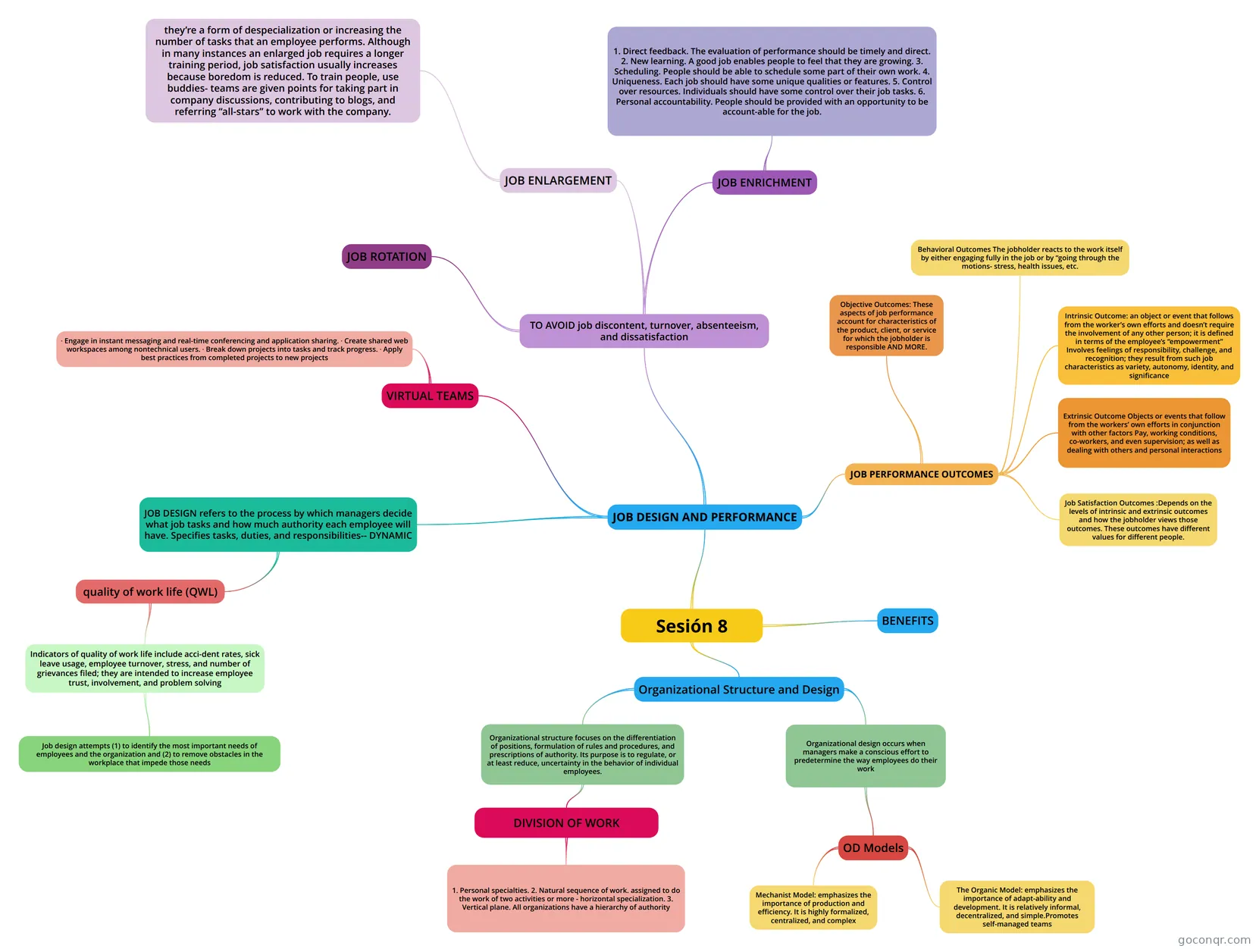
Mind map: Organizational Structure, Design, and Job Performance
Inhalt der Mindmap
Sesión 8
Organizational Structure and Design
- Organizational structure focuses on the differentiation of positions, formulation of rules and procedures, and prescriptions of authority. Its purpose is to regulate, or at least reduce, uncertainty in the behavior of individual employees.
- DIVISION OF WORK
- 1. Personal specialties. 2. Natural sequence of work. assigned to do the work of two activities or more - horizontal specialization. 3. Vertical plane. All organizations have a hierarchy of authority
- DIVISION OF WORK
- Organizational design occurs when managers make a conscious effort to predetermine the way employees do their work
- OD Models
- Mechanist Model: emphasizes the importance of production and efficiency. It is highly formalized, centralized, and complex
- The Organic Model: emphasizes the importance of adapt-ability and development. It is relatively informal, decentralized, and simple.Promotes self-managed teams
- OD Models
- Organizational structure focuses on the differentiation of positions, formulation of rules and procedures, and prescriptions of authority. Its purpose is to regulate, or at least reduce, uncertainty in the behavior of individual employees.
JOB DESIGN AND PERFORMANCE
- JOB DESIGN refers to the process by which managers decide what job tasks and how much authority each employee will have. Specifies tasks, duties, and responsibilities-- DYNAMIC
- quality of work life (QWL)
- Indicators of quality of work life include acci-dent rates, sick leave usage, employee turnover, stress, and number of grievances filed; they are intended to increase employee trust, involvement, and problem solving
- Job design attempts (1) to identify the most important needs of employees and the organization and (2) to remove obstacles in the workplace that impede those needs
- Indicators of quality of work life include acci-dent rates, sick leave usage, employee turnover, stress, and number of grievances filed; they are intended to increase employee trust, involvement, and problem solving
- quality of work life (QWL)
- JOB PERFORMANCE OUTCOMES
- Objective Outcomes: These aspects of job performance account for characteristics of the product, client, or service for which the jobholder is responsible AND MORE.
- Behavioral Outcomes The jobholder reacts to the work itself by either engaging fully in the job or by “going through the motions- stress, health issues, etc.
- Intrinsic Outcome: an object or event that follows from the worker’s own efforts and doesn’t require the involvement of any other person; it is defined in terms of the employee’s “empowerment” Involves feelings of responsibility, challenge, and recognition; they result from such job characteristics as variety, autonomy, identity, and significance
- Extrinsic Outcome Objects or events that follow from the workers’ own efforts in conjunction with other factors Pay, working conditions, co-workers, and even supervision; as well as dealing with others and personal interactions
- Job Satisfaction Outcomes :Depends on the levels of intrinsic and extrinsic outcomes and how the jobholder views those outcomes. These outcomes have different values for different people.
- TO AVOID job discontent, turnover, absenteeism, and dissatisfaction
- JOB ROTATION
- JOB ENLARGEMENT
- they’re a form of despecialization or increasing the number of tasks that an employee performs. Although in many instances an enlarged job requires a longer training period, job satisfaction usually increases because boredom is reduced. To train people, use buddies- teams are given points for taking part in company discussions, contributing to blogs, and referring “all-stars” to work with the company.
- JOB ENRICHMENT
- 1. Direct feedback. The evaluation of performance should be timely and direct. 2. New learning. A good job enables people to feel that they are growing. 3. Scheduling. People should be able to schedule some part of their own work. 4. Uniqueness. Each job should have some unique qualities or features. 5. Control over resources. Individuals should have some control over their job tasks. 6. Personal accountability. People should be provided with an opportunity to be account-able for the job.
- VIRTUAL TEAMS
- ∙ Engage in instant messaging and real-time conferencing and application sharing. ∙ Create shared web workspaces among nontechnical users. ∙ Break down projects into tasks and track progress. ∙ Apply best practices from completed projects to new projects
- JOB DESIGN refers to the process by which managers decide what job tasks and how much authority each employee will have. Specifies tasks, duties, and responsibilities-- DYNAMIC
BENEFITS
Informationen
- Beschreibung
- Mindmap am Sesión 8, erstellt von Romina Flores Gómez am 02/09/2020.
- Erstellt von
- Romina Flores Gómez
- Aufrufe
- 1
- Bewertung