
Mindmap
PHARMACY LAWS
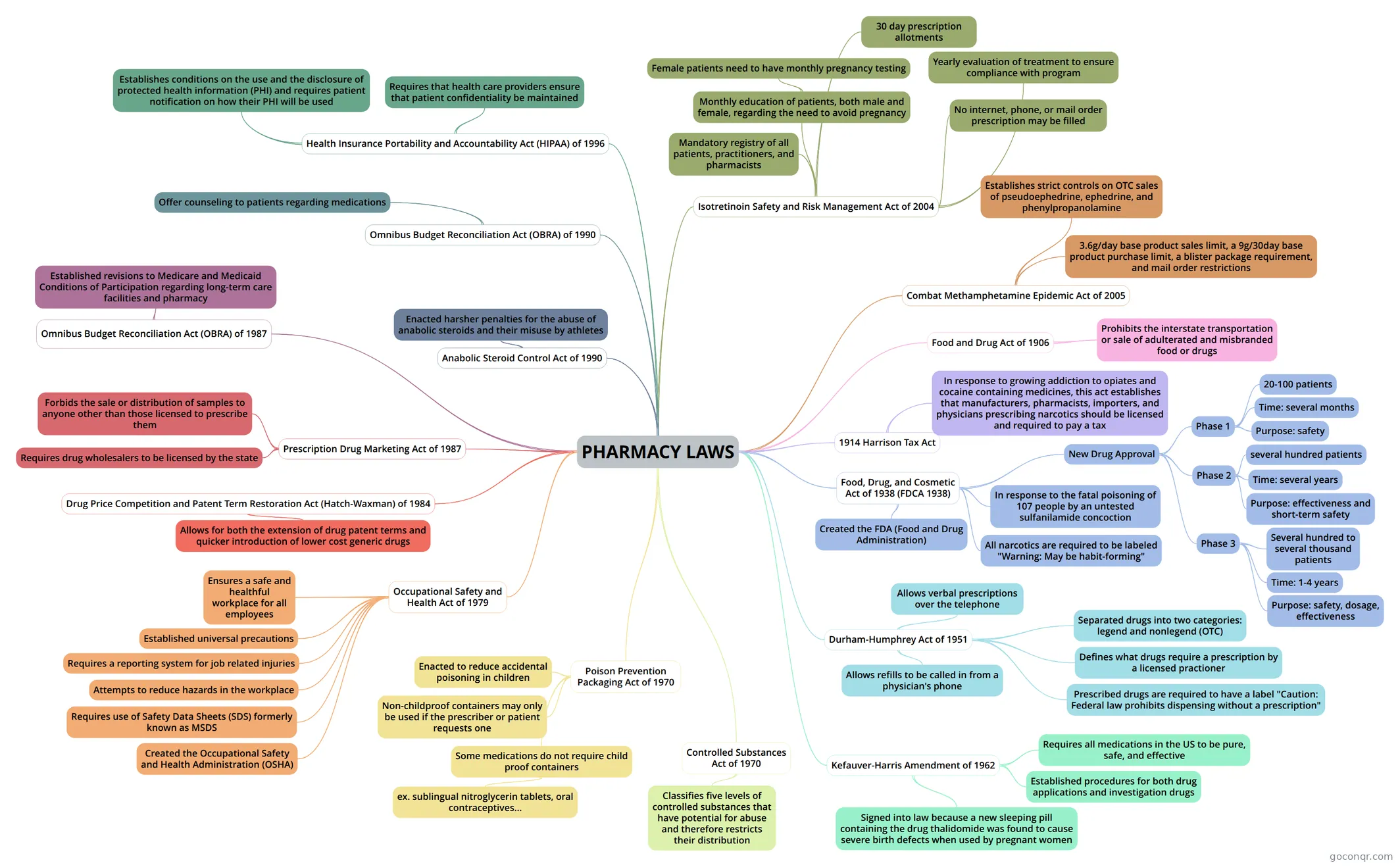
Mind map: pharmacy laws
Inhalt der Mindmap
PHARMACY LAWS
1914 Harrison Tax Act
- In response to growing addiction to opiates and cocaine containing medicines, this act establishes that manufacturers, pharmacists, importers, and physicians prescribing narcotics should be licensed and required to pay a tax
Food, Drug, and Cosmetic Act of 1938 (FDCA 1938)
- Created the FDA (Food and Drug Administration)
- In response to the fatal poisoning of 107 people by an untested sulfanilamide concoction
- All narcotics are required to be labeled "Warning: May be habit-forming"
- New Drug Approval
- Phase 1
- 20-100 patients
- Time: several months
- Purpose: safety
- Phase 2
- several hundred patients
- Time: several years
- Purpose: effectiveness and short-term safety
- Phase 3
- Several hundred to several thousand patients
- Time: 1-4 years
- Purpose: safety, dosage, effectiveness
- Phase 1
Durham-Humphrey Act of 1951
- Separated drugs into two categories: legend and nonlegend (OTC)
- Defines what drugs require a prescription by a licensed practioner
- Prescribed drugs are required to have a label "Caution: Federal law prohibits dispensing without a prescription"
- Allows verbal prescriptions over the telephone
- Allows refills to be called in from a physician's phone
Kefauver-Harris Amendment of 1962
- Requires all medications in the US to be pure, safe, and effective
- Established procedures for both drug applications and investigation drugs
- Signed into law because a new sleeping pill containing the drug thalidomide was found to cause severe birth defects when used by pregnant women
Food and Drug Act of 1906
- Prohibits the interstate transportation or sale of adulterated and misbranded food or drugs
Controlled Substances Act of 1970
- Classifies five levels of controlled substances that have potential for abuse and therefore restricts their distribution
Poison Prevention Packaging Act of 1970
- Enacted to reduce accidental poisoning in children
- Non-childproof containers may only be used if the prescriber or patient requests one
- Some medications do not require child proof containers
- ex. sublingual nitroglycerin tablets, oral contraceptives...
Occupational Safety and Health Act of 1979
- Created the Occupational Safety and Health Administration (OSHA)
- Ensures a safe and healthful workplace for all employees
- Requires a reporting system for job related injuries
- Established universal precautions
- Attempts to reduce hazards in the workplace
- Requires use of Safety Data Sheets (SDS) formerly known as MSDS
Drug Price Competition and Patent Term Restoration Act (Hatch-Waxman) of 1984
- Allows for both the extension of drug patent terms and quicker introduction of lower cost generic drugs
Anabolic Steroid Control Act of 1990
- Enacted harsher penalties for the abuse of anabolic steroids and their misuse by athletes
Prescription Drug Marketing Act of 1987
- Forbids the sale or distribution of samples to anyone other than those licensed to prescribe them
- Requires drug wholesalers to be licensed by the state
Omnibus Budget Reconciliation Act (OBRA) of 1987
- Established revisions to Medicare and Medicaid Conditions of Participation regarding long-term care facilities and pharmacy
Omnibus Budget Reconciliation Act (OBRA) of 1990
- Offer counseling to patients regarding medications
Health Insurance Portability and Accountability Act (HIPAA) of 1996
- Requires that health care providers ensure that patient confidentiality be maintained
- Establishes conditions on the use and the disclosure of protected health information (PHI) and requires patient notification on how their PHI will be used
Isotretinoin Safety and Risk Management Act of 2004
- Mandatory registry of all patients, practitioners, and pharmacists
- Monthly education of patients, both male and female, regarding the need to avoid pregnancy
- Female patients need to have monthly pregnancy testing
- No internet, phone, or mail order prescription may be filled
- Yearly evaluation of treatment to ensure compliance with program
- 30 day prescription allotments
Combat Methamphetamine Epidemic Act of 2005
- Establishes strict controls on OTC sales of pseudoephedrine, ephedrine, and phenylpropanolamine
- 3.6g/day base product sales limit, a 9g/30day base product purchase limit, a blister package requirement, and mail order restrictions