
Mindmap
present perfect vs continuous
Inhalt der Mindmap
present perfect vs continuous
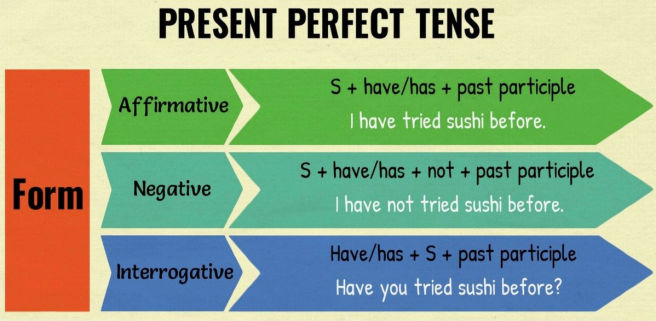
To form the present perfect, the auxiliary verb "to have" is used in the present and the past participle of the verb. For regular verbs, the past participle is the simple past form.
- Structure Affirmative Sentences Subject + auxiliary verb (to have) + past participle...
- Negative Sentences (Frases negativas) Sujeto + verbo auxiliar (to have) + “not” + participio pasado…
- Interrogative Sentences (Frases interrogativas) Verbo auxiliar (to have) + sujeto + participio pasado…?
- Uses
- The present perfect is used to describe an experience. We do not use it for specific actions.
- The present perfect is used for a change in time.
- We use the present perfect for actions that have not yet happened. The use of the present perfect in these cases indicates that we are still waiting for the action, so we often use the adverbs "yet" and "still".
- The present perfect is used for a change in time.
- The present perfect is used to describe an experience. We do not use it for specific actions.
- Uses
- Interrogative Sentences (Frases interrogativas) Verbo auxiliar (to have) + sujeto + participio pasado…?
- Negative Sentences (Frases negativas) Sujeto + verbo auxiliar (to have) + “not” + participio pasado…
- Structure Affirmative Sentences Subject + auxiliary verb (to have) + past participle...
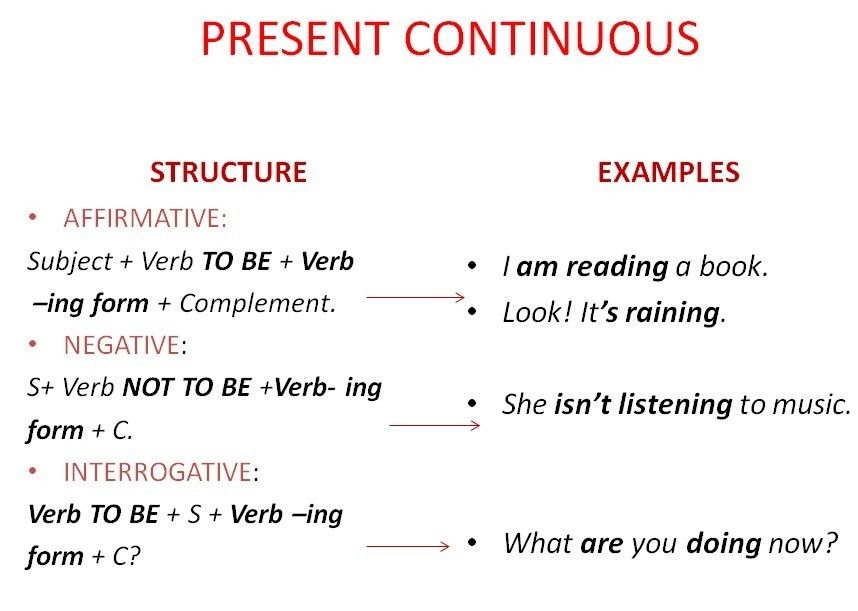
Grammatical Rules: Form To form the present continuous, the auxiliary verb "to be" and the verb+ing are used.
- Structure 1. Affirmative Sentences Subject + auxiliary verb (to be) + verb+ing.
- Negative Sentences (Negative Sentences) Subject + auxiliary verb (to be) + negative auxiliary (not) + verb+ing.
- interrogative Sentences Auxiliary verb (to be) + subject + verb+ing?
- Uses
- The present continuous is used to talk about something that is happening at the moment we are speaking.
- We use the present continuous to talk about something that is already decided to be done in the near future. Its use indicates that it is fairly certain that what is planned will happen.
- The present continuous is used to talk about something that is happening at the moment we are speaking.
- Uses
- interrogative Sentences Auxiliary verb (to be) + subject + verb+ing?
- Negative Sentences (Negative Sentences) Subject + auxiliary verb (to be) + negative auxiliary (not) + verb+ing.
- Structure 1. Affirmative Sentences Subject + auxiliary verb (to be) + verb+ing.
Bilder und Dateien der Mindmap
Informationen
- Beschreibung
- Mindmap am present perfect vs continuous, erstellt von Juan Esteban Mateus Bernal am 10/03/2021.
- Erstellt von
- Juan Esteban Mateus Bernal · Mär 2021
- Aktualisiert
- 10 Mär 2021
- Aufrufe
- 0
- Bewertung