
Mindmap
ADR
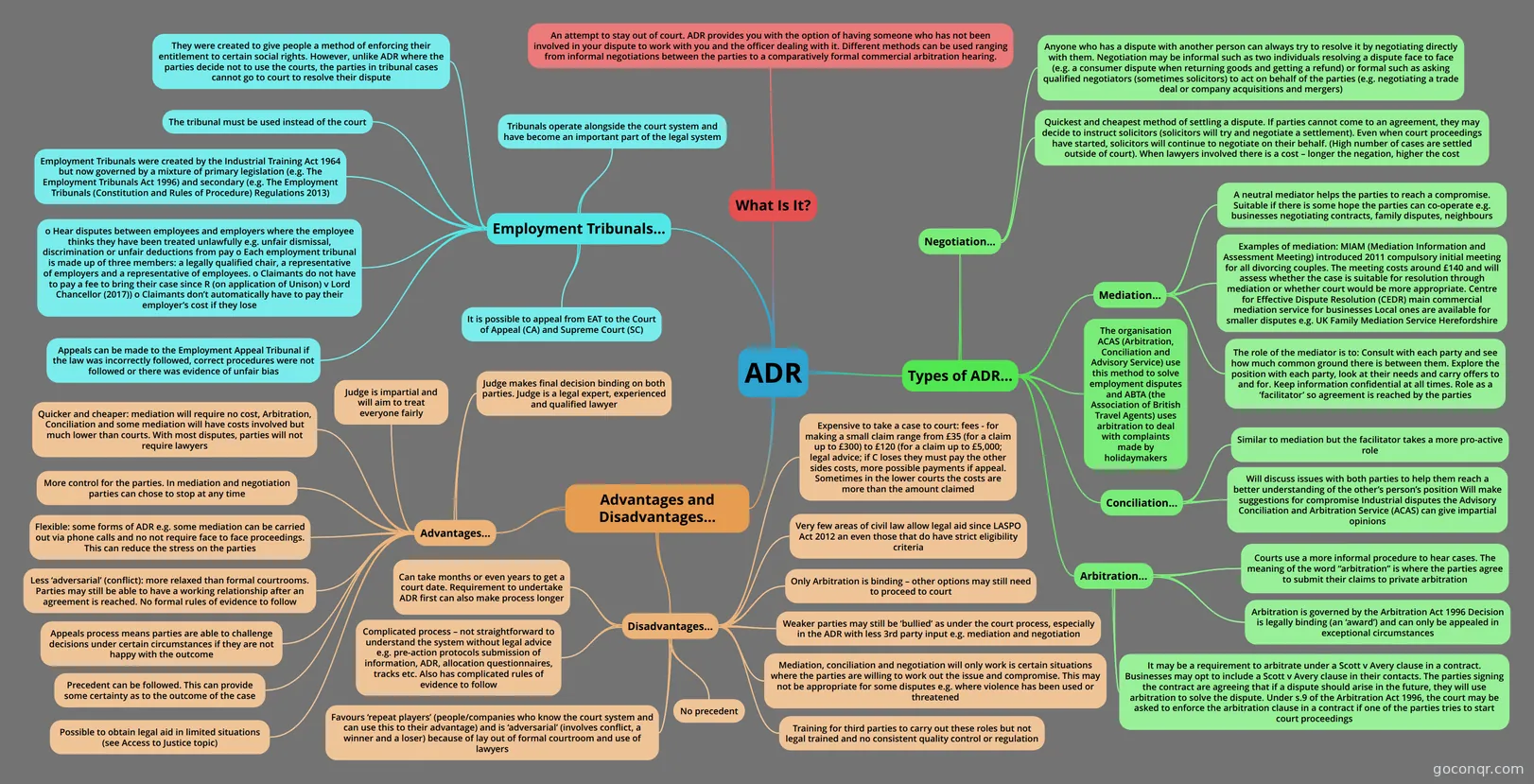
Mind map: ADR
Inhalt der Mindmap
ADR
What Is It?
- An attempt to stay out of court. ADR provides you with the option of having someone who has not been involved in your dispute to work with you and the officer dealing with it. Different methods can be used ranging from informal negotiations between the parties to a comparatively formal commercial arbitration hearing.
Advantages and Disadvantages...
- Advantages...
- Quicker and cheaper: mediation will require no cost, Arbitration, Conciliation and some mediation will have costs involved but much lower than courts. With most disputes, parties will not require lawyers
- More control for the parties. In mediation and negotiation parties can chose to stop at any time
- Flexible: some forms of ADR e.g. some mediation can be carried out via phone calls and no not require face to face proceedings. This can reduce the stress on the parties
- Less ‘adversarial’ (conflict): more relaxed than formal courtrooms. Parties may still be able to have a working relationship after an agreement is reached. No formal rules of evidence to follow
- Judge makes final decision binding on both parties. Judge is a legal expert, experienced and qualified lawyer
- Appeals process means parties are able to challenge decisions under certain circumstances if they are not happy with the outcome
- Precedent can be followed. This can provide some certainty as to the outcome of the case
- Possible to obtain legal aid in limited situations (see Access to Justice topic)
- Judge is impartial and will aim to treat everyone fairly
- Disadvantages...
- Expensive to take a case to court: fees - for making a small claim range from £35 (for a claim up to £300) to £120 (for a claim up to £5,000; legal advice; if C loses they must pay the other sides costs, more possible payments if appeal. Sometimes in the lower courts the costs are more than the amount claimed
- Can take months or even years to get a court date. Requirement to undertake ADR first can also make process longer
- Complicated process – not straightforward to understand the system without legal advice e.g. pre-action protocols submission of information, ADR, allocation questionnaires, tracks etc. Also has complicated rules of evidence to follow
- Favours ‘repeat players’ (people/companies who know the court system and can use this to their advantage) and is ‘adversarial’ (involves conflict, a winner and a loser) because of lay out of formal courtroom and use of lawyers
- Only Arbitration is binding – other options may still need to proceed to court
- Very few areas of civil law allow legal aid since LASPO Act 2012 an even those that do have strict eligibility criteria
- Mediation, conciliation and negotiation will only work is certain situations where the parties are willing to work out the issue and compromise. This may not be appropriate for some disputes e.g. where violence has been used or threatened
- No precedent
- Training for third parties to carry out these roles but not legal trained and no consistent quality control or regulation
- Weaker parties may still be ‘bullied’ as under the court process, especially in the ADR with less 3rd party input e.g. mediation and negotiation
- Advantages...
Types of ADR...
- Negotiation...
- Anyone who has a dispute with another person can always try to resolve it by negotiating directly with them. Negotiation may be informal such as two individuals resolving a dispute face to face (e.g. a consumer dispute when returning goods and getting a refund) or formal such as asking qualified negotiators (sometimes solicitors) to act on behalf of the parties (e.g. negotiating a trade deal or company acquisitions and mergers)
- Quickest and cheapest method of settling a dispute. If parties cannot come to an agreement, they may decide to instruct solicitors (solicitors will try and negotiate a settlement). Even when court proceedings have started, solicitors will continue to negotiate on their behalf. (High number of cases are settled outside of court). When lawyers involved there is a cost – longer the negation, higher the cost
- Mediation...
- A neutral mediator helps the parties to reach a compromise. Suitable if there is some hope the parties can co-operate e.g. businesses negotiating contracts, family disputes, neighbours
- The role of the mediator is to: Consult with each party and see how much common ground there is between them. Explore the position with each party, look at their needs and carry offers to and for. Keep information confidential at all times. Role as a ‘facilitator’ so agreement is reached by the parties
- Examples of mediation: MIAM (Mediation Information and Assessment Meeting) introduced 2011 compulsory initial meeting for all divorcing couples. The meeting costs around £140 and will assess whether the case is suitable for resolution through mediation or whether court would be more appropriate. Centre for Effective Dispute Resolution (CEDR) main commercial mediation service for businesses Local ones are available for smaller disputes e.g. UK Family Mediation Service Herefordshire
- Conciliation...
- Similar to mediation but the facilitator takes a more pro-active role
- Will discuss issues with both parties to help them reach a better understanding of the other’s person’s position Will make suggestions for compromise Industrial disputes the Advisory Conciliation and Arbitration Service (ACAS) can give impartial opinions
- Arbitration...
- It may be a requirement to arbitrate under a Scott v Avery clause in a contract. Businesses may opt to include a Scott v Avery clause in their contacts. The parties signing the contract are agreeing that if a dispute should arise in the future, they will use arbitration to solve the dispute. Under s.9 of the Arbitration Act 1996, the court may be asked to enforce the arbitration clause in a contract if one of the parties tries to start court proceedings
- Courts use a more informal procedure to hear cases. The meaning of the word “arbitration” is where the parties agree to submit their claims to private arbitration
- Arbitration is governed by the Arbitration Act 1996 Decision is legally binding (an ‘award’) and can only be appealed in exceptional circumstances
- The organisation ACAS (Arbitration, Conciliation and Advisory Service) use this method to solve employment disputes and ABTA (the Association of British Travel Agents) uses arbitration to deal with complaints made by holidaymakers
- Negotiation...
Employment Tribunals...
- Tribunals operate alongside the court system and have become an important part of the legal system
- It is possible to appeal from EAT to the Court of Appeal (CA) and Supreme Court (SC)
- The tribunal must be used instead of the court
- o Hear disputes between employees and employers where the employee thinks they have been treated unlawfully e.g. unfair dismissal, discrimination or unfair deductions from pay o Each employment tribunal is made up of three members: a legally qualified chair, a representative of employers and a representative of employees. o Claimants do not have to pay a fee to bring their case since R (on application of Unison) v Lord Chancellor (2017)) o Claimants don’t automatically have to pay their employer’s cost if they lose
- They were created to give people a method of enforcing their entitlement to certain social rights. However, unlike ADR where the parties decide not to use the courts, the parties in tribunal cases cannot go to court to resolve their dispute
- Appeals can be made to the Employment Appeal Tribunal if the law was incorrectly followed, correct procedures were not followed or there was evidence of unfair bias
- Employment Tribunals were created by the Industrial Training Act 1964 but now governed by a mixture of primary legislation (e.g. The Employment Tribunals Act 1996) and secondary (e.g. The Employment Tribunals (Constitution and Rules of Procedure) Regulations 2013)
Informationen
- Beschreibung
- Mindmap am ADR, erstellt von Tom Wenyon am 09/05/2021.
- Erstellt von
- Tom Wenyon
- Aufrufe
- 0
- Bewertung