
Mindmap
Operations
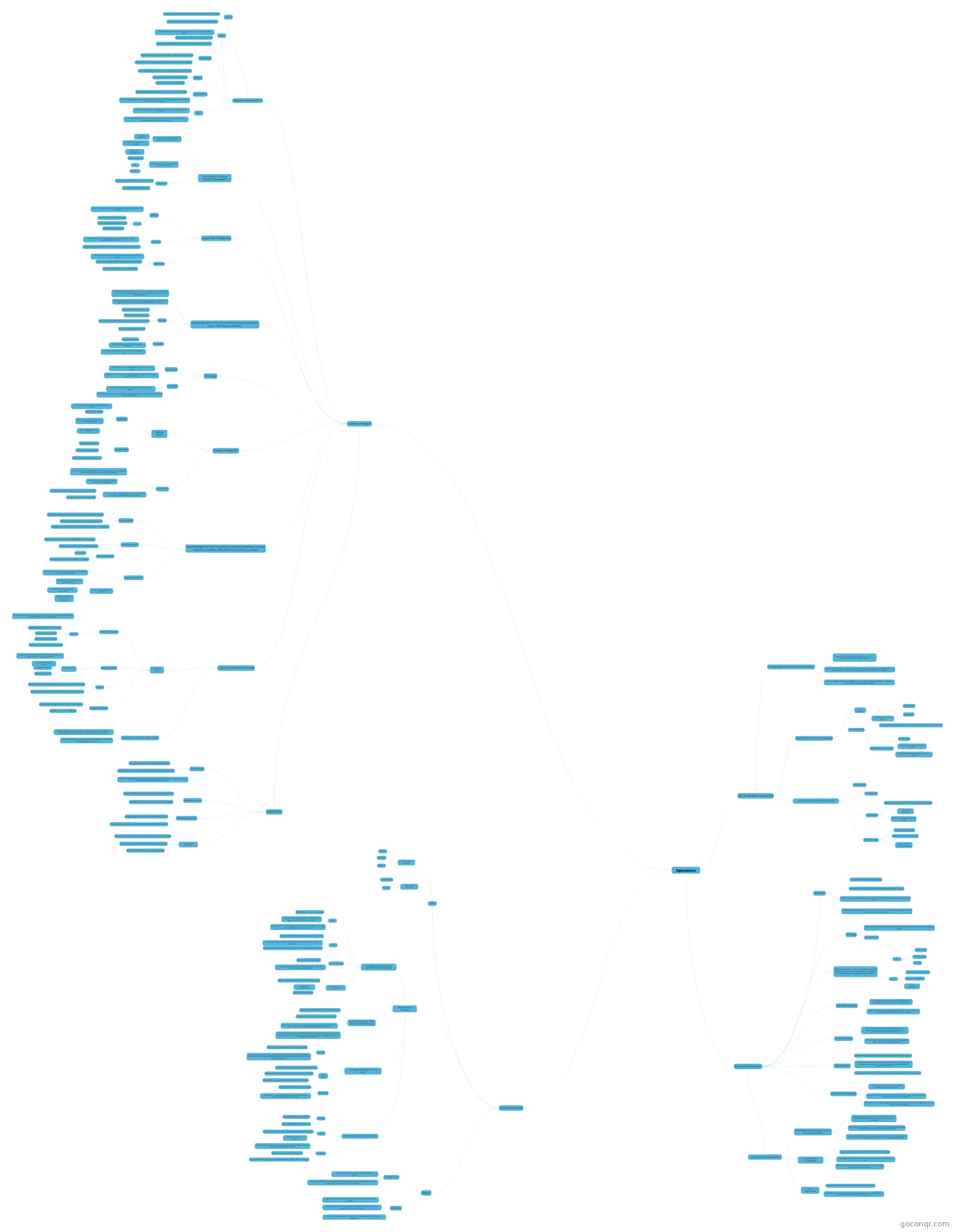
Mind map: Operations Management
Inhalt der Mindmap
Operations
Role of Operations Management
- Operations refer to the business processes involving transformation or production of inputs into outputs. Businesses try to minimize production costs so retail prices are as low as possible. Effective operations management adds value to businesses through increasing productivity, lowering costs & improving quality strategic competitive advantage through lower costs & differentiated goods
- Strategic Role of Operations Management
- Cost leadership
- Product Differentiation
- Differentiation sources in goods:
- Product features
- Product quality
- Varying augmented features (add-ons or additional benefits e.g. option for built in GPS in a car)
- Differentiation sources in services:
- Amount of time
- Qualifications or experience of service provider
- Quality of materials/technology used in service delivery
- Differentiation sources in goods:
- Goods and Services in Different Industries
- Standardised good
- Customised goods
- Perishable Goods
- High standards of safety, quality & cleanliness in all operating processes
- Very short distribution
- Appropriate, sturdy packaging & cold storage
- Non-Perishable Goods
- More durable than perishables
- Includes household and business goods
- Requires effective inventory management
- Interdependence with Other Key Business Functions
- Marketing - Research nature of goods consumers want - Marketing strategies to encourage purchases
- Human resources - Provide suitable staff & organize training based on requirements of operations - Uses leadership style + rewards to ensure quality work is done by employees in operations
- Finance - Budgets & makes funds available for inputs, equipment, repairs/ maintenance. - Minimizes production costs to maximise profit margins
Influences On Operations
- Globalisation
- the removal of trade barriers between nations
- Large businesses selling to global markets and meeting needs of global customers
- Characterized by increased integration of national economies & high flow of money, labor, ideas, financial resources.
- Global web = network of supplier’s business has chosen on basis of lowest cost, lowest risk and maximum certainty in quality & timing of supplies.
- Technology
- Robotics allow for greater precision in sophisticated production processes and also easy standardization of products
- Includes CAD & CAM
- Quality Expectations - How well designed, made and functional goods are and the degree of competence in which services are organised and delivered.
- Goods
- quality of design
- fitness for purpose
- durability
- Services
- professionalism of service provider
- reliability of service provider
- level of customisation
- Goods
- Cost-based Competition
- Derived from determining breakeven point then applying strategies to create cost advantages over competitors.
- Base cost of a product involves fixed and variable costs - Ways to cut costs include purchasing bulk inputs or updating technology.
- Government Policies
- Since policies can inform law making and lead to business opportunities, operations mangers need be aware of current government policies and what they comprise
- Includes required materials handling practices, OHS standards, public health polices, environmental policies
- Legal Regulation
- Compliance costs = expenses associated with meeting requirements of legal regulation
- Federal and state law ensures: ● Safe operations (e.g. WHS in machinery use) ● Consumer protection (product minimum safety/quality standards) ● Minimal environmental impact
- Unions also play a key role in promoting safety in workplace operations as well as industrial awards
- Environmental Sustainability
- Practices that allow resources to be used today without compromising future access
- Significantly impacted by climate change awareness and the need to integrate long-term sustainable view of resource management.
- This can be seen in businesses efforts to reduce and minimize waste; recycle water, glass, paper metals & reduce their carbon footprint.
- Corporate Social Responsibility
- Refers to open and accountable business actions based on respect for people, community & the broader environment → more than following the law Triple bottom line is crucial to CSR = business try to achieve all three aspects: ● profit ● social justice ● environmental protection
- The Difference Between Legal Compliance & Ethical Responsibility
- Legal requirements require business to follow the letter of the law (prescribed behaviour standards) E.g. labour law compliances, human rights
- Ethical responsibility sees businesses meeting all of their legal obligations and taking it further by following the intention and ‘spirit’ of the law.
- Variation in laws between countries can make it hard to know what is ethical. Businesses may choose to follow ethical standards from ILO (international labour organisation).
- Environmental Sustainability
- Requires business to evaluate full environmental effects of their operations
- Growing expectation that products should be “clean, green, safe” so businesses have been
- Businesses expected to adopt greenhouse reduction measures & develop long-term sustainability strategies
- Social responsibility
- Management of social environmental & human consequence of its actions.
- Customers may stop buying if they discover a business exploits its customers, however they will reward SR businesses by purchasing more
- Globalisation
Operations Processes
- Inputs
- Transformed Resources
- Materials
- Information
- Customers
- Transforming Resources
- Human resources
- Facilities
- Transformed Resources
- Transformation Processes
- 4Vs Influences (Volume, Variety, Variation in Demand, Visibility)
- Volume
- Amount of good or service to be produced
- Volume flexibility = how fast transformation process can adjust to increases or decreases in demand.
- Responsiveness to required changes in volume is essential to effectively managing lead times (time taken for order to be fulfilled)
- Variety
- Number of different models/variations a product or service offers
- Greater the variation made, the more the operations processes need to allow for variation
- low variety will allow business to produce high-volume of a standardised product for cost
- Variation in Demand
- How much of the product is needed
- → increased demand requires more inputs from supplier, increased HR, machinery & energy consumption
- Visibility (customer contact)
- Degree to which customers can witness the operations process
- Low visibility = manufacturing
- High visibility = service-based
- Volume
- Sequencing & Scheduling – Gantt Charts & Critical Path Analysis
- Sequencing refers to the order in which tasks are completed
- Scheduling refers to the time taken to complete these tasks.
- Gantt chart ⎯ bar chart that shows both the scheduled and completed work over a period of time. It is often used in planning and tracking a project.
- Critical Path Analysis (CPA) ⎯ flow diagram showing the interrelationship of tasks as all tasks must be completed for the project to be finished, the critical path is the longest path taken to complete the whole project.
- Technology, Task design & Process Layout
- Technology
- Many products designed and assembled using CAD and CAM
- Technology allows businesses to relocate dangerous or repetitive tasks away from employees - This has enabled more efficient production, although technology is expensive it is usually more cost effective long term.
- Task design
- Breaking down a large task into smaller, manageable activities
- Employees therefore able to perform and complete the task successfully.
- Involves job analysis & can be done after conduction of a skills audit.
- Process layout
- Arranging machinery according to what they do
- → product moves from department to department - Allows for more flexibility & customization of the product
- Technology
- Monitoring, Control and Improvement
- Monitoring
- Arranged around need to measure KPI's
- lead times, defect rates, inventory turnover
- Control
- Assessing KPIs (key performance indicators) against predetermined targets
- taking corrective action if required.
- Improvement
- Refers to the reduction of any inefficiencies and wastage, poor work processes and the elimination of any bottlenecks
- *bottleneck = aspect of operations that delays
- Improvement usually sought in quality, speed, dependability, flexibility, cost improvements.
- Monitoring
- 4Vs Influences (Volume, Variety, Variation in Demand, Visibility)
- Outputs
- Customer Service
- Refers to how well the business can meet expectations of customers.
- Operations management is responsible for the provision & quality of the product, if customers are disappointed in these things they will go elsewhere.
- Warranties
- Legally, all products must come with a guarantee it will serve its advertised purpose.
- Many businesses when selling a product over a certain value will offer written warranty valid for a period of time.
- Number of warranty claims will indicate whether transformation process requires adjustment
- Customer Service
- Inputs
Operations Strategies
- Performance Objectives (QSDFCC)
- Quality
- Often determined by consumer expectations which are inform production standards.
- Objectives include: quality of design, quality of conformance, quality of service.
- Speed
- Time taken for production and other operations processes to respond to market demand
- Aims to satisfy customer demands as soon as possible
- Speed goals include: reduced wait times, shorter lead times, faster processing times.
- Dependability
- How long products are useful before they fail → measured by warranty claims
- Consistency of service standards and reliability → measured by number of complaints
- Flexibility
- Refers to how quickly operations processes can adjust to changes in the market.
- increasing the capacity of production or for services,
- increasing the number of service providers.
- Customisation
- Refers to creation of individualised products to meet specific customer needs.
- Production of many goods now based on mass customisation (process allowing standard, mass-produced items to be customised e.g. cars)
- Cost
- Minimisation of expenses so operations processes are conducted as cheap as possible
- Can lower costs by acquiring new technologies, use inputs better and minimize wastage, reducing supplier/inventory/distribution costs
- Quality
- New Product or Service Design & Development
- Two different approaches that determine product design and development
- Consumer preference
- Changes and innovations in technology
- Important factors in new product design and development include
- Supply chain management
- Capacity management
- Cost
- Quality
- A service can be
- Explicit- the application of time, expertise, skill and effort
- Implicit- the feeling of being looked after.
- Two different approaches that determine product design and development
- Supply Chain Management
- Logistics
- Focuses on moving inputs, resources and outputs through supply chain as fast as possible
- Involves
- Distribution and modes of transportation
- Storage, warehousing & distribution centers
- Materials handling & packaging
- E- Commerce
- Enables businesses to source through online links to suppliers through business-to-business processes
- Enables customers direct access to products through business-to-consumer processes
- Global Sourcing
- Business seeks to find most cost-efficient location for manufacturing a product
- Involves the use of global markets for the purchasing of any supplies
- Expansion of supply chains over national boundaries
- Logistics
- Outsourcing refers to the use of outside businesses to perform one or more business activities.
- Onshore Outsourcing - when businesses outsources companies in the same country. E.g. A company in Australia hires an outside marketing firms to carry out its marketing activities
- Offshore Outsourcing - When businesses outsources companies in other countries. E.g Apple outsources its manufacturing function to Foxconn in China
- Advantages
- Business able to focus on core processes
- Access to expert, high quality services
- Less capital expenditure and increased cost effectiveness (e.g. training costs)
- Flexibility to change third party vendors
- Disadvantages
- Less managerial control
- Difficulty in achieving and maintaining quality standards
- Security and confidentiality issues (e.g. if outsourcing payroll or HR)
- Technology
- Leading Edge
- Technology that is most advanced or innovative at any point in time
- Helps businesses create products quicker & to higher standard, with less waste and more efficiency.
- Established
- Technology that has already been developed and is used without question.
- IT for administration, robotics for complex manufacturing, barcoding & point-of-sale (POS) data for inventory management.
- Leading Edge
- Inventory Management
- Holding Stock
- Advantages
- Ensures customers served quickly & dependability of delivery
- Bulk purchases = cheaper
- Older stock can be sold at reduced price → encourages cash flow
- Ensures sufficient back-up stock
- Disadvantages
- Capital intensive = dead cash
- Holding costs (storage, insurance)
- Risk of stockpiled goodspassing use by date
- Advantages
- LIFO, FIFO, JIT
- LIFO ⎯Last in First out - Stock purchased most recently is sold first (used for goods with no use-by-date e.g. canned goods, machinery parts)
- FIFO ⎯First in First out - Oldest stock sold first (ideal for perishables)
- JIT ⎯ Just in Time - Holding as minimal stock as possible and only bring in stock from suppliers as required
- increases liquidity of working capital as less cash tied up in inventory
- reduced costs of storing and securing stock
- Holding Stock
- Quality Management refers to processes a business undertakes to ensure consistency, reliability, safety and fit for purpose of a product.
- Quality Control
- Reduces problems and defects through inspection at various points during production
- Pre-determined quality targets are set for all products to meet
- May require that labor be trained to apply these standards throughout working process
- Quality Assurance
- Involves use of a system to ensure set standards are achieved in production.
- Measurements are taken and assessed against standards.
- Aspects important to QA
- Fit for purpose
- Achieving right the first time (so re-working isn’t required)
- Quality Improvement
- Continuous improvement ⎯ businesses ongoing commitment to improving its goods/services
- Total quality management (TQM)
- managing the total business to deliver quality to customers;
- requires benchmarking, employee empowerment
- a focus on the customer and continuous improvement.
- Quality Control
- Overcoming Resistance to Change
- Financial costs
- Purchasing New Equipment
- Purchase of equipment expensive however cost can be recovered through use (adds value in transformation processes) and depreciation.
- Can achieve
- Improved processing speeds & shorter lead times
- More consistency in production
- Higher overall quality of products
- Reduced waste and losses from equipment failure
- Redundancy Payments
- Money given to employees when they are forced out of work due to their job skills no longer being relevant
- Payment depends on
- Duration working for the company
- Level of pay they were on
- Amount of unused leave
- Retraining
- May occur when job roles change requiring employees to acquire different work skills.
- Purchase of technology may also involve training or retraining on new software.
- Reorganising Plant Layout
- Requires extensive reorganisation of the layout within the facility
- high costs can occur when reorganising.
- Purchasing New Equipment
- Psychological resistance to change - inertia
- Internal stakeholders such as owners, managers and employees can become too comfortable in a stable environment → major reason for resisting change
- Strategies to overcome resistance include retraining programs, work teams & a flatter management structure.
- Financial costs
- Global Factors
- Global Sourcing
- Sourcing goods and services from across national boundaries
- Often to access cheap skilled labour, cheap materials, tax breaks and low trade tariffs.
- Global web = strategy where business sources inputs, labour and finance from the cheapest countries and distributing them to any nation that demands them.
- Economies of Scale
- Refers to cost advantages that can be gained by producing on a larger scale
- It becomes a global factor when businesses sell to global markets
- Scanning and Learning
- Scanning the global environment and learning the best practices
- May come from management journals, conferences, industry and business associations
- Research and Development
- Helps businesses create leading edge technology & innovative products and processes
- Global businesses often have extensive R&D facilities in many countries
- Investment in R&D is investing in competitive advantage
- Global Sourcing
- Performance Objectives (QSDFCC)
Informationen
- Beschreibung
- Higher School Certificate Economics and Business Mindmap am Operations, erstellt von Gia Hân Lương Huỳnh am 09/10/2021.
- Erstellt von
- Gia Hân Lương Huỳnh
- Aufrufe
- 0
- Bewertung