
Mindmap
HIST 198 Exam 1
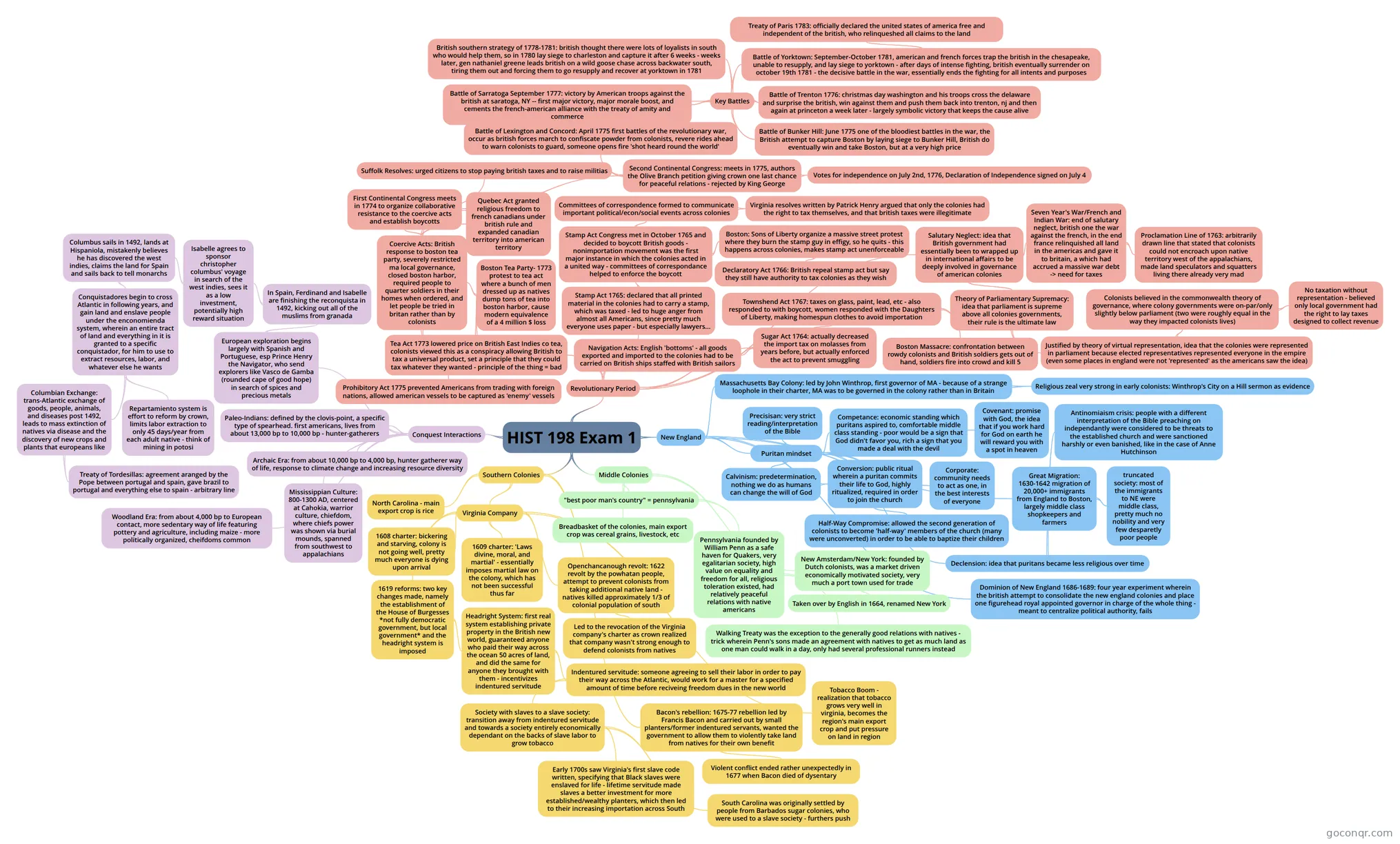
Mind map: HIST 198 Exam 1
Inhalt der Mindmap
HIST 198 Exam 1
Conquest Interactions
- Paleo-Indians: defined by the clovis-point, a specific type of spearhead. first americans, lives from about 13,000 bp to 10,000 bp - hunter-gatherers
- Archaic Era: from about 10,000 bp to 4,000 bp, hunter gatherer way of life, response to climate change and increasing resource diversity
- Mississippian Culture: 800-1300 AD, centered at Cahokia, warrior culture, chiefdom, where chiefs power was shown via burial mounds, spanned from southwest to appalachians
- Woodland Era: from about 4,000 bp to European contact, more sedentary way of life featuring pottery and agriculture, including maize - more politically organized, cheifdoms common
- European exploration begins largely with Spanish and Portuguese, esp Prince Henry the Navigator, who send explorers like Vasco de Gamba (rounded cape of good hope) in search of spices and precious metals
- In Spain, Ferdinand and Isabelle are finishing the reconquista in 1492, kicking out all of the muslims from granada
- Isabelle agrees to sponsor christopher columbus' voyage in search of the west indies, sees it as a low investment, potentially high reward situation
- Columbus sails in 1492, lands at Hispaniola, mistakenly believes he has discovered the west indies, claims the land for Spain and sails back to tell monarchs
- Conquistadores begin to cross Atlantic in following years, and gain land and enslave people under the enconomienda system, wherein an entire tract of land and everything in it is granted to a specific conquistador, for him to use to extract resources, labor, and whatever else he wants
- Repartamiento system is effort to reform by crown, limits labor extraction to only 45 days/year from each adult native - think of mining in potosi
- Columbian Exchange: trans-Atlantic exchange of goods, people, animals, and diseases post 1492, leads to mass extinction of natives via disease and the discovery of new crops and plants that europeans like
- Treaty of Tordesillas: agreement aranged by the Pope between portugal and spain, gave brazil to portugal and everything else to spain - arbitrary line
- Conquistadores begin to cross Atlantic in following years, and gain land and enslave people under the enconomienda system, wherein an entire tract of land and everything in it is granted to a specific conquistador, for him to use to extract resources, labor, and whatever else he wants
- Columbus sails in 1492, lands at Hispaniola, mistakenly believes he has discovered the west indies, claims the land for Spain and sails back to tell monarchs
- Isabelle agrees to sponsor christopher columbus' voyage in search of the west indies, sees it as a low investment, potentially high reward situation
- In Spain, Ferdinand and Isabelle are finishing the reconquista in 1492, kicking out all of the muslims from granada
Southern Colonies
- Virginia Company
- 1608 charter: bickering and starving, colony is not going well, pretty much everyone is dying upon arrival
- 1609 charter: 'Laws divine, moral, and martial' - essentially imposes martial law on the colony, which has not been successful thus far
- 1619 reforms: two key changes made, namely the establishment of the House of Burgesses *not fully democratic government, but local government* and the headright system is imposed
- Headright System: first real system establishing private property in the British new world, guaranteed anyone who paid their way across the ocean 50 acres of land, and did the same for anyone they brought with them - incentivizes indentured servitude
- Indentured servitude: someone agreeing to sell their labor in order to pay their way across the Atlantic, would work for a master for a specified amount of time before reciveing freedom dues in the new world
- Society with slaves to a slave society: transition away from indentured servitude and towards a society entirely economically dependant on the backs of slave labor to grow tobacco
- Early 1700s saw Virginia's first slave code written, specifying that Black slaves were enslaved for life - lifetime servitude made slaves a better investment for more established/wealthy planters, which then led to their increasing importation across South
- South Carolina was originally settled by people from Barbados sugar colonies, who were used to a slave society - furthers push
- Society with slaves to a slave society: transition away from indentured servitude and towards a society entirely economically dependant on the backs of slave labor to grow tobacco
- Indentured servitude: someone agreeing to sell their labor in order to pay their way across the Atlantic, would work for a master for a specified amount of time before reciveing freedom dues in the new world
- Headright System: first real system establishing private property in the British new world, guaranteed anyone who paid their way across the ocean 50 acres of land, and did the same for anyone they brought with them - incentivizes indentured servitude
- Openchancanough revolt: 1622 revolt by the powhatan people, attempt to prevent colonists from taking additional native land - natives killed approximately 1/3 of colonial population of south
- Led to the revocation of the Virginia company's charter as crown realized that company wasn't strong enough to defend colonists from natives
- Tobacco Boom - realization that tobacco grows very well in virginia, becomes the region's main export crop and put pressure on land in region
- North Carolina - main export crop is rice
- Bacon's rebellion: 1675-77 rebellion led by Francis Bacon and carried out by small planters/former indentured servants, wanted the government to allow them to violently take land from natives for their own benefit
- Violent conflict ended rather unexpectedly in 1677 when Bacon died of dysentary
- Virginia Company
Middle Colonies
- "best poor man's country" = pennsylvania
- Pennsylvania founded by William Penn as a safe haven for Quakers, very egalitarian society, high value on equality and freedom for all, religious toleration existed, had relatively peaceful relations with native americans
- Walking Treaty was the exception to the generally good relations with natives - trick wherein Penn's sons made an agreement with natives to get as much land as one man could walk in a day, only had several professional runners instead
- Pennsylvania founded by William Penn as a safe haven for Quakers, very egalitarian society, high value on equality and freedom for all, religious toleration existed, had relatively peaceful relations with native americans
- Breadbasket of the colonies, main export crop was cereal grains, livestock, etc
- New Amsterdam/New York: founded by Dutch colonists, was a market driven economically motivated society, very much a port town used for trade
- Taken over by English in 1664, renamed New York
- "best poor man's country" = pennsylvania
New England
- Puritan mindset
- Calvinism: predetermination, nothing we do as humans can change the will of God
- Conversion: public ritual wherein a puritan commits their life to God, highly ritualized, required in order to join the church
- Half-Way Compromise: allowed the second generation of colonists to become 'half-way' members of the church (many were unconverted) in order to be able to baptize their children
- Conversion: public ritual wherein a puritan commits their life to God, highly ritualized, required in order to join the church
- Competance: economic standing which puritans aspired to, comfortable middle class standing - poor would be a sign that God didn't favor you, rich a sign that you made a deal with the devil
- Corporate: community needs to act as one, in the best interests of everyone
- Precisisan: very strict reading/interpretation of the Bible
- Covenant: promise with God, the idea that if you work hard for God on earth he will reward you with a spot in heaven
- Declension: idea that puritans became less religious over time
- Antinomiaism crisis: people with a different interpretation of the Bible preaching on independantly were considered to be threats to the established church and were sanctioned harshly or even banished, like in the case of Anne Hutchinson
- Calvinism: predetermination, nothing we do as humans can change the will of God
- Massachusetts Bay Colony: led by John Winthrop, first governor of MA - because of a strange loophole in their charter, MA was to be governed in the colony rather than in Britain
- Religious zeal very strong in early colonists: Winthrop's City on a Hill sermon as evidence
- Great Migration: 1630-1642 migration of 20,000+ immigrants from England to Boston, largely middle class shopkeepers and farmers
- truncated society: most of the immigrants to NE were middle class, pretty much no nobility and very few desparetly poor people
- Dominion of New England 1686-1689: four year experiment wherein the british attempt to consolidate the new england colonies and place one figurehead royal appointed governor in charge of the whole thing - meant to centralize political authority, fails
- Puritan mindset
Revolutionary Period
- Tea Act 1773 lowered price on British East Indies co tea, colonists viewed this as a conspiracy allowing British to tax a universal product, set a principle that they could tax whatever they wanted - principle of the thing = bad
- Boston Tea Party- 1773 protest to tea act where a bunch of men dressed up as natives dump tons of tea into boston harbor, cause modern equivalence of a 4 million $ loss
- Coercive Acts: British response to boston tea party, severely restricted ma local governance, closed boston harbor, required people to quarter soldiers in their homes when ordered, and let people be tried in britan rather than by colonists
- Suffolk Resolves: urged citizens to stop paying british taxes and to raise militias
- Quebec Act granted religious freedom to french canadians under british rule and expanded canadian territory into american territory
- First Continental Congress meets in 1774 to organize collaborative resistance to the coercive acts and establish boycotts
- Second Continental Congress: meets in 1775, authors the Olive Branch petition giving crown one last chance for peaceful relations - rejected by King George
- Votes for independence on July 2nd, 1776, Declaration of Independence signed on July 4
- Battle of Lexington and Concord: April 1775 first battles of the revolutionary war, occur as british forces march to confiscate powder from colonists, revere rides ahead to warn colonists to guard, someone opens fire 'shot heard round the world'
- Key Battles
- Battle of Bunker Hill: June 1775 one of the bloodiest battles in the war, the British attempt to capture Boston by laying siege to Bunker Hill, British do eventually win and take Boston, but at a very high price
- Battle of Sarratoga September 1777: victory by American troops against the british at saratoga, NY -- first major victory, major morale boost, and cements the french-american alliance with the treaty of amity and commerce
- Battle of Trenton 1776: christmas day washington and his troops cross the delaware and surprise the british, win against them and push them back into trenton, nj and then again at princeton a week later - largely symbolic victory that keeps the cause alive
- British southern strategy of 1778-1781: british thought there were lots of loyalists in south who would help them, so in 1780 lay siege to charleston and capture it after 6 weeks - weeks later, gen nathaniel greene leads british on a wild goose chase across backwater south, tiring them out and forcing them to go resupply and recover at yorktown in 1781
- Battle of Yorktown: September-October 1781, american and french forces trap the british in the chesapeake, unable to resupply, and lay siege to yorktown - after days of intense fighting, british eventually surrender on october 19th 1781 - the decisive battle in the war, essentially ends the fighting for all intents and purposes
- Treaty of Paris 1783: officially declared the united states of america free and independent of the british, who relinqueshed all claims to the land
- Key Battles
- Second Continental Congress: meets in 1775, authors the Olive Branch petition giving crown one last chance for peaceful relations - rejected by King George
- Prohibitory Act 1775 prevented Americans from trading with foreign nations, allowed american vessels to be captured as 'enemy' vessels
- Coercive Acts: British response to boston tea party, severely restricted ma local governance, closed boston harbor, required people to quarter soldiers in their homes when ordered, and let people be tried in britan rather than by colonists
- Boston Tea Party- 1773 protest to tea act where a bunch of men dressed up as natives dump tons of tea into boston harbor, cause modern equivalence of a 4 million $ loss
- Sugar Act 1764: actually decreased the import tax on molasses from years before, but actually enforced the act to prevent smuggling
- Townshend Act 1767: taxes on glass, paint, lead, etc - also responded to with boycott, women responded with the Daughters of Liberty, making homespun clothes to avoid importation
- Boston Massacre: confrontation between rowdy colonists and British soldiers gets out of hand, soldiers fire into crowd and kill 5
- Navigation Acts: English 'bottoms' - all goods exported and imported to the colonies had to be carried on British ships staffed with British sailors
- Townshend Act 1767: taxes on glass, paint, lead, etc - also responded to with boycott, women responded with the Daughters of Liberty, making homespun clothes to avoid importation
- Stamp Act 1765: declared that all printed material in the colonies had to carry a stamp, which was taxed - led to huge anger from almost all Americans, since pretty much everyone uses paper - but especially lawyers...
- Stamp Act Congress met in October 1765 and decided to boycott British goods - nonimportation movement was the first major instance in which the colonies acted in a united way - committees of correspondance helped to enforce the boycott
- Committees of correspondence formed to communicate important political/econ/social events across colonies
- Virginia resolves written by Patrick Henry argued that only the colonies had the right to tax themselves, and that british taxes were illegitimate
- Boston: Sons of Liberty organize a massive street protest where they burn the stamp guy in effigy, so he quits - this happens across colonies, makes stamp act unenforceable
- Declaratory Act 1766: British repeal stamp act but say they still have authority to tax colonies as they wish
- Committees of correspondence formed to communicate important political/econ/social events across colonies
- Stamp Act Congress met in October 1765 and decided to boycott British goods - nonimportation movement was the first major instance in which the colonies acted in a united way - committees of correspondance helped to enforce the boycott
- Salutary Neglect: idea that British government had essentially been to wrapped up in international affairs to be deeply involved in governance of american colonies
- Theory of Parliamentary Supremacy: idea that parliament is supreme above all colonies governments, their rule is the ultimate law
- Justified by theory of virtual representation, idea that the colonies were represented in parliament because elected representatives represented everyone in the empire (even some places in england were not 'represented' as the americans saw the idea)
- Colonists believed in the commonwealth theory of governance, where colony governments were on-par/only slightly below parliament (two were roughly equal in the way they impacted colonists lives)
- No taxation without representation - believed only local government had the right to lay taxes designed to collect revenue
- Colonists believed in the commonwealth theory of governance, where colony governments were on-par/only slightly below parliament (two were roughly equal in the way they impacted colonists lives)
- Justified by theory of virtual representation, idea that the colonies were represented in parliament because elected representatives represented everyone in the empire (even some places in england were not 'represented' as the americans saw the idea)
- Seven Year's War/French and Indian War: end of salutary neglect, british one the war against the french, in the end france relinquished all land in the americas and gave it to britain, a which had accrued a massive war debt -> need for taxes
- Proclamation Line of 1763: arbitrarily drawn line that stated that colonists could not encroach upon native territory west of the appalachians, made land speculators and squatters living there already very mad
- Theory of Parliamentary Supremacy: idea that parliament is supreme above all colonies governments, their rule is the ultimate law
- Tea Act 1773 lowered price on British East Indies co tea, colonists viewed this as a conspiracy allowing British to tax a universal product, set a principle that they could tax whatever they wanted - principle of the thing = bad
Informationen
- Beschreibung
- Mindmap am HIST 198 Exam 1, erstellt von Talia Williams am 14/10/2021.
- Erstellt von
- Talia Williams
- Aufrufe
- 0
- Bewertung